Lace
Irish Crochet Lace: From Famine Relief to Paris
What is Irish crochet lace, and how do you recognize it? Raised motifs worked over a cord, joined by a ground of chain bars: a famine-relief craft that copied Venetian needle lace and sold in Paris as Point d'Irlande.
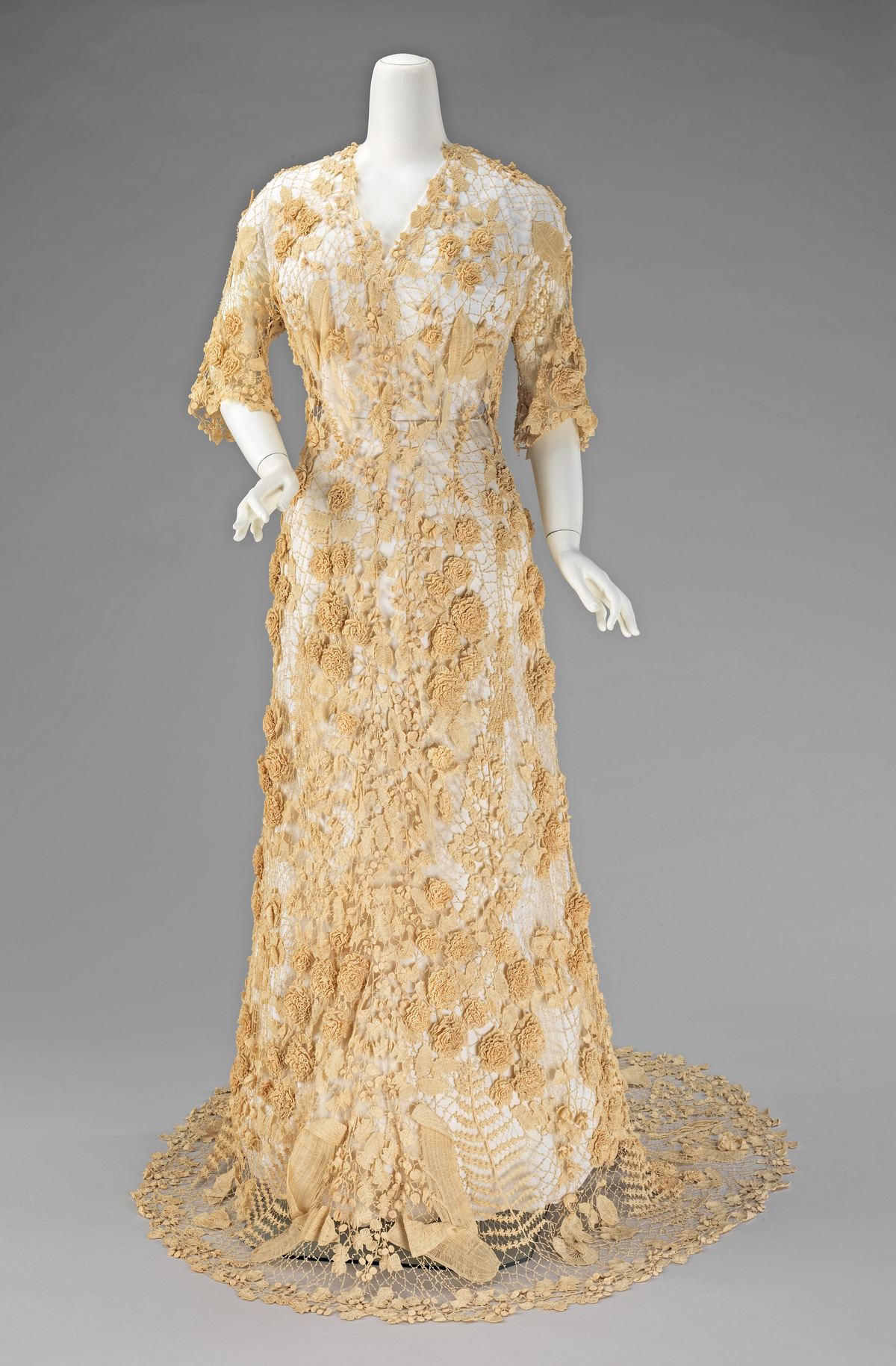
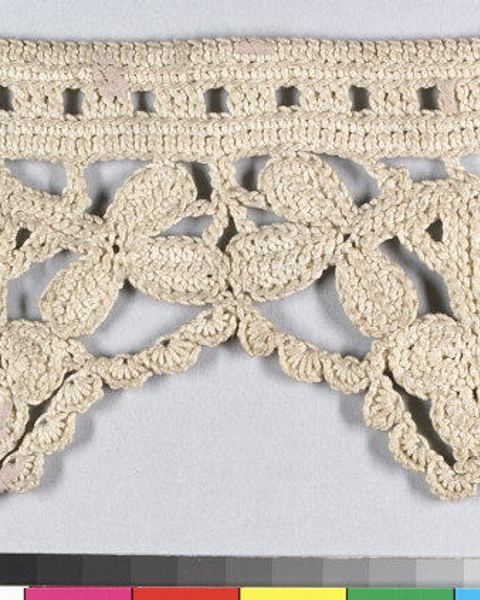
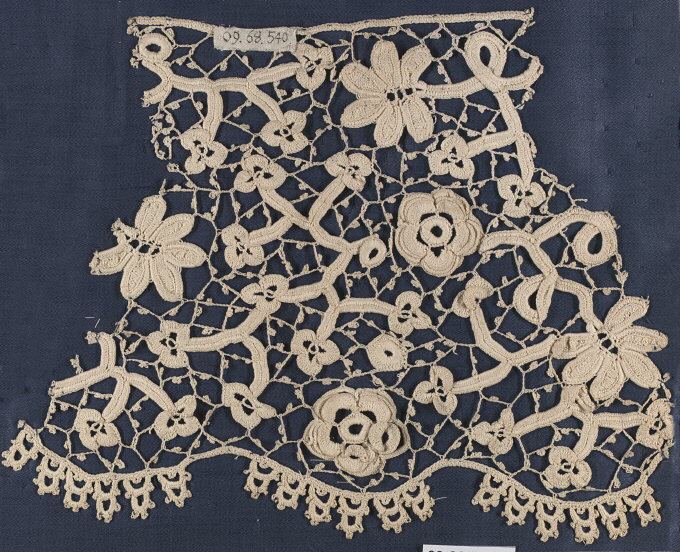
Irish crochet is lace made with a fine hook. Flowers and leaves are crocheted one by one, often over a padding cord that makes them stand up, then joined by a ground of chain bars set with picots or small knots. It began in 1840s Ireland as famine relief, copying Venetian raised needle lace, and sold as far as Paris.
What is Irish crochet lace?
Irish crochet lace is a crochet copy of expensive needle lace, developed in Irish schools and convents from the mid-1840s. Its hallmark is a set of separately made, often raised motifs held together by an open, irregular ground of crocheted bars. It was made in white cotton or linen thread and sold as collars, cuffs, trimmings and even whole dresses.
Crochet itself was a young fashion. The Dictionary of Needlework by Caulfeild and Saward (1882) says it "never attracted much attention until about 1838", when patterns and cottons for it appeared. (Its claim that nuns made crochet in the sixteenth century comes with no evidence.) It names the finer Irish kinds Irish Point, Raised Rose crochet and Honiton crochet, with patterns "evidently taken from those of needle lace."
The model was heavy Venetian needle lace, above all rose point, whose motifs are padded and covered with buttonhole stitch. The catalog of an Irish lace exhibition at the Mansion House, London, in 1883 says of crochet copies of point de Venise that "some specimens, indeed, can scarcely be distinguished from the best models of the ancient lace," at a much lower cost. In Paris the lace took a French name. The lace authority Alan S. Cole wrote in 1888: "Much Irish crochet goes abroad. In Paris it generally passes under the name of Point d'Irlande."
How is Irish crochet made?
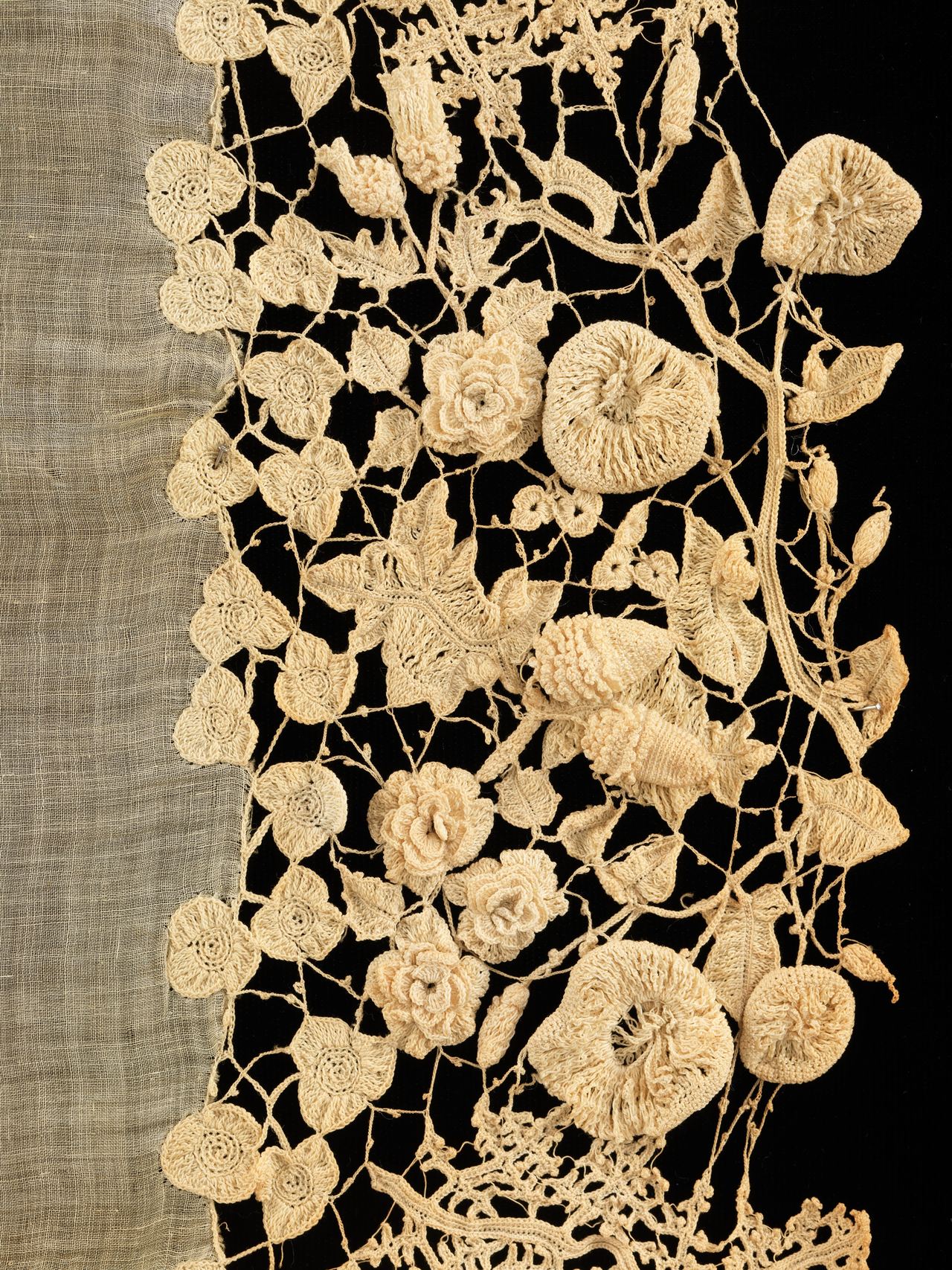
Irish crochet is made in stages. Each flower, leaf or stem is crocheted separately, usually over a padding cord; the motifs are tacked onto a cloth or paper pattern; the spaces between them are filled with chain bars set with picots; and a crocheted border finishes the edge.
A 1910 manual, Designs and Instructions for Irish Crochet Lace, from T. Buettner and Co. of Chicago, sets out the method. Ordinary crochet, it says, grows in counted rows. In Irish lace, "sprays of flowers, leaves, etc." are worked over a cord foundation, sewn on a foundation pattern, and the spaces between are filled "with lace-like bars of crochet." The cord matters most: by pulling it tighter or looser, the worker can make stems and leaves "curved in any direction desired," which counted stitches alone cannot do. It asks for fine lace thread, a firm linen thread for the cord and a fine steel hook.
The ground is what joins everything. Buettner's practice filling is a "picot bar": a short run of chain with a small loop worked into it, repeated row by row until the space is full. The Ulster Folk Museum describes the finished ground as a grid of bars, which lacemakers call brides, the same word used for the bars in needle lace. Each bar may carry a picot.
The work was often divided. The 1883 Mansion House catalog describes Cork pieces whose designs "are wrought separately" and joined "by a second worker"; Laces of Ireland, a heritage project led by Limerick City and County Council, says several Clones lacemakers worked on the motifs of one piece.
| Operation | What the worker does | What it leaves in the lace |
|---|---|---|
| 1. Working the sprays | Crochets flowers, leaves and stems one by one, many over a padding cord | Raised, rounded shapes with a ridged edge where stitches wrap the cord |
| 2. Arranging | Bastes the sprays onto a foundation of pink cambric cut to the exact size of the piece | Motifs placed freely, not in counted rows |
| 3. Filling | Fills the spaces with picot bars of chain, joining them to the sprays | An irregular net whose bars change length and direction |
| 4. Shaping | Works a line of chain along the outline once the filling is done | A firm line that holds the shape of the collar or cuff |
| 5. Edging | Adds a crocheted border | A scalloped or looped edge continuous with the ground |
What is a Clones knot?
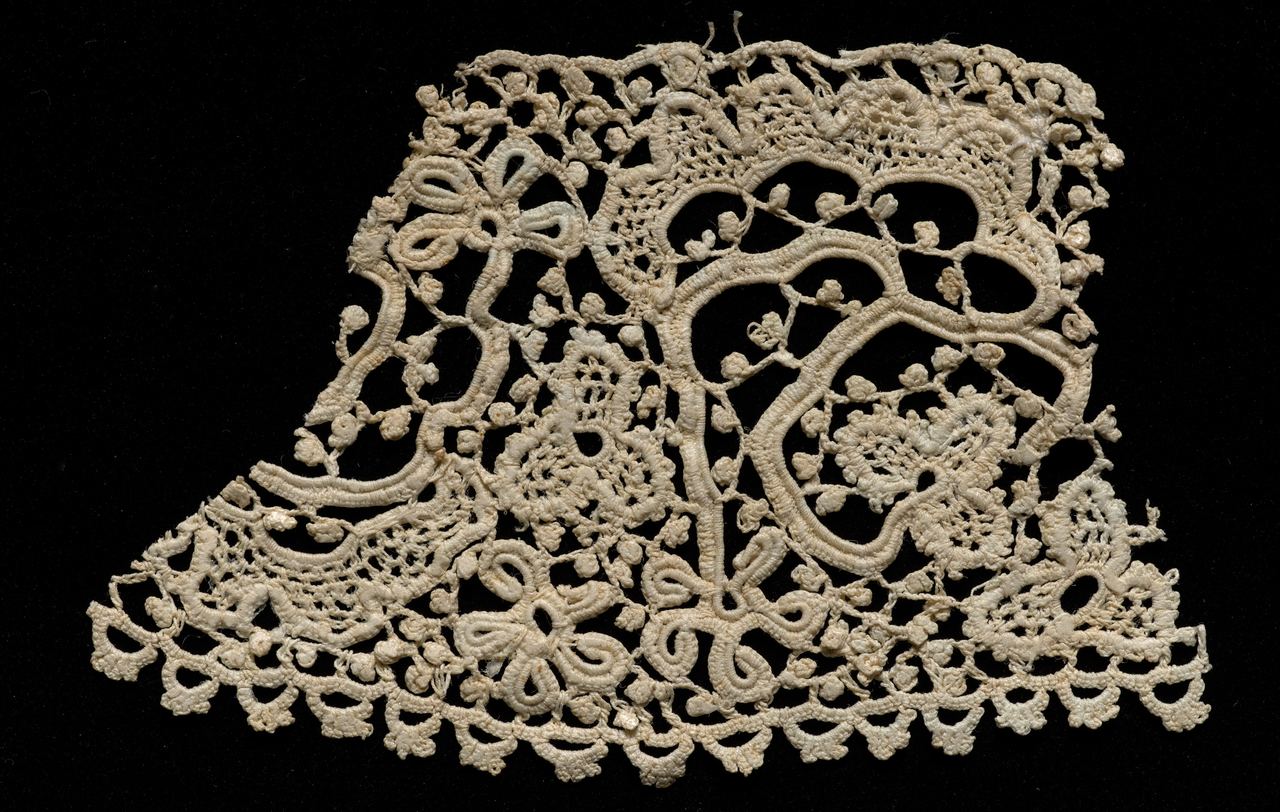
The Clones knot is a small ball of thread made on the hook and set into the chain ground, typical of lace from Clones, County Monaghan. Laces of Ireland describes it as a ball made by turning the hook ten to twelve times around the thread, with hundreds of these rolled dots joining the motifs. The craft site Gathered builds it from about twenty loops over a short chain, noting that methods vary. The Ulster Folk Museum points to a collar of the 1890s in the Clones style, with small knots worked into the background grid. See Clones knot.
Where did Irish crochet begin?
Irish crochet began as relief work during the Great Famine. The earliest firm date is 1845, when pupils of the Ursuline convent at Blackrock, near Cork, earned about ninety pounds for their work. Within a few years crochet was taught across Ireland, with Cork in the south and Clones in the north as the main centers.
The Mansion House catalog of 1883 tells the story, and the 1902 edition of Mrs. Bury Palliser's History of Lace repeats it closely. The Ursuline nuns added industrial training to their day school for poor children, and "it is on record that in the year 1845 they received about ninety pounds" for the work. From there, the catalog says, crochet spread within a few years into almost every convent. The Irish Lace Guild says the earliest examples are believed to date from about 1830, but cites no document.
The second line runs through County Kildare. Mrs. W. C. Roberts of Thornton had local people knitting woolen jackets; when those orders failed in the famine year, she had a few of her best workers taught crochet, and within six months they were copying guipure and point de Venise. Her rule was that each worker taught three others before receiving work, so that hundreds were trained. The 1883 catalog dates this to 1847; the Irish Lace Guild gives 1846.
One of Mrs. Roberts's twenty-four trained teachers went to Clones at the request of Mrs. Hand, wife of the rector, Rev. T. Hand. Laces of Ireland names her Cassandra Hand and says the family arrived in October 1847. The 1902 edition of Palliser called Clones the most important center of the industry. For Cork it gives a figure of no fewer than 12,000 women making crochet near the city "some thirty years ago", which puts the peak well after the famine years.
| Date | Event | Source |
|---|---|---|
| 1845 | Ursuline convent, Blackrock, Cork, receives about £90 for pupils' work | Mansion House 1883; Palliser 1902 |
| 1846 | Mlle Riego de la Branchardière publishes Knitting, Crochet, and Netting in London | Library copies on archive.org |
| 1846 or 1847 | Mrs. W. C. Roberts starts crochet copies of guipure and point de Venise at Thornton | Mansion House 1883 (1847); Irish Lace Guild (1846) |
| 1847 | The Hand family arrives in Clones; a Thornton-trained teacher follows | Laces of Ireland; Mansion House 1883 |
| 1851 | Cork crochet shown at the Great Exhibition in London | Mansion House 1883 |
| 1870–71 | The Franco-German war cuts off continental lace and boosts Irish crochet | Palliser 1902 |
| 1890s | Swiss chemical lace made "in approximate imitation of Irish crochet" | V&A, T.120-2001 |
Did Mlle Riego invent Irish crochet?
Probably not, and no document shows that she did. Éléonore Riego de la Branchardière published her first needlework book in 1846 and soon issued crochet collars named after historic laces, which may well have helped teachers. But crochet work was already being sold from a Cork convent in 1845, and the Irish makers developed the raised, joined style themselves.
The claim is common. The Ulster Folk Museum still says crochet lace developed after the 1846 publication of "the first book of Irish Crochet patterns." Riego's 1846 book, Knitting, Crochet, and Netting, is a general manual. Her 1847 Crochet Book, the first of a series, offers collars and cuffs called Point de Guise, Point d'Angleterre and Point d'Espagne: crochet in imitation of lace, but nothing labeled Irish. The crochet historian Barbara Ballantyne, who surveyed Victorian crochet pattern books, writes that she found no evidence for Riego's claim to have invented Irish crochet.
The fair reading is that pattern books and Irish schools grew up together. The 1883 catalog credits the Ursuline school and Mrs. Roberts's workers, and does not mention Riego at all.
How did Irish crochet reach Paris?
Through dealers and fashion. By the 1880s Irish crochet copies of Venetian point sold in Paris, New York and Vienna, and Paris called them Point d'Irlande. The Franco-German war of 1870 to 1871, which cut off continental lace, had given the trade a boom. Around 1900, crochet trimmed fashionable white summer dresses.
The 1883 catalog praised the Clones copies of point de Venise and wrote that "The leaders of fashion in Paris, New York, Vienna, and Brussels have used them freely." Cole added that the better Irish crochet was "not known in England at all," and might be noticed there only if it came back "as something quite new from Paris." The 1902 Palliser adds the war: when continental supply was cut off, "several years of unique prosperity followed."
The Fashion History Timeline of the Fashion Institute of Technology, citing Laver's Costume and Fashion, notes that Irish crochet was a good alternative for those who could not afford lace. The Victoria and Albert Museum holds a French lawn day dress of 1904 to 1908 with hand-crocheted flowers, and a British muslin dress of about 1910 to 1920 trimmed with Irish crochet. It also holds a watercolor design from the house of Jeanne Paquin for summer 1911, a pink afternoon dress with a crochet insertion on the bodice; the record does not say what kind of crochet.
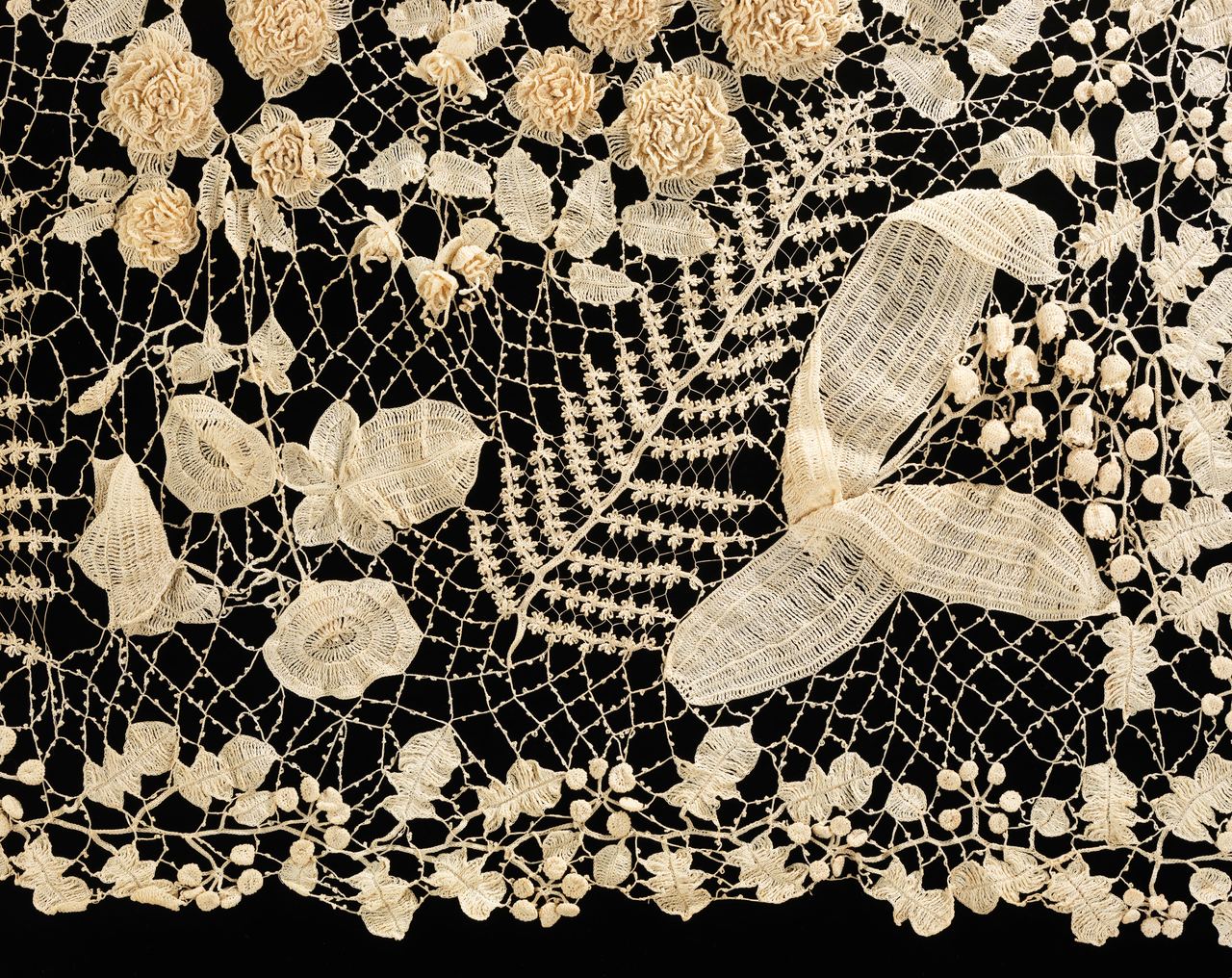
One open-access object shows how far the craft could go: a dress made almost entirely of Irish crochet, cataloged by the Metropolitan Museum of Art as a wedding dress of about 1870. Roses, ferns, long leaves and bell-shaped flowers are scattered over a web of chain bars, and the train ends in a border of leaves and berries.
The same industry was undone by cheap copies. The 1902 Palliser blamed "the machine-made work of Nottingham and Switzerland" for driving Irish crochet from the market. Sources differ on the end: the Irish Lace Guild says commercial production had ceased by about 1912, while the Ulster Folk Museum dates the sharp decline to cheaper imitations from the 1920s.
Were the patterns family secrets?
Partly, at most. Laces of Ireland says many Clones patterns were "a closely guarded secret within families." The founding schemes worked the other way: Mrs. Roberts required each worker to teach three others, charity societies sold the work, and pattern books were printed for anyone to buy. Families may have guarded favorite motifs, but the craft spread by being shared.
Buettner's 1910 booklet even tells workers to change a curve or add a leaf if it pleases them, and warns that two workers following the same directions will get different results.
How do you recognize Irish crochet?
Look for three things: motifs that are thick, rounded and raised, often with a cord inside; a ground of irregular chain bars, sometimes studded with picots or Clones knots; and stitches that are crochet loops, not buttonhole knots. Machine copies repeat exactly, and the name "Irish lace" can mean other techniques entirely.
First, check the stitches with a loupe. Caulfeild and Saward call the chain "the foundation of all crochet work," so a crochet motif shows interlocking loops, often ridged where they wrap the cord. Needle lace is built of buttonhole stitches; its raised rims are padding covered with tight buttonholing. Our guide Needle Lace or Bobbin Lace? shows what those stitches look like.
Second, follow the ground. In hand Irish crochet the bars change length and angle to reach the nearest motif, and they join the motif with a stitch. A machine ground repeats.
Third, beware the chemical copy. Chemical lace is machine embroidery in cotton on a silk ground that is then dissolved in chlorine or caustic soda. The V&A holds a Swiss length of the 1890s cataloged as "in approximate imitation of Irish crochet." Its sprigs repeat in rows. Our machine-lace guide notes that raised work in a chemical copy is dense stitching on the same surface as the rest, while a handmade rose or Clones knot stands up on its own. For the general method, see Handmade or Machine? How to Read a Piece of Lace.
Finally, read the label with care. Thérèse de Dillmont's DMC Encyclopedia of Needlework uses "Irish lace" for a tape lace: braid formed into figures and joined by needle-made bars. Ireland also made needle lace at Youghal, and Carrickmacross and Limerick lace on machine net, so "Irish lace" in a catalog or a dealer's listing does not by itself mean crochet. If you plan to try a period pattern, check its stitch names first: see US or UK? How to Read a Crochet Pattern.
| Feature | Irish crochet (hand) | Venetian raised needle lace | Chemical lace imitation |
|---|---|---|---|
| Tool | Hook and one thread | Needle and one thread | Embroidery machine; ground dissolved |
| Solid parts | Crochet loops, often worked over a cord | Buttonhole stitches over padding | Dense machine stitching |
| Relief | Separate raised motifs, sometimes layered petals | Raised outlines and pads | Raised parts are dense stitching on one surface |
| Ground | Irregular chain bars with picots or Clones knots | Buttonholed bars, often with picots | Machine-repeated bars |
| Repeat | Motifs vary in size and placement | Follows a drawn design | Exact repeats in rows |
Where can you see Irish crochet?
The Metropolitan Museum of Art has the Irish wedding dress and an Irish accessory set of about 1850; the Cleveland Museum of Art has a small Irish crochet fragment with knot-studded bars; and the V&A records many Irish crochet collars, cuffs and borders.
In Clones, the Ulster Canal Stores visitor center has an exhibition of Clones lace. In Belfast, the Ulster Museum's Ashes to Fashion runs until 3 January 2027. It rebuilds the costume collection destroyed when firebombs set Malone House alight on 11 November 1976; a staff memo of the time listed among the losses a collection of "Irish, English and continental lace." The museum's page does not say that crochet is on show. For what happened to old lace on the market, see Mended, Made Up, Made Over: The Lace Dealers.
Sources
- Irish Lace: A History of the Industry (1883). Mansion House Exhibition, London (catalog). Primary. Full text read on archive.org: Cork section (Ursuline convent, Blackrock, about £90 in 1845; Cork crochet at the 1851 Great Exhibition; designs wrought separately and joined by a second worker), Clones section (Mrs. W. C. Roberts, Thornton, 1847; teach-three rule; 24 teachers; Mrs. Hand, wife of Rev. T. Hand; Knotted Guipure; point de Venise copies; Paris, New York, Vienna, Brussels). Accessed November 26, 2026.
- History of Lace (1902 edition). Mrs. Bury Palliser, rev. M. Jourdain and A. Dryden. Primary. Project Gutenberg text (archive.org mirror; gutenberg.org was down for maintenance) read: chapter on Ireland, pp. 443-446 (Irish crochet centers Cork and Monaghan; 1845 Ursulines; 12,000 women near Cork 'some thirty years ago'; Franco-German war boom; Nottingham and Swiss machine competition; Mrs. Roberts, Mrs. Hand; Clones the most important center). Accessed November 26, 2026.
- A Renascence of the Irish Art of Lace-Making (London: Chapman and Hall, 1888). Alan S. Cole. Primary. Full text read: plate 5, Crochet Borders ('Much Irish crochet goes abroad. In Paris it generally passes under the name of Point d'Irlande'; 'something quite new from Paris'). Accessed November 26, 2026.
- Designs and Instructions for Irish Crochet Lace (1910). T. Buettner and Co., Chicago. Primary. Full text read: introduction (sprays over a cord foundation, cord curves stems, two workers differ), materials, five operations, pink cambric foundation, picot-bar filling, shaping line. Accessed November 26, 2026.
- Knitting, Crochet, and Netting (London: S. Knights, 1846). Eléonore Riego de la Branchardière. Primary. Title page and preface read (Oxford copy; archive.org and a second copy, krl00376347 from the University of Southampton, both dated 1846). A general manual, no mention of Ireland. Accessed November 26, 2026.
- The Crochet Book (1847). Eléonore Riego de la Branchardière. Primary. Preface and contents read: first of a series; collars and cuffs named Point de Guise, Point d'Angleterre, Point d'Espagne, Point de Valois. Nothing labeled Irish. Accessed November 26, 2026.
- The Dictionary of Needlework (1882). Caulfeild and Saward. Primary. Entries read: Crochet (fashionable from about 1838; Irish Point, Raised Rose and Honiton crochet; patterns taken from needle lace; chain the foundation of all crochet) and Irish Point Crochet. Accessed November 26, 2026.
- Encyclopedia of Needlework (DMC). Thérèse de Dillmont. Primary. Chapter 'Irish lace' read: braid or tape formed into figures and joined by needle-made bars (a tape lace, not crochet). Accessed November 26, 2026.
- Lacemaking. Ulster Folk Museum (National Museums NI). Page read in full: crochet lace and Point d'Irlande, brides, 1846 'first book of Irish Crochet patterns', Cork convent schools, c.1890s Clones-style collar with knots, decline from the 1920s. Accessed November 26, 2026.
- Ashes to Fashion. Ulster Museum (National Museums NI). Page read in full: dates 27 Feb 2026 to 3 Jan 2027; Malone House fire of 11 Nov 1976 caused by two firebombs; staff memo listing 'Irish, English and continental lace'. The page does not mention crochet; used only as a closing note. Accessed November 26, 2026.
- Clones Lace. Laces of Ireland (Limerick City and County Council project). Page read in full (text adapted from Mary O'Neill's book): Clones knot (10-12 turns), several makers per piece, template and tacking, Cassandra Hand arrived October 1847, patterns 'a closely guarded secret within families'. About page read for publisher. Accessed November 26, 2026.
- How to do Irish crochet. Gathered (Immediate Media). Read: foundation cord, Clones knot method (about 20 loops over a chain, many methods), motifs pinned to a template and joined by a mesh. Accessed November 26, 2026.
- Types of Lace: Irish Crochet Lace. Irish Lace Guild. Read via WebFetch (curl gets 429): earliest examples believed c.1830 (no document cited), Mrs. Roberts 1846, Paris and London fashion houses, commercial production ceased about 1912. Accessed November 26, 2026.
- Mademoiselle Riego and Irish Crochet Lace. Barbara Ballantyne, crochethistory.com. Read via WebFetch (curl gets 403): author's survey of Victorian crochet pattern books 'revealed no evidence' for Riego's claim to have invented Irish crochet. Accessed November 26, 2026.
- 1900-1909. Fashion Institute of Technology, Fashion History Timeline. Read: 'For those who couldn't afford lace, Irish crochet was a good alternative', citing Laver, Costume and Fashion, p. 216 (Karina Reddy, 2019). Accessed November 26, 2026.
- Dress trimming, chemical lace, Switzerland, 1890-1899, T.120-2001. Victoria and Albert Museum. Record read via the V&A API: machine embroidery on silk dissolved in chlorine or caustic soda; 'in approximate imitation of Irish crochet'. Accessed November 26, 2026.
- Day dress, France, 1904-1908, T.107-1939; Dress, Great Britain, ca. 1910-1920, MISC.325-1987. Victoria and Albert Museum. Records read via the V&A API (MISC.325-1987 at https://collections.vam.ac.uk/item/O1130329/): lawn dress with hand-crocheted flowers; muslin dress trimmed with Irish crochet. Accessed November 26, 2026.
- Fashion design, Jeanne Paquin, early 1911, E.2011-1957. Victoria and Albert Museum. Record read via the V&A API: pale shell-pink afternoon dress with crochet insertion on the bodice; type of crochet not stated. Accessed November 26, 2026.
- Wedding dress, Irish, ca. 1870, 2009.300.1664. The Metropolitan Museum of Art. Object record read via Met API: culture Irish, cotton, ca. 1870, isPublicDomain true. Images viewed at full size. Accessed November 26, 2026.
- Accessory set, Irish, ca. 1850, 2009.300.1665a–d. The Metropolitan Museum of Art. Object record read via Met API: culture Irish, cotton, ca. 1850 (1848-1852), isPublicDomain true. Detail images viewed and cropped. Accessed November 26, 2026.
- Specimen, crochet, 19th century, 09.68.540. The Metropolitan Museum of Art. Object record read via Met API: medium crochet, 20.3 x 17.8 cm, no place of origin, isPublicDomain true. Accessed November 26, 2026.
- Lace Fragment, Ireland, 1800s, 1933.297. The Cleveland Museum of Art. Open Access API record read: Ireland, cotton crocheted lace, 7.7 x 10.8 cm, CC0. Print image viewed and cropped. Accessed November 26, 2026.
- Irish Crochet Lace (A Tale of Two Lace Centers, pt. 2). The Liberties Archive. Used to locate references only (Riego chronology, Ballantyne, V&A objects); no claim rests on it alone. Accessed November 26, 2026.
Glossary
Last updated · Markdown · Report an error