Quilt Block Cutting Calculator
Find the size of square to cut for half-square triangles (2 or 8 at a time), quarter-square triangles and flying geese from the finished size and your seam allowance, with the number of squares, spare units and a printable cut list. Everything runs in your browser and nothing is uploaded.
Decimals or fractions: 2.5, 2 1/2, 5/8.
How it is calculated
The starting square must be big enough that, after the seams, the unit trims to its finished size plus a seam allowance on every side. With seam allowance s and finished size F, the unfinished size is U = F + 2s. The square to cut follows from where the seams fall.
| Unit | Exact | At 1/4 in | Published | Makes |
|---|---|---|---|---|
| Half-square triangle, 2 at a time | F + 2s + s√2 | F + 0.854 | F + 7/8 | 2 from 2 squares |
| Half-square triangle, 8 at a time | 2 (F + 2s + s√2) | 2F + 1.707 | 2F + 1 3/4 | 8 from 2 squares |
| Quarter-square triangle | F + 2s + 2s√2 | F + 1.207 | F + 1 1/4 | 4 from 1 square |
| Flying geese, 4 at a time | large: W + 2s + 2s√2 small: H + 2s + s√2 | large W + 1.207 small H + 0.854 | large W + 1 1/4 small H + 7/8 | 4 from 1 large and 4 small |
Where the numbers come from
- Half-square triangle, 2 at a time: the seam runs s from the cut diagonal, so the unfinished side is the square’s side minus s√2. At 1/4 in a 2 1/2 in unit needs 2.5 + 0.5 + 0.354 = 3.354 in, which rounds up to 3 3/8 in.
- Half-square triangle, 8 at a time: after the cuts every unit is the same triangle as above but with legs of half the square, so the starting square is exactly double. A 3 in unit needs 2 x 3.854 = 7.707 in, which rounds up to 7 3/4 in. The rule is 2 x finished + 1 3/4 in, not “finished + 1 1/4 in”: that smaller figure belongs to the quarter-square triangle.
- Quarter-square triangle: the long side of the triangle is the outer edge and the two short sides are seams. Moving all three edges in by s shortens the long side by 2s + 2s√2.
- Flying geese: the large square becomes four quarter-square triangles whose long side is the width; each small square is folded into a corner like a half-square triangle, so it follows the 2 at a time rule for the height. This method only makes geese exactly twice as wide as they are tall, which is why the tool asks for the height.
- Metric seams: 6 mm and 7 mm are used exactly, not converted to a quarter inch. With a 6 mm seam a 60 mm half-square triangle needs 60 + 12 + 8.5 = 80.5 mm, shown as 81 mm.
Rounding
Inches are rounded up to the next 1/8 in, and millimetres up to the next whole millimetre, with the exact value shown beside. A square that is a hair too big trims to size; one that is too small cannot be fixed. Rounding up is what the published rules do (0.854 becomes 7/8). Cut a little larger still for the first block if your seam is not exactly accurate, and trim every unit to the “trim to” size after pressing.
Limitations
- Seams are assumed accurate. Test a unit first: a scant 1/4 in seam uses a hair less fabric, so it is worth trimming rather than relying on the squares alone.
- Pairs of squares are counted per fabric: 2 at a time and 8 at a time need one square of each fabric per set.
- The tool counts finished units. Quarter-square triangles are counted as single triangles (four to a square); an hourglass block uses four.
- Sources round differently. One site gives “finished + 1/2 in” for 2 at a time, which is the unfinished size and too small to trim; this tool follows the 7/8 in rule.
Sources
- Half Square Triangles, USU Extension. Add 7/8 in to the finished square: for two 3 in finished half-square triangles, cut 3 7/8 in squares. The diagonal is a true bias edge that stretches, so sew before you cut.
- Quilting Basics, oocities.org archive. Triangles with the straight grain on the short sides: add 7/8 in. Triangles with the straight grain on the long side (quarter-square): add 1 1/4 in to the finished long side and cut the square on both diagonals; a 12 in finished long side needs a 13 1/4 in square.
- How to make a quarter square triangle quilt block, Create Whimsy. Add 1 1/4 in to the finished size: a 3 in finished block uses 4 1/4 in squares.
- Magic 8 Half Square Triangles, The Seasoned Homemaker. Eight at a time: double the finished size and add 1 3/4 in, sewing 1/4 in either side of both diagonals; one pair of squares makes 8 units.
- 8 at a time half square triangles, Coral & Co. Eight at a time: add 7/8 in to the finished size and multiply by 2; a 3 in unit uses 7.75 in squares (the same rule as 2 x finished + 1 3/4).
- How to make half square triangles, Craftsy (formerly Bluprint). Eight at a time: add 7/8 in to the finished 3 in, times 2, gives two 7 3/4 in squares.
- Flying geese, four at a time, Create Whimsy. One large square 1 1/4 in larger than the finished width and four small squares 7/8 in larger than the finished height; 4 x 2 in finished geese use a 5 1/4 in square and four 2 7/8 in squares.
- Flying Geese Four at a Time, Connie Kresin. Worked example: 2 x 4 in finished geese, one 5 1/4 in square and four 2 7/8 in squares.
Opened and read 23 October 2026. The formulas are derived on this page and checked against coordinate geometry in unit tests.
To cut squares for half-square triangles with a 1/4 in seam allowance, add 7/8 in to the finished size when you sew two at a time, or double the finished size and add 1 3/4 in when you sew eight at a time. The calculator on this page applies the same rule to quarter-square triangles and flying geese.
Where do the cut sizes come from?
Every pieced unit has a finished size, which is what you see in the quilt, and an unfinished size, which is the finished size plus one seam allowance on each side. A 3 in finished square measures 3 1/2 in before it is sewn in, with a 1/4 in seam. The cut size of the starting square is larger again, because triangles made by cutting a square on the diagonal lose a little at the seam. All of the figures below come from one piece of right-triangle geometry, so you can check them yourself instead of trusting a chart.
Seam allowance is written s, finished size F, and the square you cut S. Quilters' formulas use 1/4 in for s; the calculator also takes 6 mm and 7 mm.
What size is a half-square triangle square, sewn two at a time?
Cut two squares of F + 7/8 in, one in each fabric. Draw a diagonal on the back of one, put the two squares right sides together, sew a seam allowance on either side of the line, cut on the line and press. Utah State University Extension gives the rule as "add 7/8" to the size of the finished square", with 3 in finished units cut from 3 7/8 in squares, and a unit that measures 3 1/2 in before it is sewn in.
The reason is geometry. Cutting on the diagonal leaves two triangles with legs of S. The seam sits a distance s from the cut edge, so measured from the cut edge it is a smaller triangle whose hypotenuse is S√2 − 2s long. That seam becomes the diagonal of the opened square, and a square of side U has a diagonal of U√2. Setting the two equal gives U = S − s√2. Since U = F + 2s, the square to cut is
S = F + 2s + s√2
With s = 1/4 in that is F + 0.854 in. Published rules round it up to F + 7/8 in, which is 0.021 in generous and leaves a sliver to trim.
How big is a square for eight at a time?
Double the finished size and add 1 3/4 in. The Seasoned Homemaker states it as "double the size of the finished square and add 1-3/4"", with a 4 in finished unit cut from a 9 3/4 in square (she uses a 10 in square for trimming room). Two squares are sewn a seam allowance either side of both diagonals, cut in half each way, then cut on both diagonals.
Each quarter of the big square is a square of side S/2, and the diagonal runs through it corner to corner. So each of the eight units is the same triangle as in the two-at-a-time method, but with legs of S/2 instead of S:
S = 2 × (F + 2s + s√2) = 2F + 1.707 in
rounded up to 2F + 1 3/4 in. One mix-up is worth naming: it is not F + 1 1/4 in. That is the quarter-square figure below, and it would cut a 3 in finished unit from a 4 1/4 in square when 7 3/4 in is needed.
What about quarter-square triangles?
Add 1 1/4 in to the finished long side. Create Whimsy says to add 1-1/4" to the finished size, cutting 4 1/4 in squares for a 3 in finished block; OLFA gives the same rule, and suggests 1 1/2 in for beginners who want extra room to trim.
A quarter-square triangle comes from a square cut on both diagonals, so its long side is a straight outer edge of the square, and its two shorter sides are on the bias. In the finished piece all three sides are set in by a seam allowance. The triangle's incircle radius is S(√2 − 1)/2, and shrinking a triangle by s on every side scales it by (r − s)/r, so the finished long side is S − 2s(√2 + 1). Solving:
S = F + 2s + 2s√2
which is F + 1.207 in at 1/4 in, published as F + 1 1/4 in. The same size works for the hourglass block that quilters sew from two squares, where the block's finished side equals the triangle's long side.
How do flying geese work at four at a time?
The no-waste method uses one large square and four small ones. Quilter's Cache and Moda's chart agree: the large square is the finished width plus 1 1/4 in, and each of the four small squares is the finished height plus 7/8 in. A 2 x 4 in finished unit takes a 5 1/4 in square and four 2 7/8 in squares.
The large square is a quarter-square triangle problem: each goose is one triangle whose long side is the finished width, so the width plus 1.207 in applies. The small squares are corner pieces folded into the large square's corners, exactly the half-square triangle problem, so the height plus 0.854 in applies. The method only makes geese twice as wide as they are tall, because the four triangles of a square have a height equal to half their long side.
| Unit | Finished size F | Cut size, exact | Cut size, rounded up to 1/8 in | Squares per cut set |
|---|---|---|---|---|
| Half-square triangle, 2 at a time | 3 in | 3.854 in | 3 7/8 in (USU Extension) | 2 squares, 2 units |
| Half-square triangle, 2 at a time | 2 1/2 in | 3.354 in | 3 3/8 in | 2 squares, 2 units |
| Half-square triangle, 8 at a time | 3 in | 7.707 in | 7 3/4 in | 2 squares, 8 units |
| Half-square triangle, 8 at a time | 4 in | 9.707 in | 9 3/4 in (Seasoned Homemaker) | 2 squares, 8 units |
| Quarter-square triangle | 3 in | 4.207 in | 4 1/4 in (Create Whimsy) | 1 square, 4 triangles |
| Flying geese, 4 at a time | 2 x 4 in | 5.207 in and 2.854 in | 5 1/4 in and 2 7/8 in (Quilter's Cache) | 1 large and 4 small |
| Flying geese, 4 at a time | 3 x 6 in | 7.207 in and 3.854 in | 7 1/4 in and 3 7/8 in (Moda) | 1 large and 4 small |
Why round up, and how much do you trim?
Rulers are marked in eighths, and a square that is a hair too small cannot be fixed, so every figure is rounded up to the next 1/8 in. The cut size is the minimum the geometry allows, not an exact target. At 1/4 in the rounding leaves roughly 0.02 in of slack per unit in the two-at-a-time method.
Trimming is the safety net. Sewn units come out slightly larger than the unfinished size, so you press them and square them to it: USU's step is to lay the ruler's diagonal line over the seam and check that the unit measures its unfinished size, 3 1/2 in in its example. Some makers cut larger on purpose, as the 10 in square for a 9 3/4 in Magic 8 and the 7 1/2 in squares for a 6 in finished hourglass block show. The calculator gives the minimum; add more if you want a wider trimming margin.
How do you handle the bias edges?
Every triangle method leaves bias edges, and those edges stretch. USU explains why the two-square method works: the cut diagonal "is a true bias edge which stretches and distorts very easily", and sewing the seam before cutting prevents the distortion. The Seasoned Homemaker's advice for pressing is an up-and-down motion with the iron, not dragging it across the unit. In a quarter-square triangle the two short sides are bias and the long side is straight, so put the straight edge on the outside of the block. Bias is the same property that makes bias binding wrap a curve, which the Bias Binding planner works out strip by strip. The diagonal of the fabric is the bias; the lengthwise and crosswise threads are the grain.
What are the limits of the formulas?
They assume the seam you sew is the seam you entered. USU and Quilter's Cache both specify a scant 1/4 in seam; a seam that is wider or narrower than you think shifts every unit, and the rounding slack is too small to absorb a large error. The calculator uses the geometric minimum rather than any one author's rounding, so a figure may sit 1/8 in from a printed chart that rounds differently or adds trimming room.
It covers four units: two kinds of half-square triangle, quarter-square triangles and four-at-a-time flying geese, whose width is always twice the height. Other geese proportions, rectangles and three-part triangles need other methods. Metric figures are rounded up to the next whole millimeter, so a 60 mm finished unit at a 6 mm seam needs an 80.485 mm square, shown as 81 mm.
Where can you see the units on real quilts?
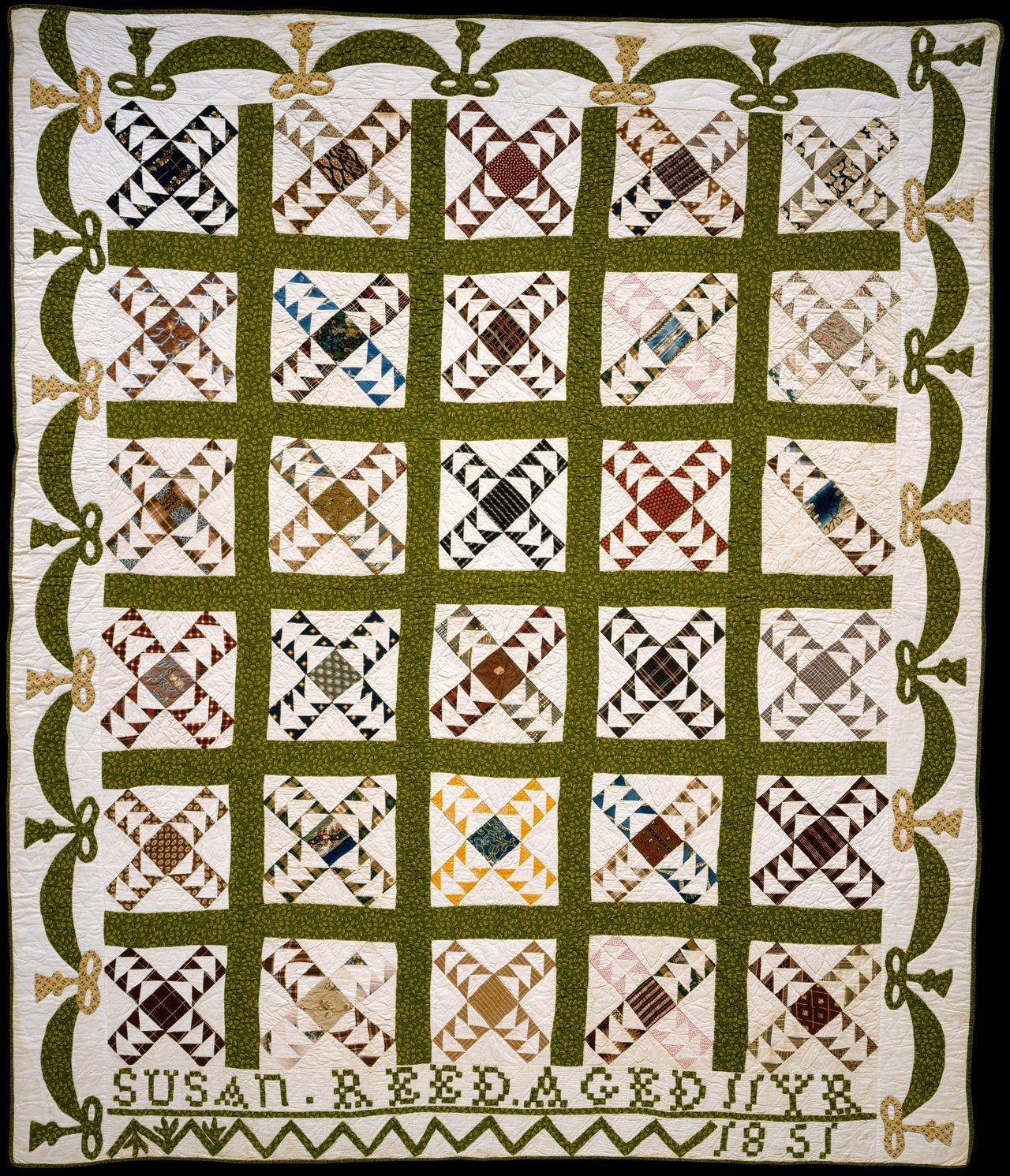
The two quilts here are in The Metropolitan Museum of Art's American Wing, both listed as public-domain images. The hero is a ca. 1840 to 1850 Flying Geese quilt, whose columns of pointed triangles show the pattern that flying geese units make. The second is a Wild Goose Chase quilt from 1851, attributed in the record to Susan Reed Ruddick, built from small triangle units.
If you came here from the question of what to call a bed covering, Quilt, Coverlet, Counterpane sorts out the words, and the quilting entry gives the definition of the craft itself.