Needlework
The Kit and the Chart: Berlin Wool Work
Berlin wool work is canvas embroidery copied square by square from hand-colored charts first sold in Berlin in the early 1800s. How the charts were made, why the dates differ, what the myths get wrong, and what a beginner kit still owes them.
Berlin wool work is needlepoint copied from a chart: a printed grid in which every square, painted in the color to be stitched, stands for one stitch on canvas. The charts were first published in Berlin in the early 1800s. The V&A calls the technique the most popular embroidery in Britain between 1830 and the 1870s, and says patterns were sold singly or as kits with the wools included.
What is Berlin wool work?
Berlin wool work is canvas embroidery in which one stitch, usually cross stitch or tent stitch, is repeated in bright wool by counting squares on a hand-colored chart. The V&A describes it as hard-wearing needlepoint worked in a single type of stitch on canvas, and the Textile Research Centre in Leiden adds that it was worked from embroidery charts. The result covers the canvas completely.
The name has two parts. "Berlin" is the city whose printers published the first charts and, in the sources, whose dyers colored the wool. "Wool work" is the material. The same chart could be worked in tent stitch or cross stitch; Miss Lambert's handbook of 1842 says Berlin patterns suit either. Teazle's guide to needlepoint, canvas work and tapestry explains how those names overlap, and the glossary entry on Berlin wool work is the short version of this story.
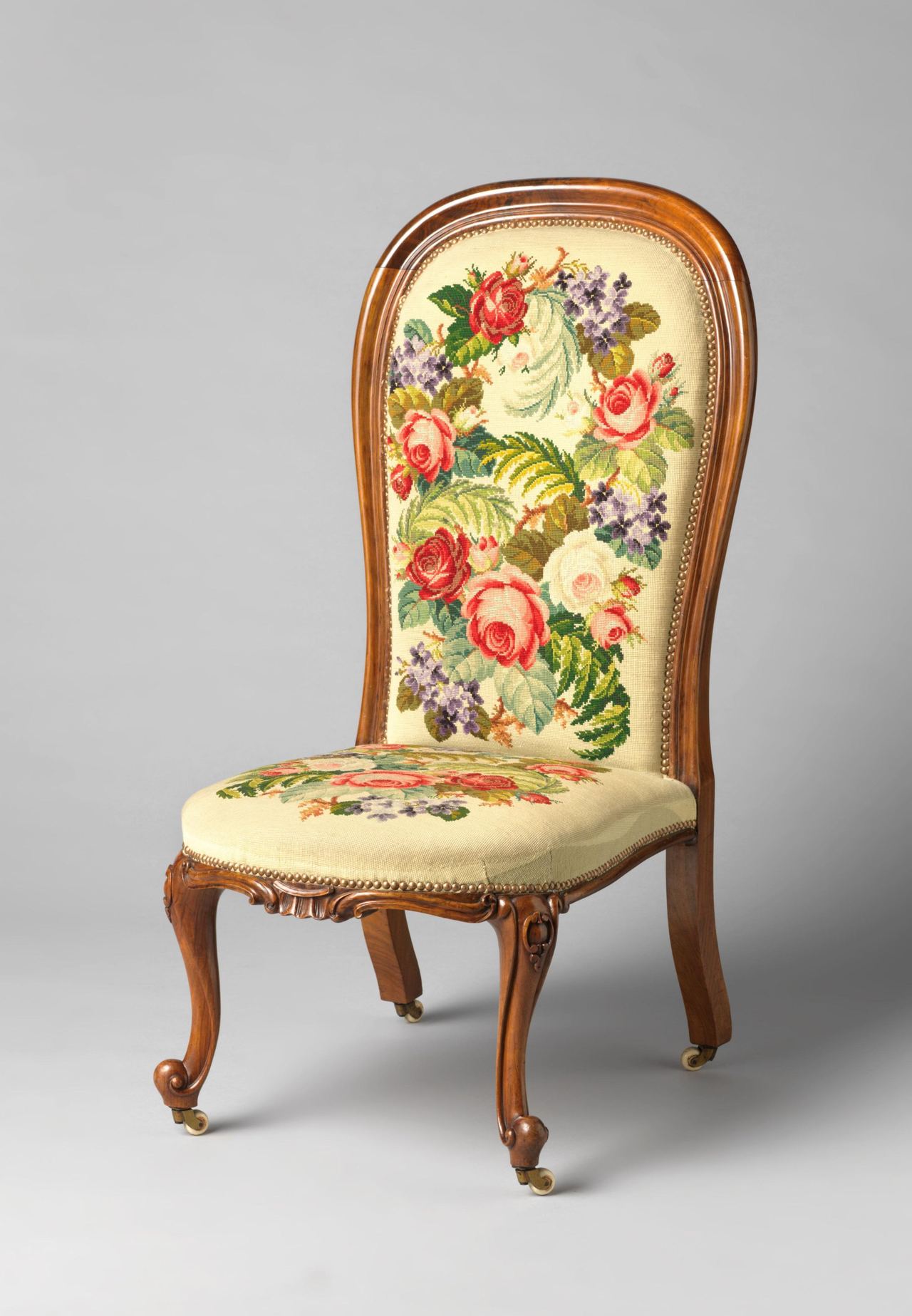
What it made is almost everything that could be covered. The Leiden centre lists chair seats and backs, cushions, curtains, footstools, fire screens, framed "paintings," bags, belts, book covers, caps, purses, slippers and tobacco pouches.
The skill involved was counting. In a research report in the Material Culture Review, Elizabeth Sifton writes that the colored pattern was "carefully counted out stitch by stitch," and that the technique required less actual skill with a needle than other forms of embroidery. That is the whole idea. The chart carries the design, and the worker carries out instructions.
Who made the first charts, and when?
The earliest hand-colored charts were published in Berlin in the first decade of the nineteenth century. A Berlin museum and the V&A both give 1804; the Countess of Wilton's book of 1840 says 1804 or 1805, and Miss Lambert, writing in 1842, says about 1805. Wilton and Lambert both name a Berlin printseller, Philipson or Phillipson. A Berlin printseller named Wittich began a better series in 1810. Dates for the rest of the story differ by source.
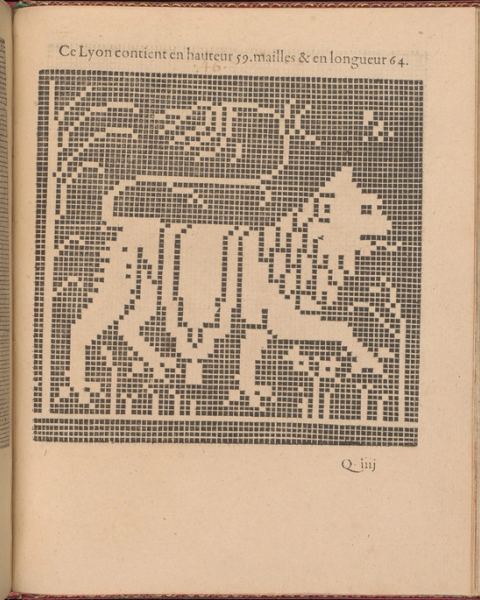
Charts as such were not new. Lambert noted that Berlin patterns resembled those in old books on needlework "above two centuries" earlier, and that the method was an improvement on the designs weavers had used for patterned cloth, which is the squared paper explained under point paper. A Paris pattern book of 1588 already prints a lion as a counting grid, as the find This Lion Is 59 Meshes Tall shows. What changed in Berlin was color and scale. Before Berlin patterns, say Caulfeild and Saward's Dictionary of Needlework (1882) and the V&A, a design was typically drawn or painted straight onto the canvas, and workers got little guidance on shades. Now the guidance was printed on the sheet.
The Museum Europäischer Kulturen in Berlin and Lambert spell the publisher's name Phillipson; the Countess of Wilton has Philipson, and calls the design the first colored one on checked paper. Lambert, who says she had the story from Wittich himself, adds that his patterns were "badly executed and devoid of taste." In 1810, she writes, Madame Wittich, "an accomplished needlewoman," persuaded her husband, a printseller of note, to publish a better series. Wilton and Caulfeild and Saward agree on Wittich and 1810; Caulfeild and Saward say his patterns were copies of celebrated pictures, and give 1801 for the first colored paper patterns. The V&A's Berlin pattern makers include L. W. Wittich, Carl F. W. Wicht, A. Todt and G. E. Falbe, but its catalog entry adds that no records remain about these printers and very little is known about them.
| What | Date | Source |
|---|---|---|
| First hand-colored patterns on grid paper | 1804 | Museum Europäischer Kulturen, Berlin; V&A ("1804 onwards") |
| Same, by a printseller named Philipson | 1804 or 1805 | Countess of Wilton, 1840 |
| Same, by a Mr. Phillipson | about 1805 | Lambert, 1842 (from Wittich) |
| First colored paper patterns | 1801 | Caulfeild and Saward, 1882 |
| Wittich begins a better series | 1810 | Wilton; Lambert; Caulfeild and Saward |
| Name "Berlin work" settled, with Berlin wools | about 1820 | Caulfeild and Saward |
| Patterns reach Wilks of Regent Street, who builds the English trade | 1831 | Wilton, 1840 (Wilks was her informant) |
| 14,000 designs published | by the start of 1840 | Wilton; V&A guide says "imported" |
| 14,000 designs available | an estimated figure for 1847 | V&A catalog record |
| Demand falls | late 1880s | Textile Research Centre, Leiden |
| Berlin wool still produced | into the 1930s | V&A; Textile Research Centre |
The sources tie the name to those patterns. Caulfeild and Saward say the colored paper patterns earned the work the title of Berlin work, though it was not finally adopted until about 1820, when Berlin wools arrived. An undated work-table guide, printed after 1878, says "the introduction of the point patterns in Berlin at the beginning of this century gave the work the name." The V&A says the first printed patterns and the dyed wools both came from Berlin.
How was a chart made?
A chart began as a painting on squared paper and ended as a copperplate print that people colored by hand, square by square. Lambert gives the clearest account. A designer drew the picture in colors on point paper. An engraver then ruled a copper plate in squares matching the threads of the canvas and marked each square with a figure for its color.
Printed in outline, the sheet went to the colorists. Lambert says each worker was given a half-dozen or dozen copies at a time with the original as a guide, laid down one color at a time across several copies with a pencil kept "very square." Some patterns, she adds, had well over half a million small squares to be colored separately, like a mosaic. Hers is a primary account, written within about four decades of the first charts, and the Smithsonian's record of a Berlin pattern for a lily describes the same method.
each square is coloured by hand
The trade employed many hands. Lambert says men, women and children were employed to color, and that the first colored design on point paper could cost from three to thirty or forty guineas; Caulfeild and Saward put the cost of an original picture pattern at £40. The Countess of Wilton wrote in 1840 that a principal manufacturer estimated the colorists at upwards of twelve hundred, chiefly women, and the Berlin museum repeats the figure of about 1,200 women working at home in 1840. The museum adds that a broad supporting industry grew up around the charts: wool dyeing, canvas factories and manufacturers of colored yarn.
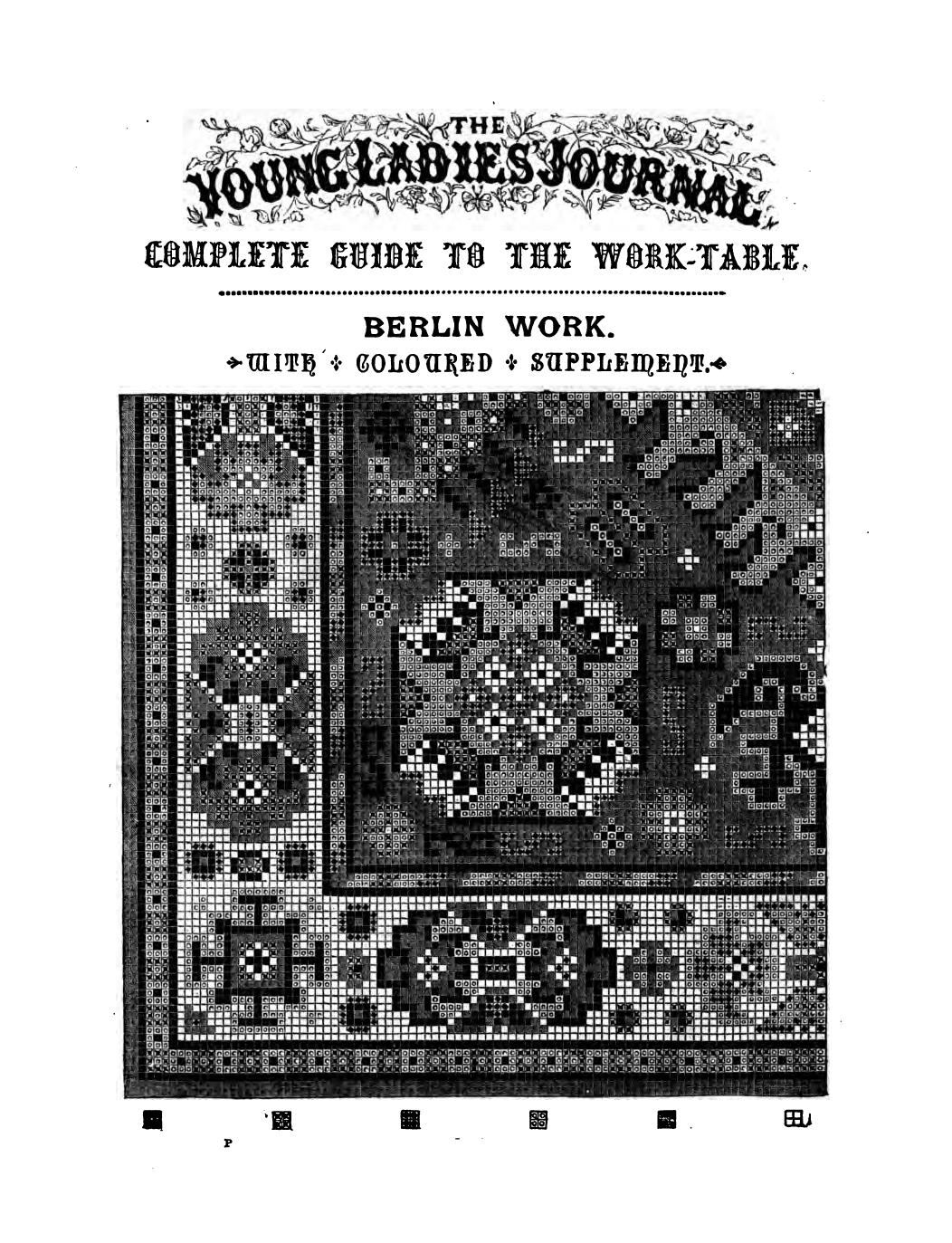
The V&A notes that Berlin patterns were always colored by hand at first, until industrial printing took over. The chart above comes from an undated English work-table guide whose advertisements cite a medal of 1878, and its page is headed "with coloured supplement." The principle is still Lambert's: one square on the sheet, one stitch on the canvas.
What was Berlin wool, and was it made in Berlin?
Berlin wool was a fine, soft, smoothly spun yarn from Merino sheep in Saxony. Sources describe it as processed in Gotha and dyed in Berlin; the Countess of Wilton wrote in 1840 that the "Zephyr" yarns were dyed in Berlin but manufactured at Gotha. The V&A says the wool was spun there, while the Leiden centre says combed. By 1882 the name had become a trade term, and Caulfeild and Saward call Keighley, in Yorkshire, the chief seat of its manufacture.
The Leiden centre says Berlin wool was softer and divided into strands more easily than English or Dutch wool, which suited canvas work. Lambert's account of 1842 is a recommendation: German wool, "as it is termed by the wool staplers of Germany, Zephyr merino," could be split to work on the finest canvas or doubled and trebled on the coarsest, was skeined in small quantities that made it convenient and cheap, and came in "unequalled brilliancy and variety of shades." The Leiden centre calls Zephyr an American brand name for Berlin wool; Lambert's wording suggests it was also a German trade word. See Berlin wool for the terms.
Caulfeild and Saward complicate the geography. Berlin wool, they write, otherwise called German wool and Zephyr merino, was made for knitting and embroidery in two sizes, single and double; in one entry Gotha is the principal seat of making it into thread and Berlin a place where it is dyed, and in another Keighley is the chief seat of manufacture. Some real German wool was brought into Britain raw and combed, spun and dyed chiefly in Scotland, but wool dyed there was "less perfect and durable" than wool imported ready for use. Merino of the same breed was exported from Australia and Van Diemen's Land. The name described a quality and a trade, not a place of origin.
Did aniline dyes make Berlin work bright?
No. Berlin work was bright before the first aniline dye existed. William Henry Perkin, then 18, made mauve in 1856, and the first British patent for it was granted on 26 August of that year, according to the Science History Institute and the Science Museum Group. Berlin charts were already about fifty years old.
The brightness was already a selling point by 1842. Lambert praised the wool's "unequalled brilliancy" fourteen years before mauve. The claim that aniline dyes drove Berlin work is widespread: the Royal School of Needlework's StitchBank says its bright wool is "often attributed" to aniline dyes of the 1850s, and the Leiden centre says they stimulated the craft from the 1830s. Leiden's own timeline puts the isolation of aniline in 1826 and 1834 and Perkin's mauveine in 1856, so the 1830s date appears to refer to the chemical, not to dyes made from it.
The sources suggest that aniline extended a palette that already existed. Caulfeild and Saward, writing in 1882, grumbled that crewels were being "dyed in brilliant aniline shades" and that the use of aniline dyes was "one of recent date." The Leiden centre says Berlin wool easily absorbed the new dyes. Nothing in the sources reaches further than that. A conservator, Jennifer Barnett, told a conservation mailing list in 2004 that every late nineteenth-century Berlin work she had treated or examined over twenty years "was significantly changed in appearance by faded and changed colours," and noted that dye analysis was never carried out, so synthetic dyes were never confirmed.
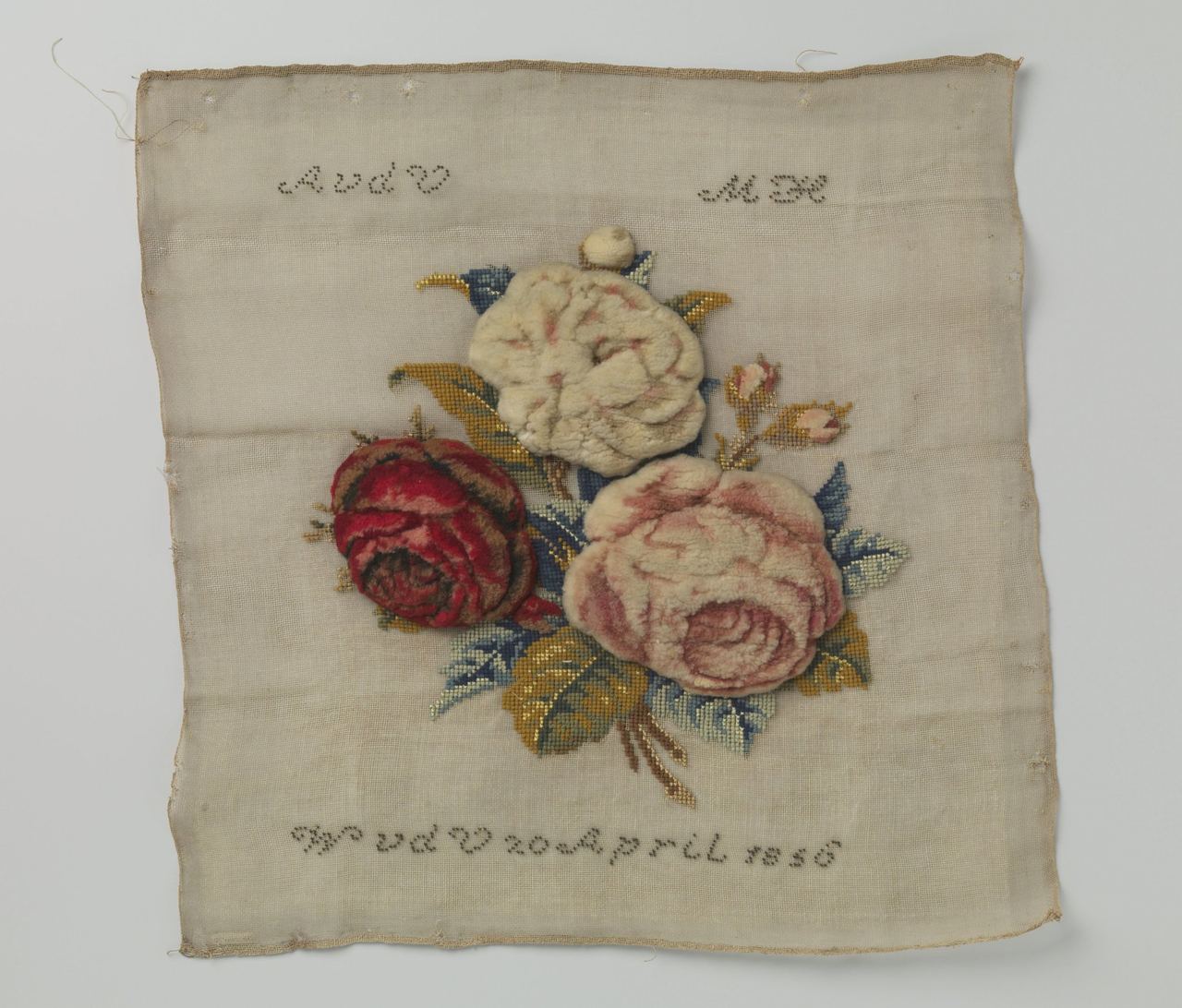
The cushion cover above is dated in beads, 20 April 1856, the year Perkin made mauve. The Rijksmuseum's record does not say how its wool was dyed, so the cushion shows only that the style was fully formed by then. The record describes the roses as worked in a high knotted pile, shorn into relief, one of the later developments the RSN StitchBank lists for the technique.
How did it reach Britain and America?
Through shops, magazines and ships. Lambert says England and, next to her, perhaps Russia profited most from Berlin patterns, that Sweden and Denmark worked a great deal from them, and that the French used them little, still preferring to draw subjects on canvas. She adds that great numbers were exported to America and other Continental countries. The Countess of Wilton ranked consumption differently in 1840: Germany first, then Russia, England, France and America, with the first three far the largest.
In England the trade had a founder. The Countess of Wilton wrote that until 1831 Berlin patterns were known to very few people in England, though a few had been imported by Ackermann and others in very small numbers. In 1831, she says, they fell under the notice of Mr. Wilks of Regent Street, who bought all the good designs he could find, bought patterns and materials direct from Berlin, and so laid the foundation of the trade. She names him as her informant, so the account is his, filtered through her. A V&A pattern book dated 1850 to 1900 holds a print by Wilks of Regent Street dated 1854.
The scale was large. By the start of 1840, Wilton says, leading houses had published "no less than fourteen thousand copper-plate designs." The V&A's guide says "more than 14,000" had been imported by 1840, and its catalog record for a firescreen estimates 14,000 different designs available in 1847. The figure appears to be Wilton's, repeated.
America followed through magazines. Sifton writes that Godey's Lady's Book of Philadelphia kept readers regularly supplied with patterns and suggestions for using them, and that Peterson's Magazine regularly included Berlin patterns, colored or in black and white. The Smithsonian holds a lily pattern by the Berlin firm Hertz & Wegener whose record says it was sold in the United States.
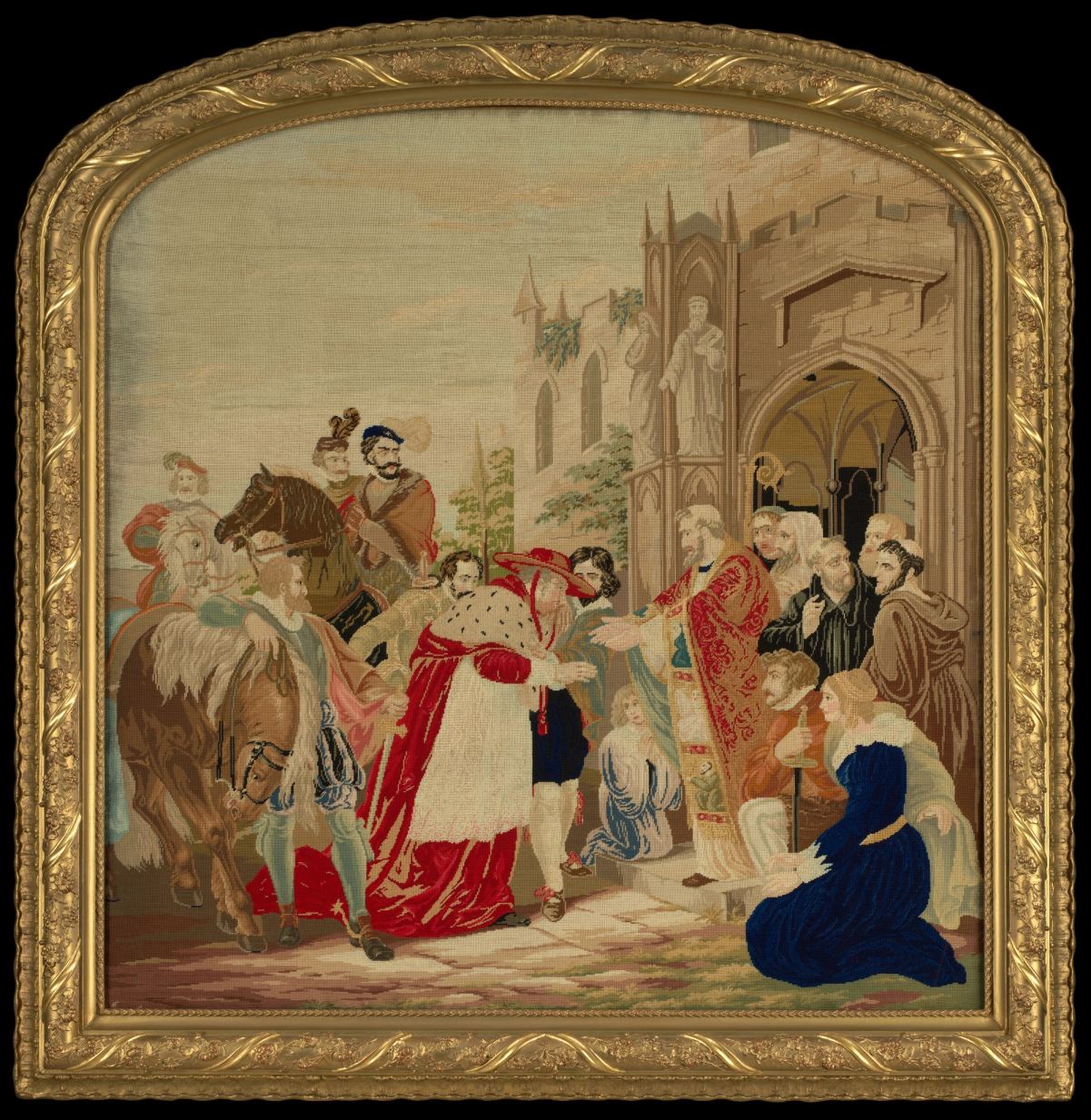
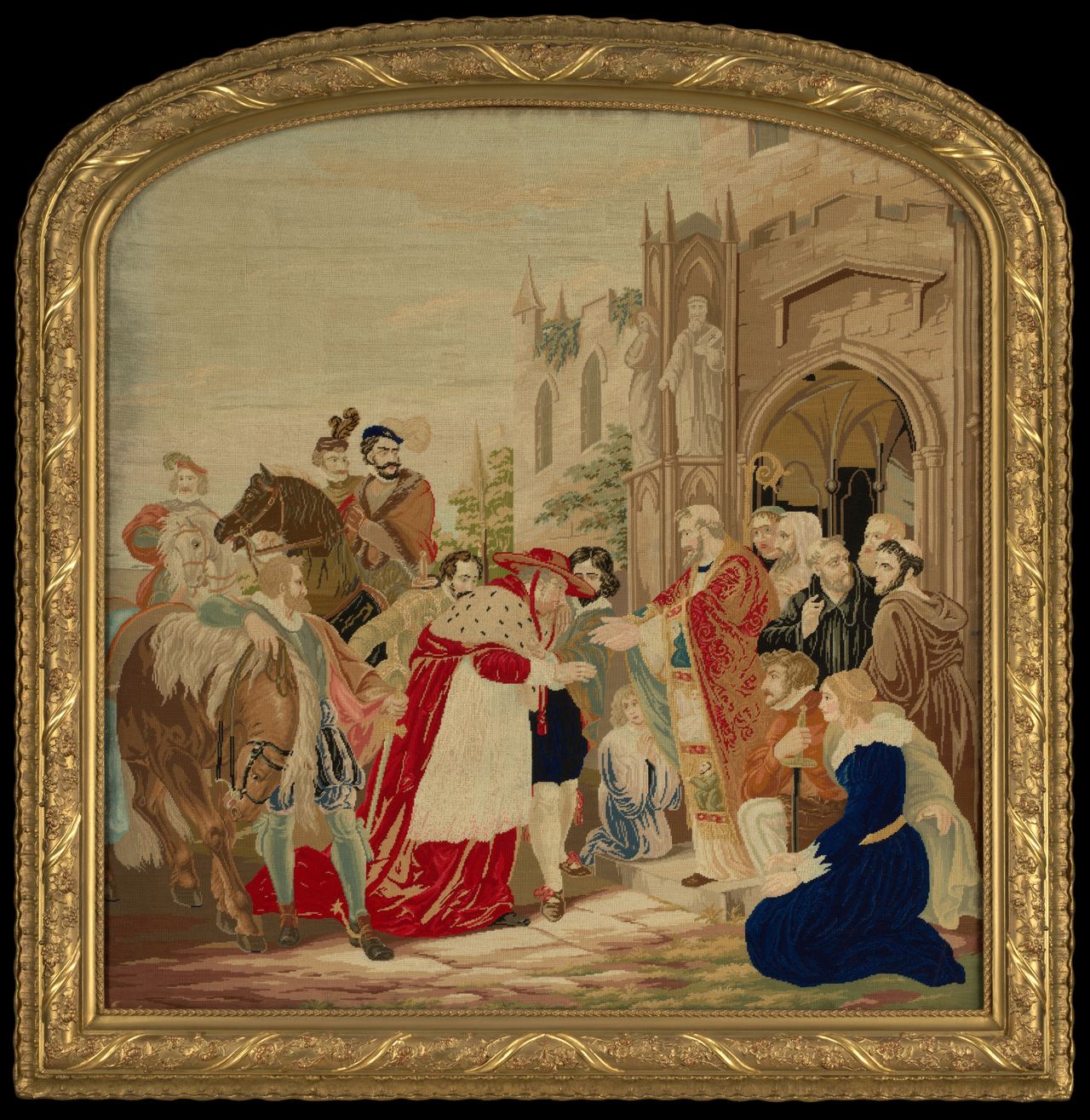
Two American results are in the Met's collection: a needlework picture of The Finding of Moses in the River Nile by Mary Ann Parks Hammond (1839–1866), dated about 1855 and possibly made in New York, and a scene from Shakespeare's Henry VIII, made about 1865 and probably by Agnes (Pruyn) Strain of Albany, New York, at just over a meter square.
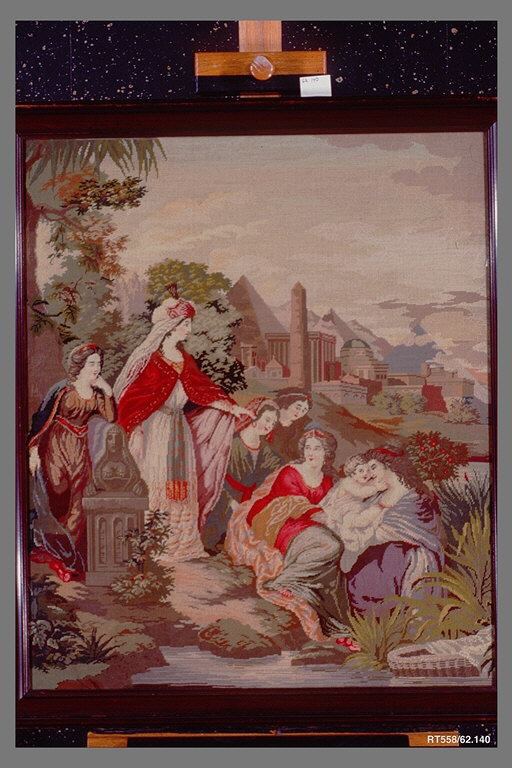
Whatever prints these two pictures followed, Lambert says Berlin patterns were copied either from celebrated pictures or, more often, from the newest and most favored engravings published in England, France or Germany, with flowers and arabesques designed expressly. A Berlin picture pattern was a painting's image translated into squares.
Why did Berlin work fall out of fashion?
Because taste turned against it, and the complaint began early. Even in 1840 the Countess of Wilton judged that of the fourteen thousand patterns published, scarcely one-half were moderately good. Caulfeild and Saward complained in 1882 that large canvas and cross stitch made figured designs coarse, and that these had been displaced by "impossible parrots, animals, and groups of flowers" which they said had done much to debase public taste. Yet they admitted that the work "is capable of good results, and is strong and lasting."
The reaction had an institution. The Royal School of Needlework began in 1872 as the School of Art Needlework, founded by Lady Victoria Welby, with the aim "to revive a beautiful art which had fallen into disuse." Its StitchBank ties the formulaic, boldly colored Berlin style to the rise of art needlework and, ultimately, the school itself. Sifton writes that art needlework, with its sinuous line and muted colors, "eclipsed" the grid-like Berlin patterns. The Leiden centre dates the fall in demand to the late 1880s.
It did not disappear. The V&A's pattern book of Berlin patterns and samples runs from 1850 to 1900 and includes colored-printed patterns dated 1864 and 1868, and probably the 1880s. Berlin wool itself was made into the 1930s, according to the V&A and the Leiden centre.
What does today's beginner kit owe to the chart?
A good deal: the printed grid, the counted stitch and the idea that a design and its yarns can arrive in one package. The V&A's catalog says Berlin patterns were sold individually or as kits with the required wools. The Leiden centre says the charts drove developments in canvases, in materials such as Aida and in techniques such as tramming, and that designs from the tradition still appear in commercial canvas embroidery kits.
Hobby retail is where the idea has returned. The magazine Luxus+, reporting on 7 April 2026 on Etsy's spring and summer trend report, lists beginner embroidery kits at +175%. The article says Etsy compares searches and sales year over year but does not say which of the two this figure counts, so it is a demand signal for the subject, not a measurement of how many people stitch. Which Embroidery Should You Learn First? helps with the choice.
Two of Teazle's tools follow the same grid logic. The cross-stitch size calculator turns a chart's stitch counts and a fabric's count into a finished size, and the floss estimator works out how much thread each color of a chart needs. Caulfeild and Saward note that Berlin patterns stated the number of stitches they covered, so fitting one to a canvas was no difficulty. That is the size calculator's job, done in print.
Where can you see Berlin wool work?
The best way to see it is online. The images and records below are open or free to read.
- The Metropolitan Museum of Art: The Finding of Moses (62.140) and the Henry VIII scene (2021.160), both open access.
- The Rijksmuseum, Amsterdam: the dated cushion cover (BK-1970-152) and the chair covering (BK-1972-183).
- The Textile Research Centre, Leiden: the online exhibition Berlin Work Charts, with scans of original charts.
- The V&A: the catalog record for the cockatoo firescreen panel (T.95-1970) and the guide Embroidery styles.
- The Internet Archive: Miss Lambert's Hand-Book of Needlework (1842), chapter IX on Berlin patterns, and Caulfeild and Saward's Dictionary of Needlework (1882).
Sources
- The Art of Needle-work, from the Earliest Ages, edited by the Countess of Wilton, second edition (1840), chapter "On Modern Needlework". Henry Colburn, via the Internet Archive. Primary. Full-text OCR read: Philipson 1804-5, Wittich 1810, 14,000 copper-plate designs by the start of 1840, upwards of 1,200 colorists chiefly women, Zephyr yarns dyed in Berlin and manufactured at Gotha, Wilks and 1831, earlier small imports by Ackermann, consumption ranking, "scarcely one-half" moderately good. Accessed October 26, 2026.
- Hand-Book of Needlework (1842), chapter IX "Berlin patterns", chapter IV "German wool". Miss Lambert, John Murray, via the Internet Archive. Primary. Full-text OCR read: history footnote from Wittich (Phillipson about 1805, Wittich 1810), how patterns were designed, engraved and colored, colorists and costs, export to England, Russia, America, German wool and Zephyr merino. Preface dated March 1842. Accessed October 26, 2026.
- The Dictionary of Needlework (1882), entries Berlin Work, Berlin Wool, German Wool, Berlin Canvas, aniline passages. S. F. A. Caulfeild and Blanche C. Saward, via the Internet Archive. Primary. Full-text OCR read: 1801 and 1810 dates, 1820 naming, "impossible parrots", wool made at Keighley and in Scotland, Merino from Australia, aniline remarks in the crewel and ticking-work entries. Accessed October 26, 2026.
- Pattern, hand-coloured design (E.3729-1915) and firescreen panel (T.95-1970), catalog records. Victoria and Albert Museum. Primary. Read via the V&A collections API: "1804 onwards", kits with wools, 14,000 designs estimated in 1847, wool route Saxony-Gotha-Berlin, patterns colored by hand at first, printers Wittich, Wicht, Todt, Falbe, no records remain. Accessed October 26, 2026.
- Pattern book of Berlin wool work patterns and samples (T.749-1974), catalog record. Victoria and Albert Museum. Primary. Read via the V&A API: 1850-1900, hand-colored Berlin patterns, a print by Wilks of Regent Street dated 1 July 1854, colour-printed patterns of 1864, 1868 and probably the 1880s. Accessed October 26, 2026.
- Embroidery styles: an illustrated guide (Berlin woolwork section). Victoria and Albert Museum. Read in full: single stitch on canvas, patterns on point paper, first produced in Berlin in the 1800s, more than 14,000 imported by 1840. Accessed October 26, 2026.
- Stickbild im runden Rahmen (N (34 H) 102/1995,2): essay on Berliner Wollstickerei. Museum Europäischer Kulturen, Staatliche Museen zu Berlin (museum-digital). Primary. Read in full (German): A. Phillipson, 1804, first hand-colored pattern collections on grid paper; about 1,200 women home workers coloring patterns in Berlin in 1840; dye works, canvas factories and yarn industry. Accessed October 26, 2026.
- Philomène's Peacock, Material Culture Review 39 (1994). Elizabeth Sifton, Material Culture Review. Scholarly. Read: stitches counted, Godey's and Peterson's patterns, art needlework eclipsed Berlin work; her 1831 Wilks and 14,000 figures are drawn from the Countess of Wilton (1840), which was read directly. Accessed October 26, 2026.
- Berlin Work Charts (online exhibition, 2018) and the entries on Berlin wool, Berlin work colours and aniline. Textile Research Centre, Leiden. Read: hand-colored charts, Saxon Merino, Gotha, Berlin; wool softer than English or Dutch; aniline timeline 1826, 1834, 1840, 1856; decline in the late 1880s; production until the 1930s; designs still in kits. The TRC attributes aniline dyes to the 1830s, which its own timeline contradicts. Accessed October 26, 2026.
- Berlin wool work (TRC Needles) and Zephyr yarn. Textile Research Centre, Leiden. Read in full: Zephyr as an American brand name for Berlin wool; list of objects covered with Berlin work; charts and single stitch. Accessed October 26, 2026.
- Berlin wool work pattern (1998.0360.054). Smithsonian National Museum of American History. Primary. Read via the Smithsonian Open Access API (CC0 metadata): lily pattern by Hertz & Wegener, Berlin, sold in the United States; copperplate with symbols in each square, painted by colorists with square-tipped brushes. No image in Open Access. Accessed October 26, 2026.
- The Story of Mauve. Science History Institute. Read: Perkin synthesized mauve in 1856 aged 18; factory at Greenford Green in 1857. Accessed October 26, 2026.
- William Henry Perkin (people record). Science Museum Group. Read: patent granted 26 August 1856 for a new coloring matter for dyeing silk, cotton, wool or other materials lilac or purple. Accessed October 26, 2026.
- Berlin wool work (StitchBank) and Our history. Royal School of Needlework. Read in full: bright wool often attributed to aniline dyes of the 1850s; formulaic style fell out of favor, art needlework, RSN. History page: founded 1872 as the School of Art Needlework by Lady Victoria Welby, to revive a beautiful art fallen into disuse. Accessed October 26, 2026.
- Conservation DistList, message of 4 August 2004 (Jennifer Barnett). American Institute for Conservation. Read: late 19th-century Berlin work significantly changed by faded and changed colors; dye analysis never carried out. Accessed October 26, 2026.
- The Young Ladies' Journal Complete Guide to the Work-Table, second edition (E. Harrison, London). Internet Archive (Google Books scan). Primary. Page 115 read: naming of Berlin work from the point patterns; the coloured supplement page used as an image. Undated; advertisements cite a medal of 1878. Accessed October 26, 2026.
- Spring-Summer 2026: the 7 trends redefining our desires according to Etsy. Luxus+, 7 April 2026. Read: "beginner embroidery kits (+175%)" in the "Bubble of whimsy" section; the article does not say whether searches or sales, or the period. Accessed October 26, 2026.
- Chair covering (BK-1972-183) and cushion cover (BK-1970-152). Rijksmuseum. Primary. Read via the Rijksmuseum linked-data API: dates, materials, inscriptions in beads (20 April 1856), Public Domain Mark on images. Accessed October 26, 2026.
- Needlework picture of scene from Shakespeare's Henry VIII (2021.160) and The Finding of Moses in the River Nile (62.140). The Metropolitan Museum of Art. Primary. Object data read via the Met Open Access API (isPublicDomain true); web pages returned 429, so only API fields were read. Accessed October 26, 2026.
Glossary
On the Workbench
Last updated · Markdown · Report an error