Needlework
Needlepoint, Canvas Work, Tapestry: What's the Difference?
Is needlepoint the same as tapestry or cross-stitch? Not quite. How the names got tangled, what mesh count and canvas type mean, which tent stitch to use, and how to choose a first kit.
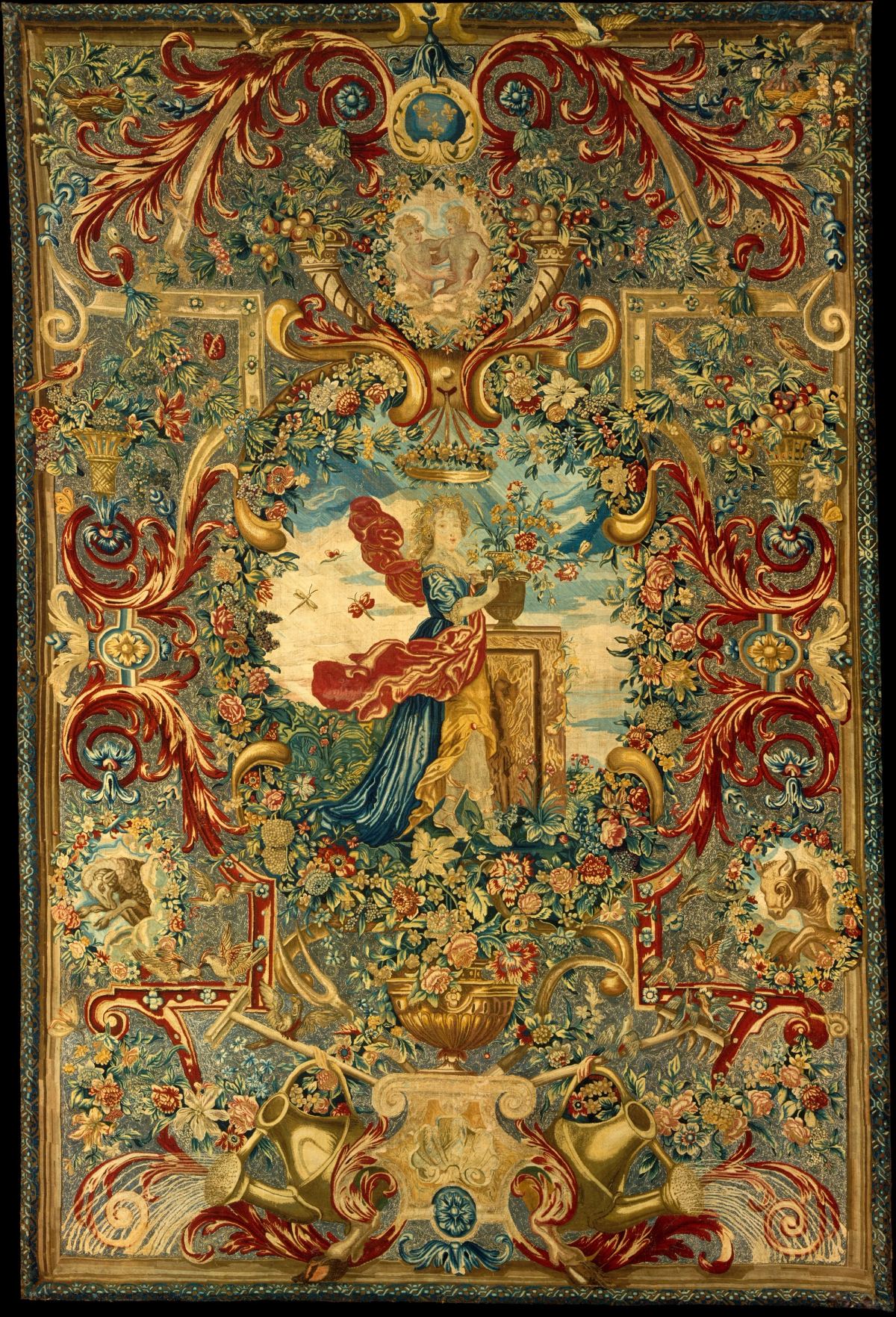
No. Needlepoint, also called canvas work, is stitched with a needle through an open canvas until the canvas disappears. A tapestry is woven on a loom, with the picture built into the cloth. Cross-stitch is a close cousin: a single stitch, usually counted onto soft fabric that is allowed to show.
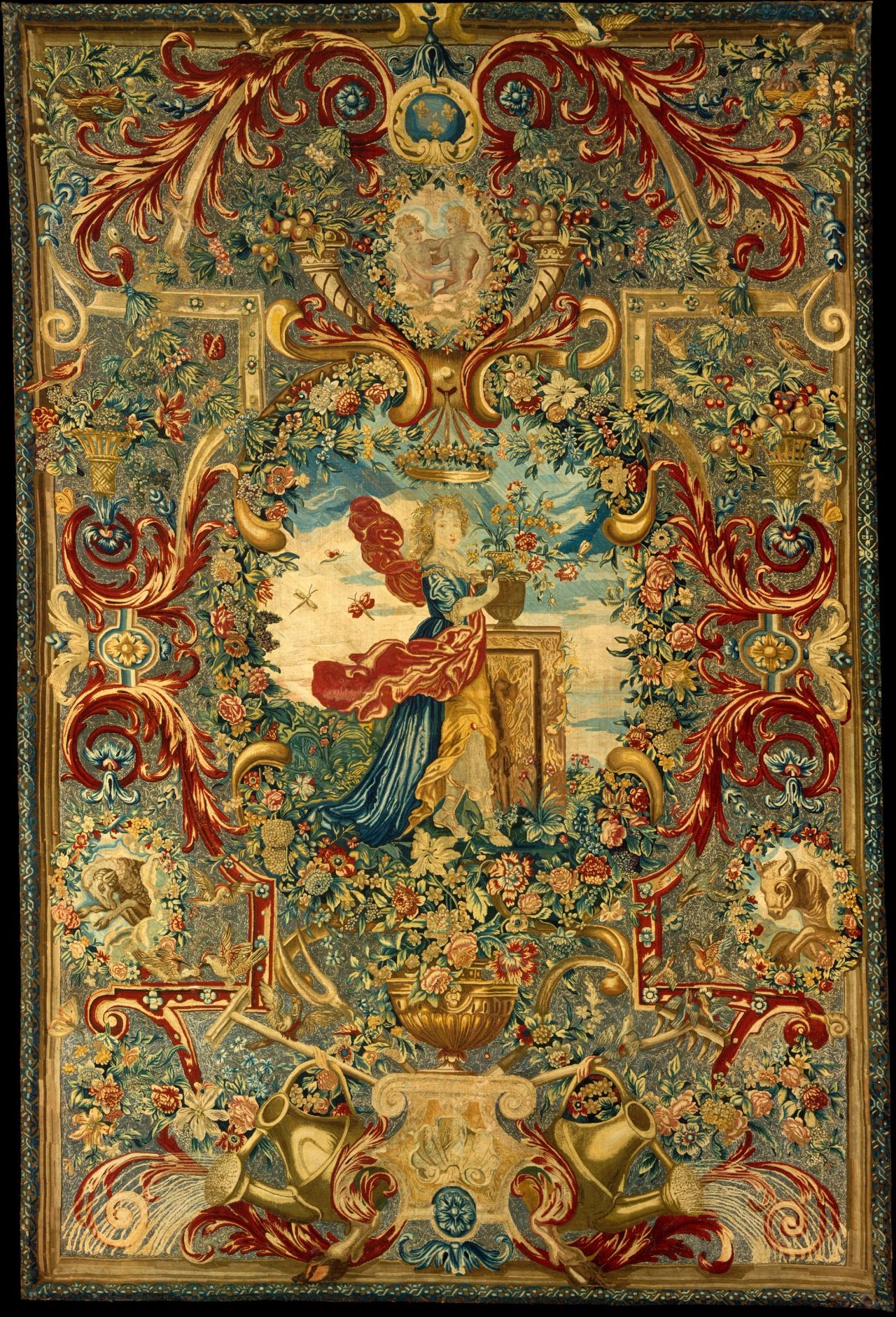
The hanging above looks like a tapestry from across a room. It is not. The Metropolitan Museum of Art records it as silk, wool and metal thread embroidered on canvas in tent stitch, at 316 stitches to the square inch. That works out at about 18 stitches to the inch each way, as fine as a modern 18-mesh canvas, over a hanging more than four meters long. It is needlepoint at its most ambitious, and it shows why the names get confused.
Is needlepoint the same as tapestry?
No. A tapestry is a weave; needlepoint is embroidery on a ready-made grid. In tapestry, colored weft threads are packed down over the warp on a loom until they hide it, and each color travels only across its own patch of the design. In needlepoint, a needle carries yarn through the holes of a woven canvas, one stitch at a time, until the stitches cover it.
The Victoria and Albert Museum describes tapestry as a weft-faced textile with a "discontinuous weft," built up in blocks of color, with the design visible on the front and the back. The British Tapestry Group sets out the same criteria and then lists the things the word is commonly borrowed for: "tapestry" chair backs, screens and cushions, "including those sold in kit form," which are needlepoint, canvas work or woolwork. Its explanation is cost. Woven tapestry was slow and expensive, so the word drifted to cheaper ways of making pictures in wool.
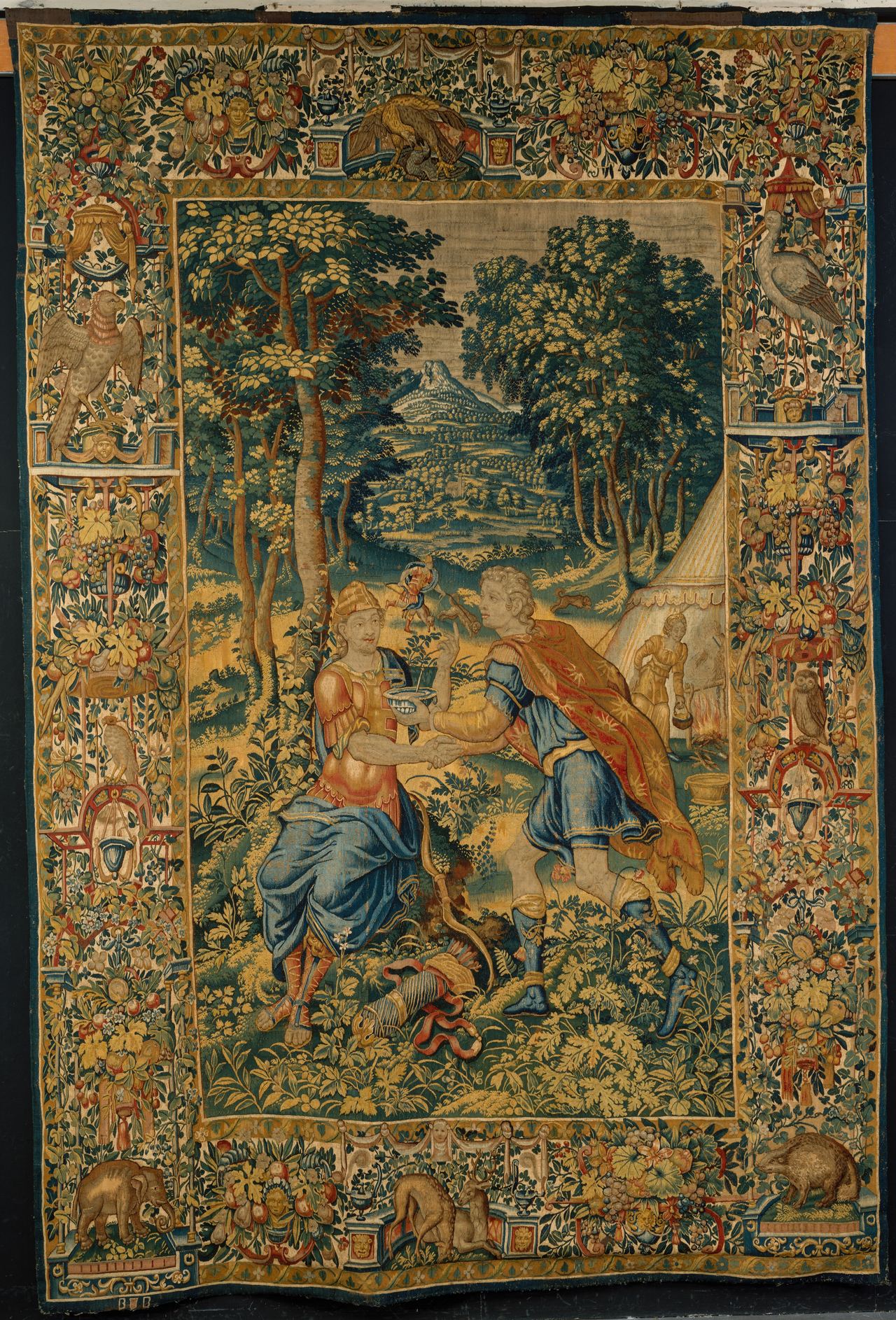
The Royal School of Needlework's Stitch Bank calls the usage "strictly incorrect" and suggests it began because seventeenth-century canvas work imitated the woven tapestries of palaces and country houses. A handbook from 1842 points the same way. Miss Lambert wrote that although the word tapestry was "now generally restricted to one species of fabric," the woven kind, it had once covered "all kinds of ornamental hangings" for walls, and those were generally needlework.
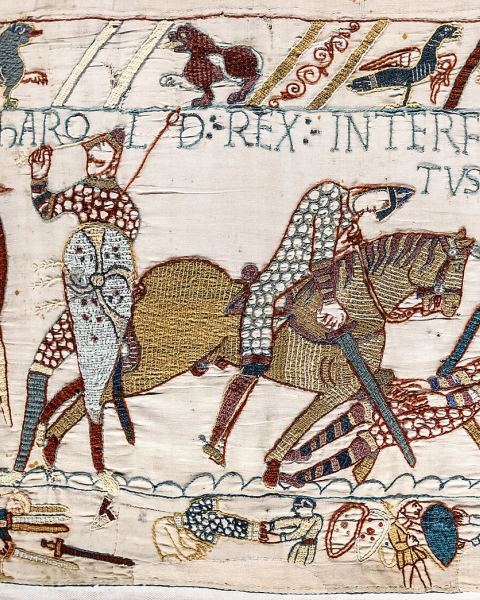
The borrowing never stopped. Merriam-Webster still gives "embroidery on canvas resembling woven tapestry" as one sense of the word. The chapter on canvas work in Thérèse de Dillmont's Encyclopedia of Needlework (an English edition is cataloged at about 1890) is headed "Tapestry and Linen Embroidery," and the supply aisle keeps the habit alive: a needlepoint needle is a blunt "tapestry needle," and its wool is often sold as "tapestry yarn." Teazle has covered the most famous misnomer of all in The Bayeux Tapestry Is Not a Tapestry: that one is embroidery on linen, but the error is the same.
Needlepoint, canvas work, petit point: one craft
The RSN files needlepoint, petit point and "tapestry" as other names for canvas work. Older books used other words again: Caulfeild and Saward's 1882 Dictionary of Needlework has entries for "Canvas Work" and "Berlin Work," and for them "needle-point" meant something else. That is a warning for anyone searching museum catalogs: "needlepoint" also names a kind of lace made with a needle. The same dictionary speaks of "Needle-point Laces," and the Cleveland Museum of Art still catalogs a seventeenth-century "Needlepoint (Point de France) Lace Edging."
What is needlepoint canvas, and what does mesh count mean?
Needlepoint canvas is a stiff, open, evenly woven grid. Its mesh count is the number of holes, or threads, per inch: 14-mesh has 14 to the inch, and a smaller number means bigger holes and bigger stitches. In tent stitch, one stitch covers one crossing of the canvas, so the mesh count is also the number of stitches per inch.
Three kinds of canvas are sold.
| Canvas | How it is woven | What it is good for |
|---|---|---|
| Mono (plain) | Single threads in both directions | Has some "give"; can distort if handled roughly |
| Interlock mono | Pairs of vertical threads locked around single horizontal ones | Less give and less distortion; recommended for pillows and pieces that get used |
| Penelope (double) | Pairs of threads in both directions | Large and small stitches on one canvas: gros point over the pairs, petit point over single threads |
The descriptions come from a University of Kentucky extension guide to needlepoint, Erica Wilson's guide to canvas and the RSN. Penelope canvas is older than it sounds. Lambert described it in 1842 as "much used," and explained the name: it looked like a canvas "from which the work has been unpicked." The allusion is to Penelope, who in the Odyssey, as Lambert's own quotation of it puts it, "each night unravell'd what the day begun."
Erica Wilson's guide puts 10-count at the beginner's end, 12 to 14 for general work such as pillows and bags, and 16 to 18 for detail. Historic work can be finer still. At about 18 stitches to the inch, the Met's hanging of Spring sits at the fine end of that range; the tapestry above is counted differently, in warps, at 18 to the inch.
Half-cross, continental or basketweave: which stitch?
All three are tent stitch: a small diagonal stitch over one crossing of the canvas, and they look identical from the front. They differ on the back. Half-cross uses the least yarn, continental is harder-wearing, and basketweave is the most durable and the least likely to pull the canvas out of shape.
Dillmont describes it as "simply the first half of a cross," worked over a single thread each way, and the 1882 Dictionary of Needlework gives petit point as its French name. Here is how the three ways of working it compare, drawing on the guides from DMC, the RSN and the University of Kentucky.
| Method | How you travel | Back of the canvas | Best for |
|---|---|---|---|
| Half-cross | Horizontal or vertical rows | Short straight stitches; the least yarn | Framed pictures and pieces that get little wear |
| Continental | Horizontal or vertical rows | Long diagonal stitches, longer than those on the front | Smaller areas and details |
| Basketweave | Diagonal rows, alternately up and down | Stitches cross like a woven basket | Large areas, seats, cushions, anything that gets wear |
Why does basketweave distort the canvas less?
Stitches pull on the canvas, and over a large area a piece can skew out of square. The Kentucky guide calls some distortion "nearly unavoidable" and says basketweave does not distort the canvas as much as continental. The RSN explains why: the back of a basketweave row lays its yarn vertically on the way up and horizontally on the way down, so the back crosses like a basket, and that structure is "most likely to keep the canvas square." Continental, by contrast, puts a long diagonal on the back of every stitch. The usual advice follows: basketweave for large backgrounds, continental for small areas and details.
Where do bargello and flame stitch fit?
Bargello is also canvas work, but it abandons the tent stitch. It uses straight, upright stitches laid parallel to the canvas threads, usually over several threads at once, and steps them up and down to make zigzags, flames and waves.
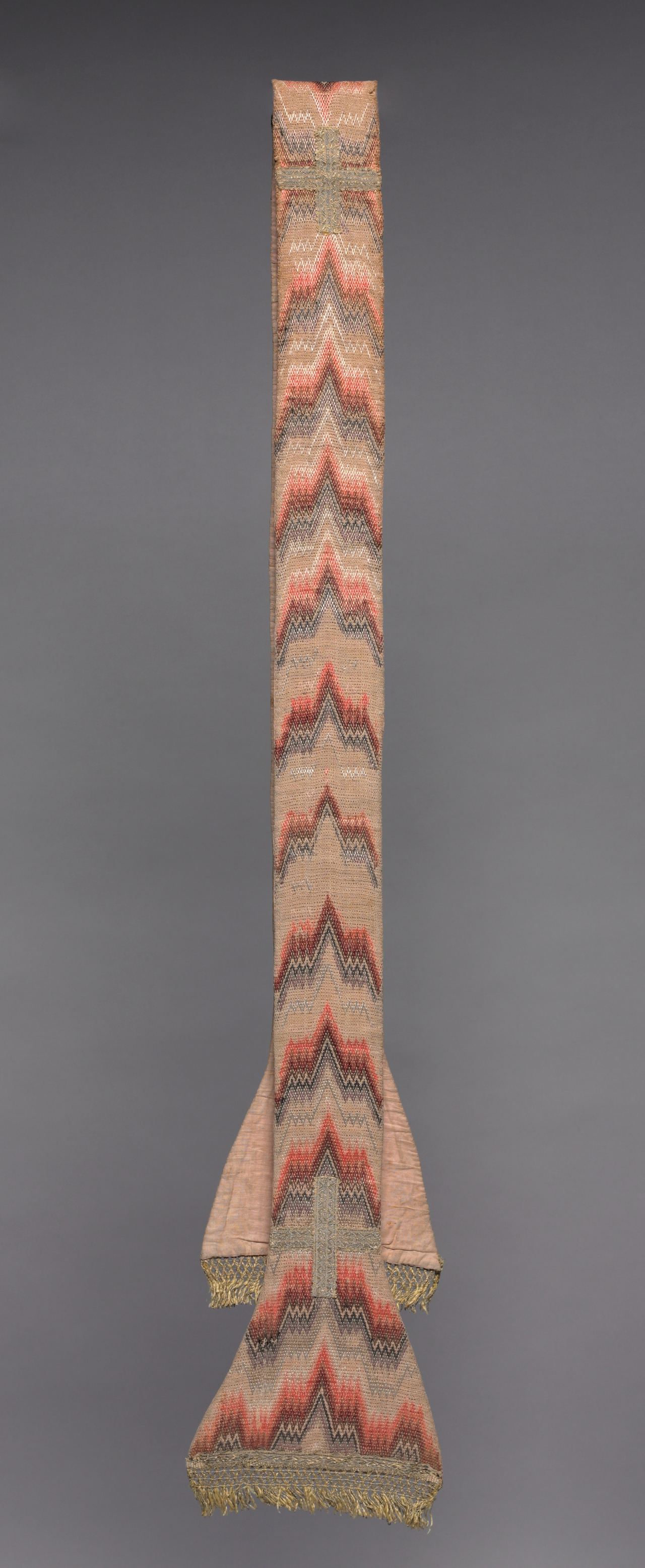
The V&A notes that the origins are uncertain, "as indicated by the variety of names it goes by": flame stitch, Florentine work, Hungarian point and Irish stitch. The Embroiderers' Guild of America adds the Italian punto unghero and punto fiamma, and calls the story that it was taught to prisoners in Florence's Bargello unlikely. Caulfeild and Saward, in 1882, described "Irish Stitch" as a long upright stitch over five or more canvas threads, used for "patterns formed with shades of colour." The Cleveland Museum of Art's nineteenth-century Italian stole, above, shows the effect in silk on linen.
How is needlepoint different from cross-stitch and crewel?
Needlepoint covers a stiff canvas completely. Cross-stitch places counted Xs on soft, even fabric, which may show as background. Crewelwork is free embroidery in fine wool on a firm cloth, following drawn lines rather than a grid. Tapestry, again, is not stitched at all.
| Needlepoint | Cross-stitch | Crewelwork | Tapestry | |
|---|---|---|---|---|
| Made by | Stitching | Stitching | Stitching | Weaving |
| Ground | Stiff open canvas | Aida or evenweave fabric | Firm linen twill | None: the weft is the cloth |
| Coverage | Canvas fully covered | Fabric may show | Motifs on a plain ground | Warp fully covered |
| Design from | Painted canvas or chart | Chart | Drawn lines | Full-size cartoon |
| Size measure | Mesh (holes per inch) | Count (threads or blocks per inch) | Not counted | Warps per inch |
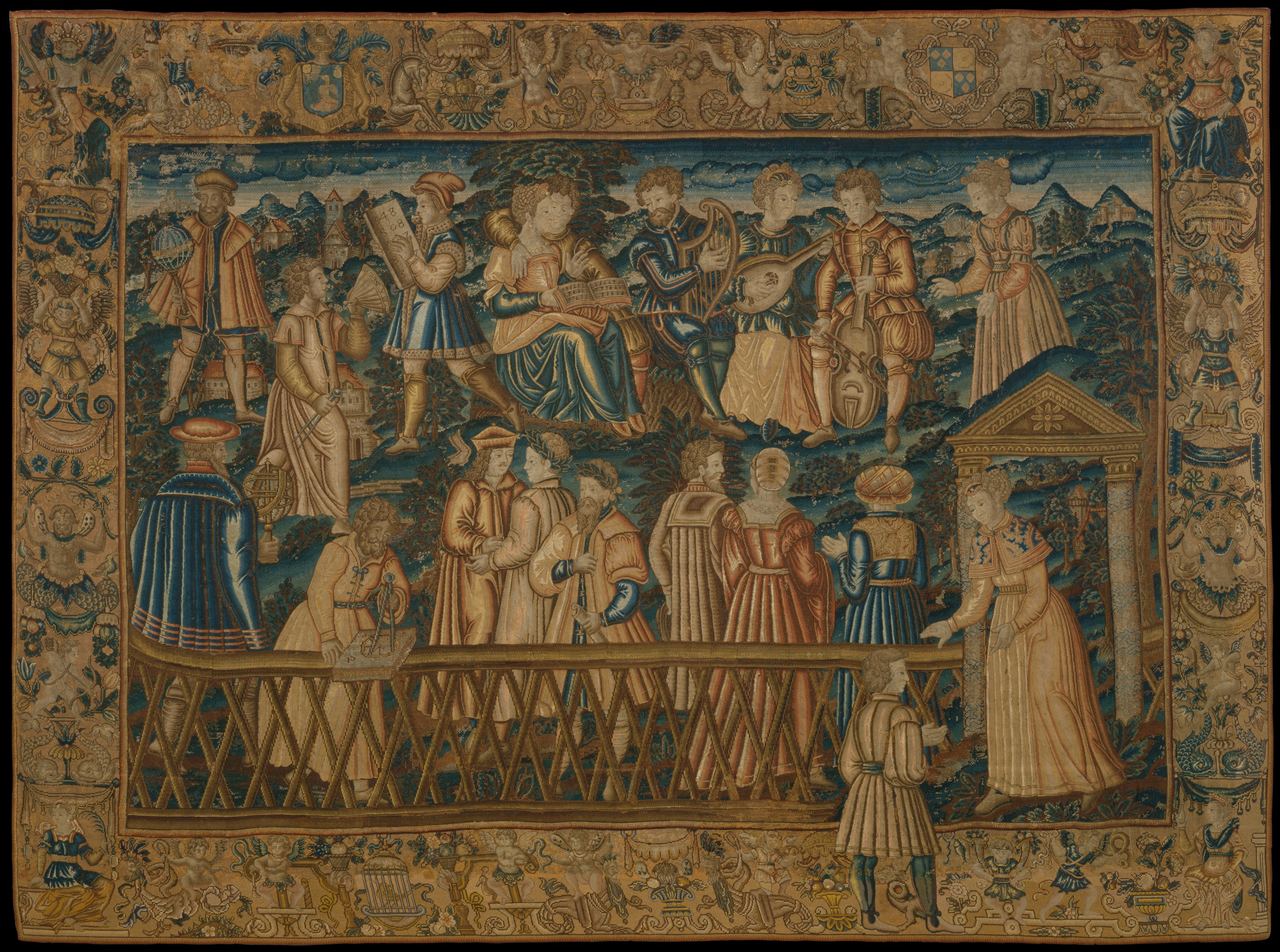
The line between needlepoint and cross-stitch is blurrier in history than in shops. Cross stitch is itself a canvas stitch, and the Met's sixteenth-century hanging from The Table of Cebes uses both: the museum records cross stitch at 48 to 56 to the square inch and tent stitch at 156 to 190, on the same canvas.
Modern cross-stitch fabrics are counted differently, too. On Aida, the count is the number of stitchable squares per inch, and one X fills one square. On evenweave the count is threads per inch, and stitches usually go over two threads, so 28-count evenweave gives the same stitch size as 14-count Aida. A canvas is easier: on 14-mesh, a 140-stitch design in tent stitch is 10 inches wide. Teazle's embroidery and cross-stitch size calculator does that arithmetic; for canvas, enter the mesh as a custom count worked over one thread.
For the difference between counted and free embroidery in general, see Which Embroidery Should You Learn First?.
What was Berlin woolwork?
Berlin woolwork was the nineteenth century's needlepoint boom. Hand-colored charts printed in Berlin, one square for each stitch, let amateurs copy flowers, birds and paintings onto canvas in bright wool, usually in a single stitch, tent or cross. Its influence can still be traced in commercial canvas kits.
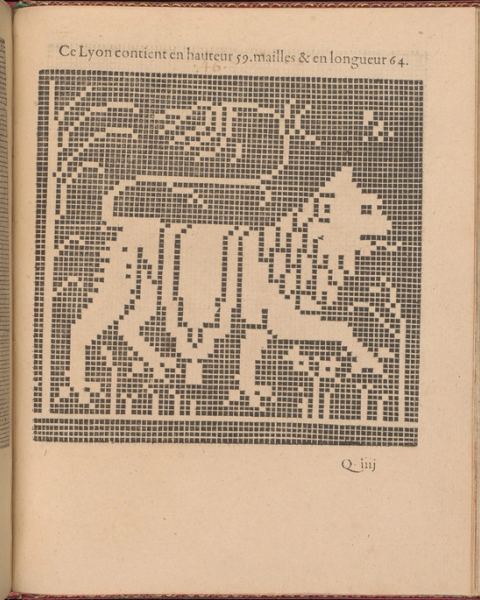
The dates come from the period. Lambert's 1842 handbook says she had them from Mr. Wittich himself: about 1805 a Mr. Phillipson published patterns that failed, and in 1810 Madame Wittich persuaded her husband, a Berlin printseller, to publish a better series. Caulfeild and Saward, in 1882, date the first colored paper patterns to 1801 and agree on Wittich in 1810, adding that the name Berlin work stuck around 1820, when Berlin wools arrived. The Textile Research Centre in Leiden describes the method: a chart printed in black and white on grid paper with symbols for the colors, then painted square by square by hand. The principle is the one Federico de Vinciolo used in 1588 for a lion 59 meshes tall.
It sold in enormous numbers. The V&A says that more than 14,000 patterns had been imported into Britain by 1840. The wool, according to the TRC, came from Merino sheep in Saxony, was combed and spun in Gotha and dyed in Berlin. Taste turned against it. Caulfeild and Saward complained of "impossible parrots," and the RSN notes that the reaction against Berlin work's formula fed the art needlework movement and the founding of the school itself. By the 1880s, the TRC says, demand was falling.
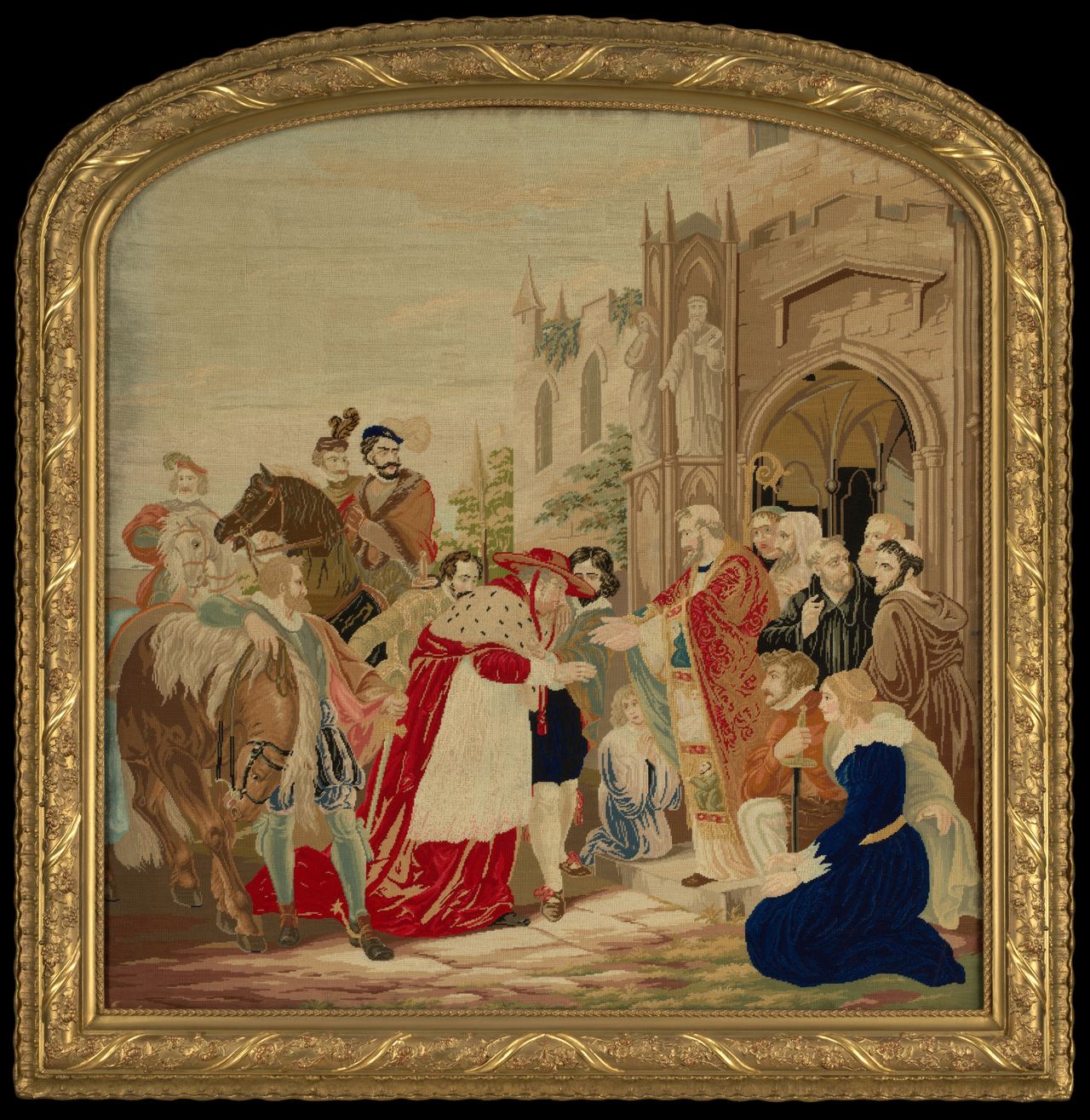
The Met's large picture of a scene from Shakespeare's Henry VIII, worked in wool and silk on canvas about 1865 and probably by Agnes Pruyn Strain of Albany, was made in those decades. The museum does not call it Berlin work, and nothing in its record links it to a printed chart, so it appears here simply as a shaded wool picture of the period. Seen up close, the canvas is covered with small, even, slanting stitches.
How do you choose your first needlepoint kit?
Choose a small design on 10- to 14-mesh canvas (interlock if it will become a pillow) with wool yarn, a blunt tapestry needle and enough canvas around the design to frame and finish it. Decide between a painted canvas, where you stitch over the colors, and a chart, where you count. Plan to block the piece when it is done.
The renewed interest is real enough to show up in retail data. In March 2026 Etsy's trend team listed "beginner needlepoint kits (+175%)" among its spring and summer signals, in a preview of a report it says draws on its own search data, without saying what was measured or over what period. Museums are paying attention too: Hillwood Estate, Museum & Gardens in Washington, D.C., names "embroidery and needlepoint" as one of four key techniques in Interwoven: A Tradition of Textiles, on view until January 3, 2027. The same show includes a point de France lace panel, needlepoint in the older sense.
What to look for, drawing on the Kentucky extension guide and Erica Wilson's:
- Mesh. Ten-mesh is the easiest to see; 12 to 14 suits pillows and bags; 16 to 18 suits fine detail.
- Canvas. Interlock holds its shape better under stitching; mono has more give. Cotton is the usual fiber.
- Margin. Allow three to four inches more than the finished size, leaving a border of about two inches all round, and tape the raw edges.
- Yarn. Persian yarn is three strands you can separate; tapestry yarn is a single four-ply strand. Wool is the traditional choice. Cut lengths of no more than 18 inches. As a guide, an ounce of yarn covers about 25 square inches of 14-mesh in tent stitch.
- Needle. A blunt tapestry needle sized to the canvas: for 10-mesh, the Kentucky guide pairs a #18.
- Frame. Stitching in a frame lessens distortion. Nineteenth-century manuals said the same, though Dillmont allowed work in the hand with the ends of the canvas weighted.
- Blocking. Before you start, trace the canvas outline on paper. At the end, dampen the piece, stretch it back to that outline on a board, tack it every inch or two, and let it dry, repeating if it is badly skewed.
Then work backgrounds in basketweave and details in continental, and keep the tension even: too loose snags, too tight distorts.
Where can you see historic needlepoint?
The Metropolitan Museum of Art holds the tent-stitch Spring, from a set of four Seasons and Elements, and The Garden of False Learning from The Table of Cebes. The Cleveland Museum of Art has the bargello stole and a pair of French needlework bed hangings from 1710–20, worked in tent and cross stitch on canvas. In Washington, Hillwood's Interwoven runs until January 3, 2027. For Berlin charts themselves, the Textile Research Centre in Leiden publishes its collection in an online exhibition.
Sources
- Seasons and Elements (Spring) 46.43.1; The Garden of False Learning 42.193.2; Esau Selling His Birthright to Jacob 1983.73.1; Needlework picture of scene from Henry VIII 2021.160. The Metropolitan Museum of Art (Open Access API). Four object records read through the Met Collection API v1 (medium, stitch counts per square inch, warps per inch, dates, attributions, dimensions, credit lines, isPublicDomain true). The Met web pages returned 429, so museum label texts were not read. Accessed October 22, 2026.
- Embroidered Stole 1940.1191; Pair of Needlework Bed Hangings in the Bizarre Style 2006.2; Needlepoint (Point de France) Lace Edging 1920.1253. The Cleveland Museum of Art (Open Access API). Records read through the Open Access API: technique, date, culture, dimensions, credit line, CC0 status. Accessed October 22, 2026.
- What is tapestry?. Victoria and Albert Museum. Page read in full: weft-faced textile, discontinuous weft, design visible front and back, cartoon. Accessed October 22, 2026.
- What is Tapestry Weaving?. The British Tapestry Group. Page read in full: criteria for woven tapestry; list of techniques called tapestry, including needlepoint and kits; cost as the likely reason. Accessed October 22, 2026.
- Tapestry (definition). Merriam-Webster. Entry read: sense 1c, "embroidery on canvas resembling woven tapestry". Accessed October 22, 2026.
- Canvaswork; Tent stitch; Basketweave tent stitch; Continental tent stitch (RSN Stitch Bank). Royal School of Needlework. Five entries read in full (also Berlin wool work): other names, coverage, count, Penelope with gros and petit point, "strictly incorrect" tapestry usage, basketweave "most likely to keep the canvas square", decline of Berlin work. Accessed October 22, 2026.
- The Hand-Book of Needlework (1842). Miss Lambert, via the Internet Archive. Full-text OCR read: tapestry once meaning all ornamental hangings (pp. 18-19), Penelope canvas and its name (pp. 73-74), Berlin patterns and the Wittich footnote (pp. 82-83), Penelope quotation from Pope's Odyssey (introduction). Accessed October 22, 2026.
- The Dictionary of Needlework (1882). S. F. A. Caulfeild and Blanche C. Saward, via the Internet Archive. Full-text OCR read: entries Berlin Work, Canvas, Canvas Work, Tent Stitch, Petit Point, Gros Point, Penelope Canvas, Irish Stitch; "Needle-point Laces". Accessed October 22, 2026.
- Encyclopedia of Needlework. Thérèse de Dillmont, via Project Gutenberg. Chapter "Tapestry and Linen Embroidery" read in full: plain and Penelope canvas, frame or hand, half cross, tent stitch. English edition dated 1890 in the Internet Archive catalog (encyclopediaofne00dill). Accessed October 22, 2026.
- Needlepoint (CT-MMB.760). University of Kentucky Cooperative Extension (Combs, Klee; revised by Baker, 2005). PDF read in full: tapestry needles and yarns, mesh count, mono/interlock/Penelope, canvas margins, yarn quantities, stitch tension, basketweave vs continental, frames, blocking. Accessed October 22, 2026.
- How To Select the Right Canvas for Needlepoint: The Complete Guide. Erica Wilson. Page read in full: mesh-count ranges and uses, mono/interlock/Penelope, painted canvases, interlock for pillows. Accessed October 22, 2026.
- Needlepoint stitches. DMC. Page read in full: three methods of tent stitch, backs, durability, distortion, thread use, uses. Accessed October 22, 2026.
- Aida fabric count explained: which count for your project. Stitcher. Page read: count as stitchable squares per inch; 28-count evenweave over two equals 14-count Aida; colored Aida showing as background. Accessed October 22, 2026.
- Embroidery styles: an illustrated guide. Victoria and Albert Museum. Read in full: counted-thread work, background visible or covered; bargello and its names; Berlin woolwork and 14,000 patterns imported by 1840; crewelwork. Accessed October 22, 2026.
- Embroidery Techniques from Around the World: Bargello (18 September 2024). Embroiderers' Guild of America. Article read in full: names including punto unghero and punto fiamma, contested origins, Bargello chairs, prison legend unlikely, upright stitches. Accessed October 22, 2026.
- Berlin Work Charts (online exhibition, 2018); Berlin wool work (TRC Needles). Textile Research Centre, Leiden. Exhibition sections 1, 2 and 4 and the TRC Needles entry read in full: single stitch, hand-colored charts with symbols, Saxon Merino wool, subjects, decline in the 1880s, influence on modern kits. Accessed October 22, 2026.
- Etsy Insights: Explore the Trends Shaping Spring and Summer 2026. Etsy Community (post by Etsy staff, 17 March 2026). Post read in full: report "informed by exclusive Etsy search data"; "beginner needlepoint kits (+175%)". No measure or period given. Accessed October 22, 2026.
- Interwoven: A Tradition of Textiles (press release, 4 February 2026, and exhibition page). Hillwood Estate, Museum & Gardens. Press release PDF read in full; dates June 6, 2026 to January 3, 2027 confirmed on hillwoodmuseum.org/exhibitions/interwoven-tradition-textiles. Four key techniques include "embroidery and needlepoint"; point de France lace panel. Accessed October 22, 2026.
Glossary
Last updated · Markdown · Report an error