Tapestry or embroidery
The Bayeux Tapestry Is Not a Tapestry
The Bayeux hanging is wool stitched onto linen, not woven. How to tell a tapestry from an embroidery by its back, its edges and its stitches, and how the wrong name stuck.
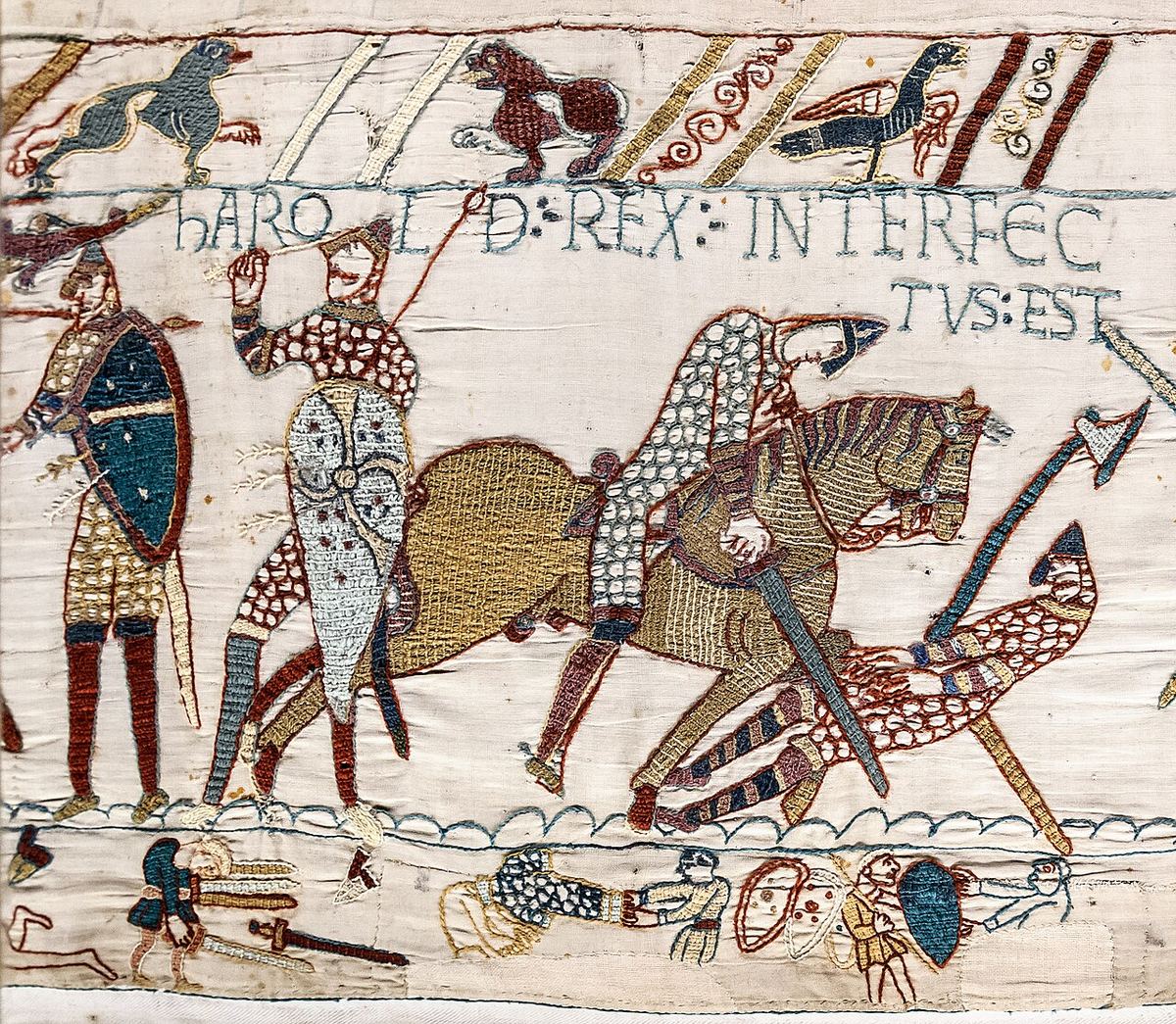
The Bayeux Tapestry is an embroidery, not a tapestry. Its wool picture is stitched onto linen that was already woven, while a true tapestry builds its picture into the cloth as it is woven on a loom. You can tell the two apart by looking at the back, the edges and the surface of the stitches.
The hanging is on loan to the British Museum from September 2026 to July 2027, and on 23 October a show of woven tapestries opens at the Guildhall Art Gallery. It is a good moment to learn the difference, because the most famous "tapestry" in the world is the standard example of a wrong name that nobody has managed to correct.
Is the Bayeux Tapestry a tapestry or an embroidery?
It is an embroidery. The Bayeux Museum, the work's home museum, says that "the technique used is unquestionably embroidery." The scenes are worked with a needle in wool thread on a linen ground. A tapestry, by contrast, is a woven structure in which the colored weft threads make the picture as the cloth is made. The two techniques produce a similar object, a large picture hung on a wall, by opposite routes.
The point is not new. An 1898 history by Frank Rede Fowke called "historical embroidery" the more accurate title and added that "time has, however, consecrated the misnomer." More than a century later the museum still has a web page to explain it.
How was the Bayeux Tapestry made?
The Bayeux Museum gives the measurements as about 68.3 meters long and about 70 centimeters wide, of which only 50 centimeters carry embroidery. It consists of nine panels of linen cloth joined together. The British government's announcement of the London display rounds the length to about 70 meters and says the work is widely thought to have been made in England in the eleventh century, probably commissioned by Bishop Odo of Bayeux.
The wool was dyed with three plants, according to the museum: woad for blues, madder for reds, pinks and browns, and dyer's rocket, also called weld, for yellows. It counts ten colors of thread. It also notes that the regular lines of the wool suggest guide marks, perhaps drawings, were made on the cloth first.
The museum lists four stitches: stem stitch, chain stitch, split stitch worked with two threads, and couching, which it calls "Bayeux stitch" and says is used to fill colored surfaces. A stitcher who visited in 2014 and wrote about the work in Needle Arts, the Embroiderers' Guild of America's magazine (December 2015), describes how that filling works. A bottom layer of long stitches is laid side by side; a second layer is laid across the first at right angles; and the whole is anchored with small tacking stitches, "not unlike couching." She reports stem stitch on figures, trees and water, and outline stitch for the Latin captions. Fowke described the same construction in 1898 in his own words: worsted threads "laid down flat side by side, and then bound at intervals by cross fastenings."
Wool embroidery of this kind is the broad territory of crewelwork, though that word is usually tied to later English bed hangings.
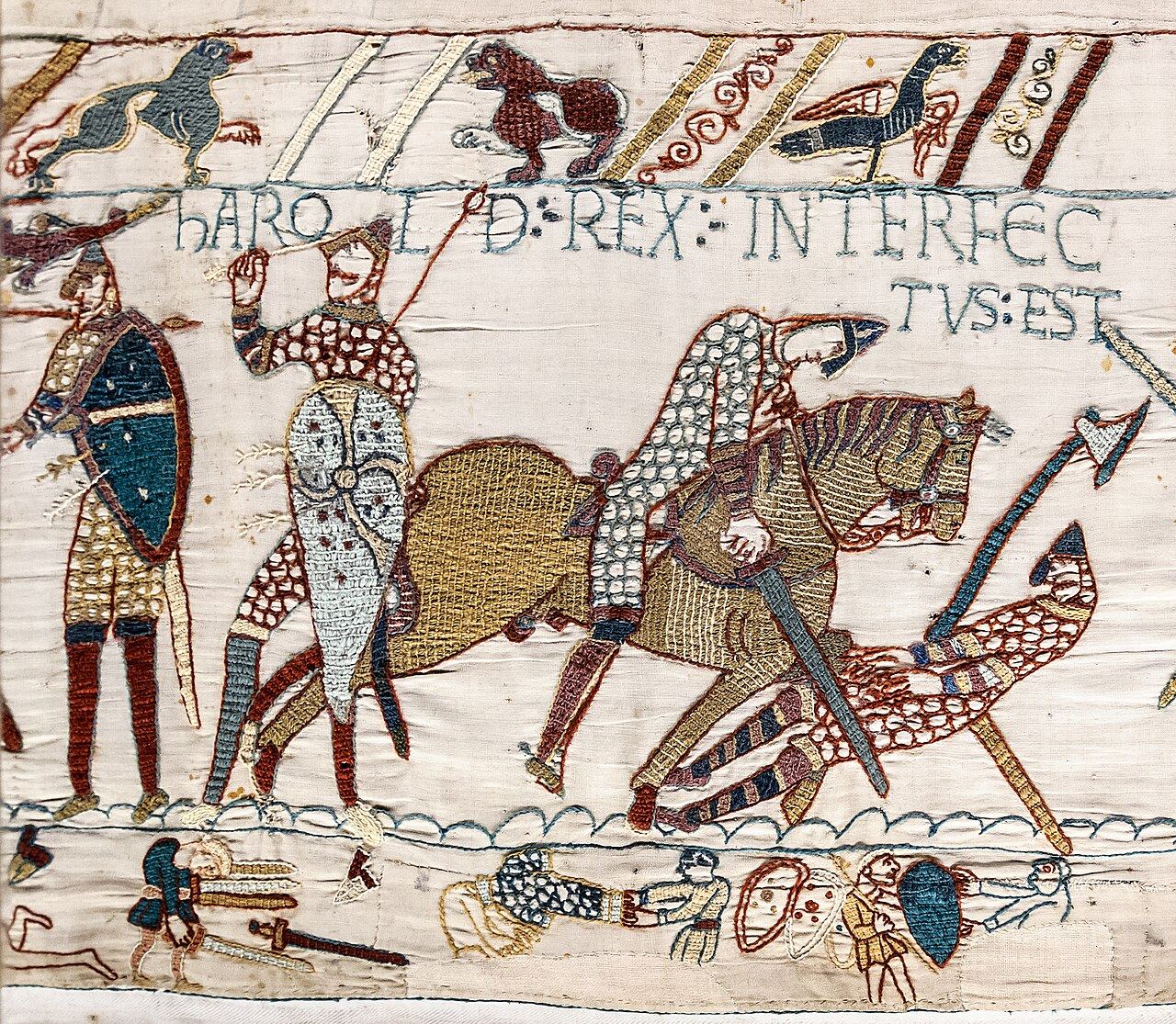
Look at the photograph above with those descriptions in mind. The lettering and the outlines are single lines of thread. The horse and the mail are filled with close, gridded stitching that appears to be laid work. Between the figures the pale linen shows bare, which is the first sign that this is embroidery.
What makes a tapestry a tapestry?
A tapestry is a weft-faced weave with discontinuous wefts. Warp threads are stretched on a loom, and the weaver packs colored weft threads down so tightly that they cover the warp completely. Each color of weft travels back and forth only across the part of the warp where the design needs it, so most wefts never cross the whole width. The picture is not added to a finished cloth; it is the cloth.
Several institutions agree on those essentials. The Victoria and Albert Museum explains that weft threads are beaten down to hide the warp and that most of them do not run all the way across. The British Tapestry Group describes the weft as packed to hide the warp, "weft facing," and notes that each color is worked only in its own section. The Textile Research Centre in Leiden adds that the binding is usually plain weave and that tapestry is made from separate weft threads that "interweave only with the warp when required for the pattern." The RKD's corpus of wall tapestries in the Netherlands makes the contrast with embroidery in a sentence: a tapestry's image is created on the loom, whereas embroidery is worked onto fabric that has already been woven. The warp is the fixed frame; the weft is the picture.
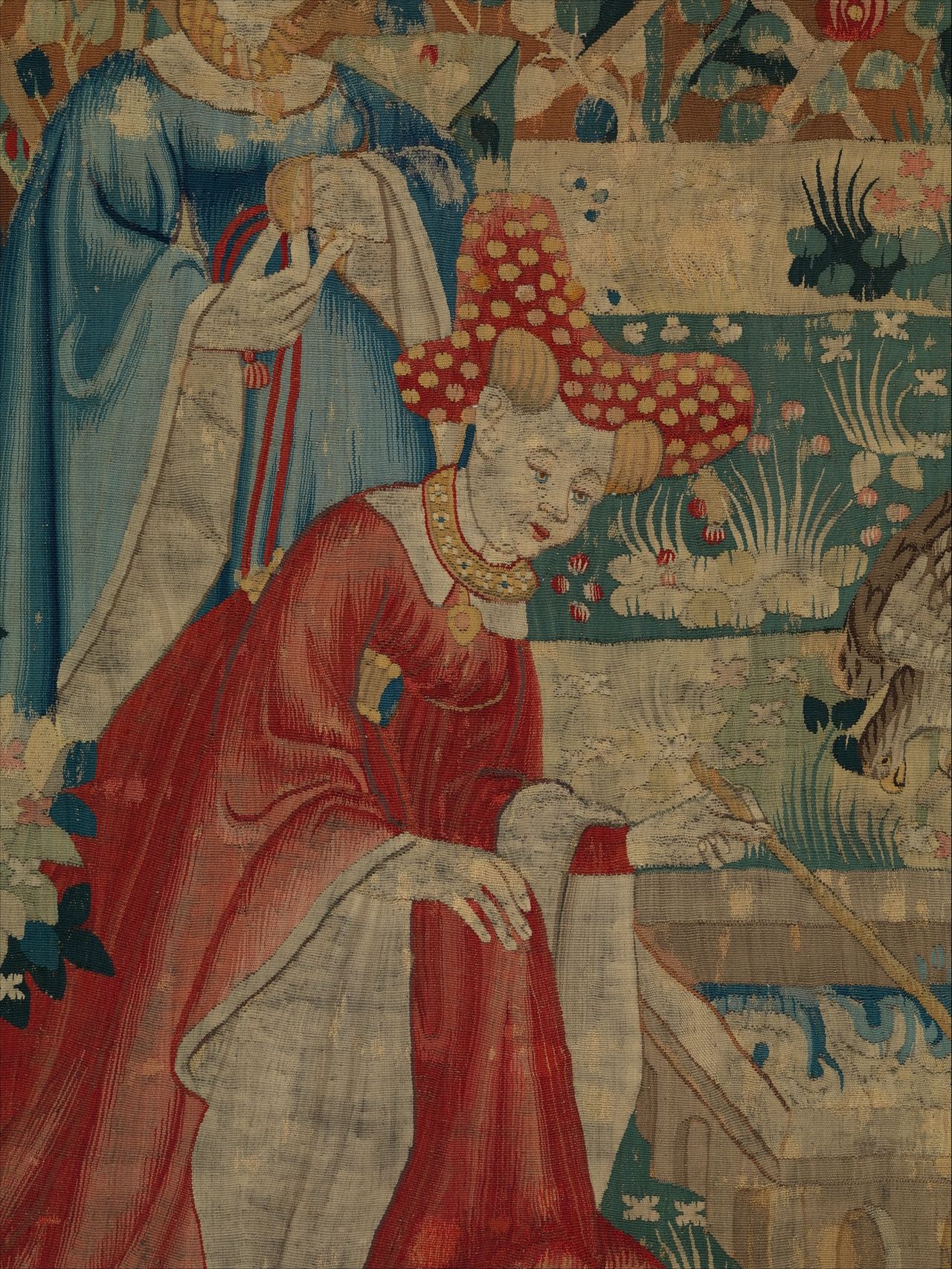
The detail above shows the result. The surface is finely ribbed, and where one color meets another the edges step and interlock in small teeth. There are no stitches lying on top and no bare ground cloth, because the colored wools are the cloth. The Met's catalog entry gives the construction in a phrase: "wool warp and wool wefts."
Tapestry is slow. The V&A reports that one square meter of coarse tapestry could take one person a month, and that finer work takes longer.
How can you tell a tapestry from an embroidery?
Three checks work on most objects: turn it over, look at the edges (a woven edge is a selvage), and look for the ground. The table sets out what each technique usually shows.
| Tapestry (woven) | Embroidery (stitched) | |
|---|---|---|
| How the picture is made | Colored wefts woven over stretched warps, so the picture and the cloth are made together | Thread stitched with a needle onto cloth that was already woven |
| The surface | Weft-faced and finely ridged; the warp is hidden; colors change in small stepped blocks | Individual stitches lie over a ground, and the ground may show between them |
| The back | The picture shows on the back too, and loose thread ends remain there, because the weavers work on that side | As a rule, the underside of the stitches over a plain ground cloth rather than a second picture |
| The edges | The weft turns back at the sides to make a self-finished selvage; the top and bottom are where the warp ends, since it is stretched between the loom's beams | The edge of the ground cloth, which may be bare, seamed, or pierced where it was stretched on a frame |
| Colors | Each color is a separate weft in its own area | Thread can be laid over any area, and outlines can be added on top |
The description of a tapestry's back rests on three sources. Merriam-Webster's definition calls tapestry "reversible," the V&A says the design is "visible on the front and back," and the RKD notes that the weavers work on the rear side "where the loose threads remain." So a tapestry's back is the same picture with its thread ends showing. These sources describe the back of a tapestry in detail but not the back of an embroidery, so the embroidery column is a rule of thumb that follows from how it is made: stitches sit on a ground, and the underside of a stitched picture looks like the underside of stitches.
The Bayeux Tapestry passes the other tests. Besides the bare linen between the figures, only 50 of its 70 centimeters of width carry embroidery, so there are plain margins. The Needle Arts writer noticed holes along the top and bottom edges that she took to show where the linen had been fastened to a frame. Those are the edges of a ground cloth, not woven selvages.
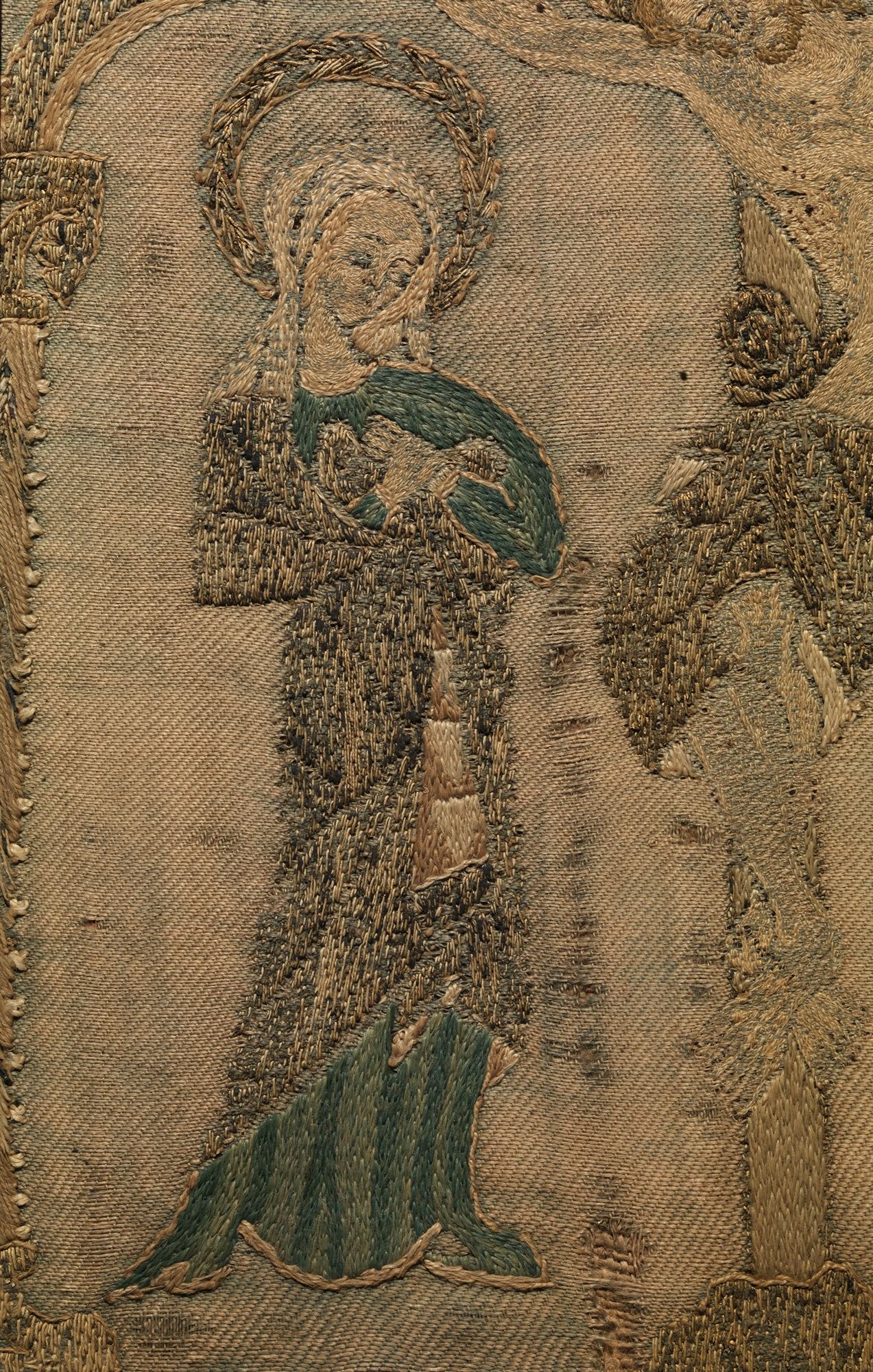
The second photograph shows the same principle in a British embroidery of 1270 to 1290 at the Metropolitan Museum, whose record lists the medium as silk. A small haloed figure, stitched in green, cream and gold-colored thread, sits on a plain woven ground with a fine diagonal rib that remains visible all around it. A tapestry weaver typically has no such ground to leave showing, because in a tapestry there is no cloth under the picture.
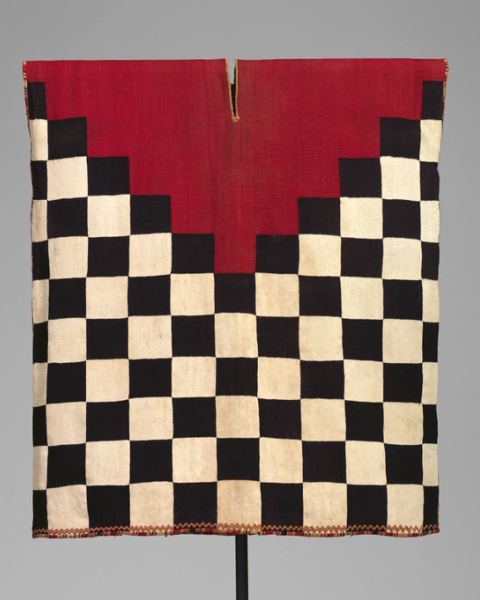
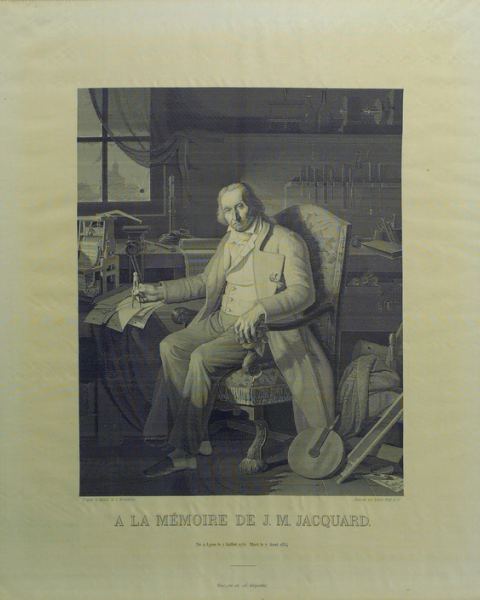
The two techniques can also be combined. Teazle's story on Inka tunics describes the finest unku as tapestry-woven from camelid fiber, with seams and edges covered in embroidery. And a woven picture is not automatically a tapestry. The British Tapestry Group calls Jacquard-woven pictures controversial because they are often computer controlled, may not be hand woven, and do not meet the weft-facing, discontinuous-weft test. Our guide to plain, dobby and Jacquard weaves explains how a loom chooses which threads to lift.
Why is it called a tapestry anyway?
Because "tapestry" was never a strict technical word. Merriam-Webster traces it through Anglo-French to a word for a carpet or hanging, and ultimately to Greek, with a first known English use in the fifteenth century. Besides the woven sense, its dictionary lists "embroidery on canvas resembling woven tapestry," which stitchers know as needlepoint. The British Tapestry Group counts needlepoint among the things wrongly called tapestry, and names the Bayeux work, the Quaker Tapestry (1989) and the Great Tapestry of Scotland (2013) as embroidered wall hangings.
The hanging was described accurately long before anyone argued about the name. Fowke's history prints the entry from the 1476 inventory of Bayeux Cathedral: a "very long and narrow" hanging "de telle a broderie," meaning a cloth of embroidery, with figures and captions representing the conquest of England, hung around the nave on the feast of the Relics. Fowke adds that it picked up other titles, among them "La Toilette de St. Jean," from the feast on which it was shown. The "tapestry" wording he quotes comes later.
| Date | Wording | Source |
|---|---|---|
| 1476 | A very long and narrow hanging "de telle a broderie" (cloth of embroidery) | Cathedral inventory, printed by Fowke (1898); the Bayeux Museum also dates the inventory to 1476 |
| About 1729-30 | "A piece of tapestry" kept in the cathedral, in a prior's reply to Father Montfaucon | Fowke (1898), summarizing the correspondence |
| 1804 | "La tapisserie brodée par la reine Mathilde": the tapestry embroidered by Queen Matilda | Denon's letter returning it to Bayeux, printed by Fowke; the Bayeux Museum dates its Louvre display 6 December 1803 to 18 February 1804 |
| 1898 | "Historical embroidery would be a more accurate title"; the misnomer is "consecrated" | Fowke |
| Today | "Unquestionably embroidery" | Bayeux Museum |
Two things in that record explain the survival of the name. People who used the French word "tapisserie" often attached "embroidered" to it, as Denon did, so the noun never hid the technique from them. And the 1803 exhibition in Paris made the hanging famous under that name: a handbook was published as the "Notice historique sur la Tapisserie brodée de la reine Mathilde," and a one-act comedy called "La Tapisserie de la reine Mathilde" was staged. Fowke judged in 1898 that the name was unlikely ever to change. The Matilda attribution did not last as well: Fowke found nothing connecting the work with her, and the 2025 government announcement says it was probably commissioned by Bishop Odo.
What is the quickest way to check at a museum?
Look for the ground first. If you can see plain cloth between the motifs, or the direction of individual stitches, it is embroidery. If the surface is a continuous fabric of fine ribs with colors meeting in stepped teeth, it is probably a tapestry. The wall label helps: "wool warp, wool wefts" describes a woven piece, and "wool on linen" describes a stitched one. A canvas-work cushion cover sold as "tapestry" is needlepoint.
For a stitched object that stands away from its cloth entirely, see our guide to stumpwork.
Where can you see them?
- The Bayeux Tapestry is on loan at the British Museum, in the Sainsbury Exhibitions Gallery, from September 2026 to July 2027, according to the UK government's announcement of the loan.
- A Victorian replica, made by a group of Victorian embroiderers in the late nineteenth century, is displayed at Reading Museum, which has also put the whole work online with a zoom tool.
- Woven tapestry now: Beyond Bayeux: Tapestry Now at the Guildhall Art Gallery, London, runs 23 October 2026 to 21 March 2027. Its listing describes more than 20 tapestries made by Dovecot Studios' master weavers.
- Online: The Met's The Falcon's Bath (2011.93) and the embroidered panel in the second photograph (17.190.186) both have open-access images and records in its online collection.
Sources
- What makes the Bayeux Tapestry an embroidery?. Bayeux Museum. Page read in full (fetched text). Dimensions (68.3 m x 70 cm, 50 cm embroidered, nine linen panels), wool on linen, ten colors, woad/madder/weld, four stitches, guide marks, 'unquestionably embroidery'. Accessed October 19, 2026.
- From Odo's Cathedral to the Louvre. Bayeux Museum. Page read in full. 1476 inventory, Louvre display 6 Dec 1803 to 18 Feb 1804, Denon's letter, names used. Accessed October 19, 2026.
- The Bayeux Tapestry: A History and Description. Frank Rede Fowke (London: George Bell, 1898), via the Internet Archive. Full text (OCR) read: the 1476 inventory entry in French, the Lancelot/Montfaucon/prior episode, Denon's 1804 letter, the 1803 handbook and comedy, the laid-and-bound method, 'historical embroidery would be a more accurate title'. Accessed October 19, 2026.
- A Stitcher's View of the Bayeux Tapestry (Needle Arts, December 2015). Dolores Andrew, Embroiderers' Guild of America. Article pages read (PDF text). Stitches by area, three-pass Bayeux stitch, frame holes along the edges, nine lengths of linen. A practitioner's account, not a conservation report. Accessed October 19, 2026.
- What is tapestry?. Victoria and Albert Museum. Page read in full. Weft-faced weave, discontinuous weft, design visible front and back, low- and high-warp looms, one square meter of coarse tapestry could take a month. Accessed October 19, 2026.
- What is Tapestry Weaving?. The British Tapestry Group. Page read in full. Definition, ridges, misuse of the word (needlepoint, Bayeux, Quaker Tapestry, Great Tapestry of Scotland), Jacquard controversy. Accessed October 19, 2026.
- Tapestry (weaving technique). Textile Research Centre, Leiden. Page read. Weft-faced, usually tabby binding, separate weft threads that interweave only where the pattern requires. Accessed October 19, 2026.
- Introduction to the Corpus of Wall Tapestries in the Netherlands: Technique. RKD (Netherlands Institute for Art History). Page read. Weavers work on the rear side where loose threads remain; the image is made on the loom, embroidery is worked on woven fabric; cartoon and mirror image. Accessed October 19, 2026.
- Tapestry. Merriam-Webster. Page read. Definitions (1a 'heavy handwoven reversible textile'; 1c 'embroidery on canvas resembling woven tapestry'), etymology, first known use in the 15th century. Accessed October 19, 2026.
- Bayeux Tapestry to go on display at the British Museum in 2026. GOV.UK. Page read. Display September 2026 to July 2027, Sainsbury Exhibitions Gallery, about 70 m, probably commissioned by Odo; announced 8 July 2025. The British Museum's own pages return 403 to bots. Accessed October 19, 2026.
- Beyond Bayeux: Tapestry Now. ArtRabbit listing (Guildhall Art Gallery / Dovecot Studios). Page read. 23 Oct 2026 to 21 Mar 2027; more than 20 tapestries by Dovecot Studios' master weavers. Accessed October 19, 2026.
- Britain's Bayeux Tapestry. Reading Museum. Page read. Victorian replica held and displayed at Reading, zoom tool online. Accessed October 19, 2026.
- The Falcon's Bath (2011.93) and Crucifixion flanked by Saints (17.190.186). The Metropolitan Museum of Art. Object records read through the Met Open Access API (title, date, medium, accession, credit, isPublicDomain true). The Met web pages return 429 to bots. Accessed October 19, 2026.
Glossary
Last updated · Markdown · Report an error