Technique
Tailleur or Flou? The Two Workrooms of a Couture House
What is the difference between flou and tailleur in haute couture? One workroom builds jackets and coats on canvas and the iron, the other lets silk fall. Their tools, steps and history, and how to read a garment for them.
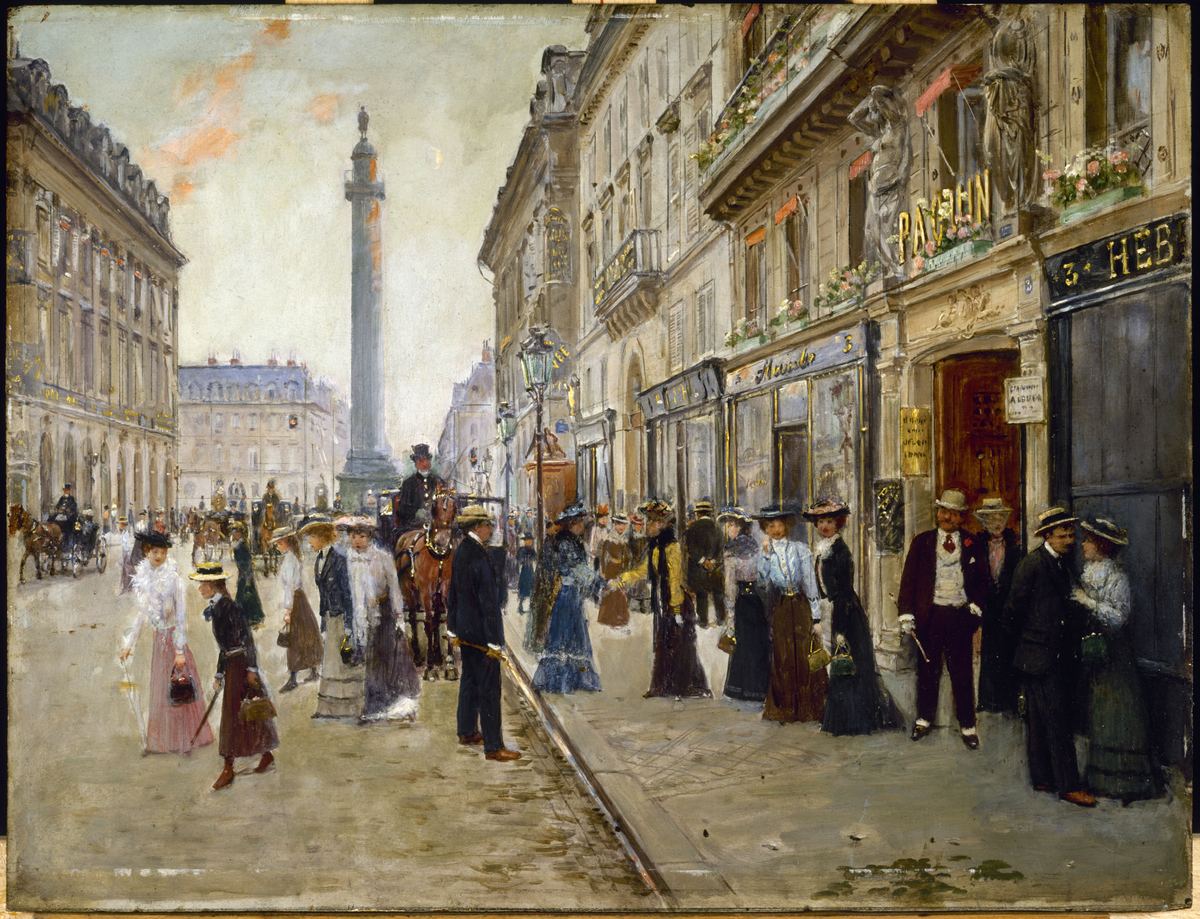
Flou and tailleur are the two workrooms of a Paris couture house. The tailleur workroom builds jackets, coats and trousers whose shape is fixed by precise cutting, canvas, hand stitching and the iron. The flou workroom makes dresses and blouses in light fabrics that are draped, gathered and finished so the cloth keeps its movement.
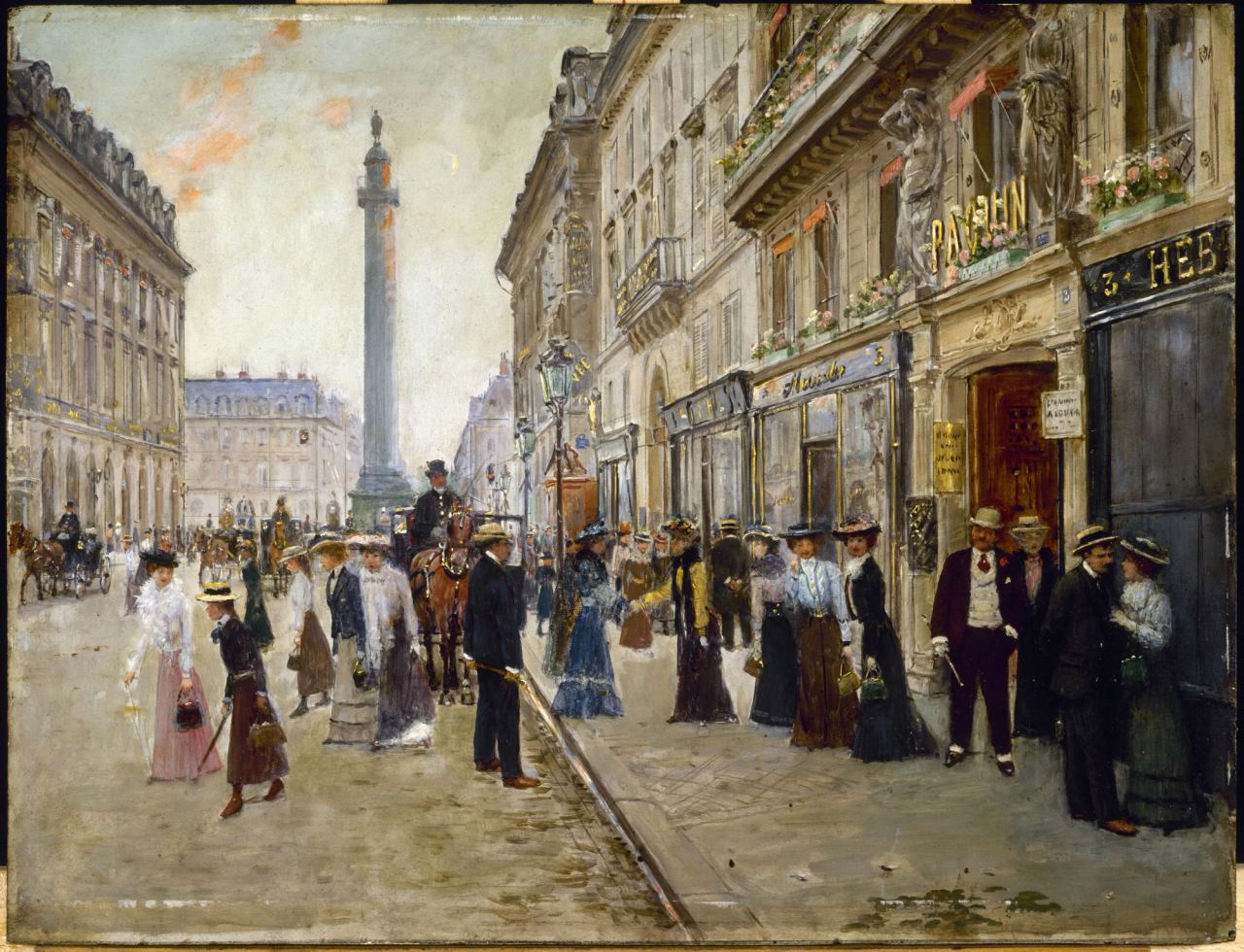
The words come up whenever a couture house opens its doors, and this winter they come up in a museum. From 12 December 2026 to 17 October 2027 the Palais Galliera in Paris shows En volume ! Donner corps à la mode (in English, Crafting Volume! Embodying Fashion), built around three techniques: tailleur, flou and maille. The museum promises patterns, toiles and prototypes, and some garments laid flat or opened to show how they were built. This guide explains the split before you go.
What do flou and tailleur mean?
Tailleur is French for tailor, a word derived from tailler, to cut. Flou means blurred or hazy; the French dictionary Trésor de la langue française records a dressmaking sense, "vaporeux," and a noun for supple, airy women's garments that are not fitted to the body, as in travailler dans le flou. In a couture house each word names a workroom, an atelier, and the skills practiced in it. The French Ministry of Culture's 2025 inventory sheet on haute couture describes the two as complementary specialties into which every model is divided.
According to that sheet, the flou atelier makes supple, fluid garments, mainly dresses, blouses and airy pieces, in light fabrics such as chiffon (mousseline), organza, crepe and silk satin. Cuts are often less structured, playing on drapery, layering and transparency, and seams are fine and discreet. The tailleur atelier makes structured garments, jackets, coats, trousers and some corsets, where the cut is fixed exactly from the start to sculpt the garment on the body, and the tailor holds many fittings to balance shoulders, waist and the fall of the lapels.
The sheet sums up the difference with a workroom saying: in flou "le tissu nous oblige," the fabric dictates to us; in tailleur "on oblige le tissu," we make the fabric obey. The Galliera's English text translates the three pillars as tailoring, draping and knitwear.
Who works in each workroom?
Each workroom is run by a première d'atelier, a head of workroom. The inventory sheet lists her team: seconds who assist her, premières mains who make the garments, pattern makers (modélistes), toilistes who turn patterns into trial toiles, specialist sewers, and in some houses separate cutters. The titles première d'atelier and première main are used only in the feminine, the sheet notes, although the trade is mixed.
The Federation of Haute Couture and Fashion (FHCM) publishes interviews that show how distinct the posts are. Josette Peltier, interviewed as première of the Chanel tailleur atelier in January 2024, came there in 2008 after 20 years in the flou department at Yves Saint Laurent. Colette Maciet recalls that when Karl Lagerfeld took over at Chanel in 1983, one person was appointed to the tailleur department and she "was called to take over the Flou." Workrooms are often known by their head: an FHCM profile of Gaëlle Duval, a seconde d'atelier at Dior, says she joined "Madame Jacqueline's Flou atelier" in 2015, and that this atelier made 12 of the 59 models in the Spring-Summer 2024 collection.
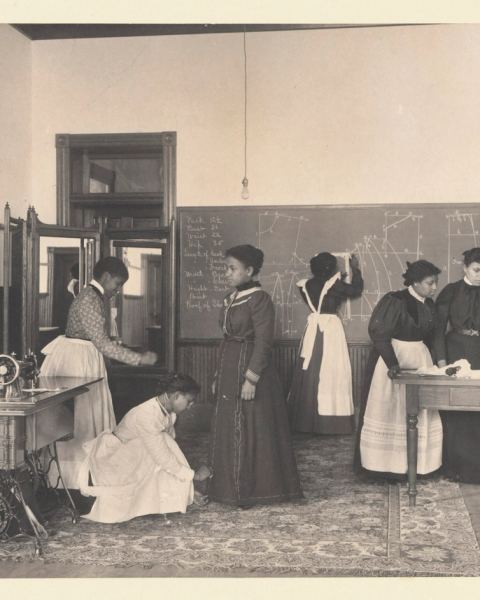
The work moves through the same stages in both rooms. The première d'atelier receives the designer's sketches. Pattern makers and toilistes produce a toile, and under France's 2025 diploma rules for the première main, she builds the model "en s'appuyant sur un patron en toile," from a pattern in toile supplied by the pattern maker or toiliste. The garment is basted, tried on and corrected, repeatedly if needed. For a client's order, the inventory sheet says the garment must have at least one or two fittings on the client or on a dress form made to her measurements.
How does the tailleur workroom shape a jacket?
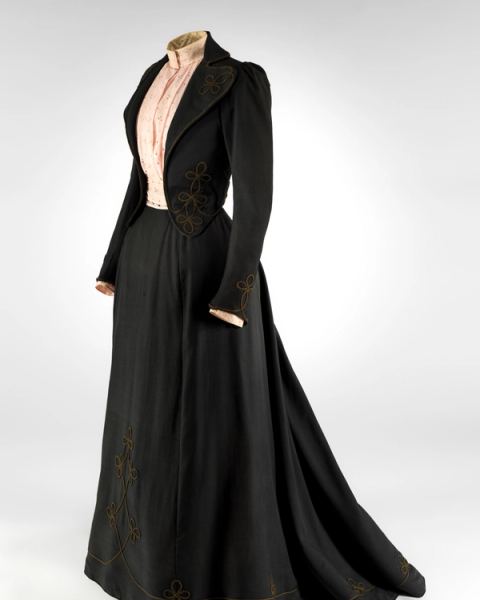
A tailored jacket holds its shape because a hidden layer of stiffer cloth, the canvas, is shaped and stitched to the outer fabric. The tailleur workroom fixes that shape with many small hand stitches, tape along edges that must not stretch, built-up shoulders and pressing.
The inventory sheet lists the tailleur's special gestures. Picotage tailleur, done in a herringbone stitch, is what English tailors call pad stitching. Straight-grain tape is sewn along the roll of the lapels so they do not stretch. The workroom makes its own shoulder pads and the small rolls called bananes and cigarettes, and hand-sews the structures that create the shape. The 2025 diploma glossary defines picotage as stitches that shape the interfacing and the cloth together, for example to make a collar or a lapel roll, and a cigarette as a piece added after the sleeve is set to fill out the sleeve head and give it a natural curve.
Home sewers learned the same moves from print. Butterick's The New Dressmaker (1921) tells readers to cut a collar interlining of tailors' canvas and to hold canvas and cloth together with "padding stitches," about half an inch long on the canvas side and barely caught through on the right side, while rolling the lapel over the hand "in the direction in which it is to lie." Lapel creases and front edges are taped, and a collar that does not sit is "shaped by shrinking, stretching and pressing." The book also describes the tailors' cushion, a ham-shaped pad for pressing darts and curved seams.
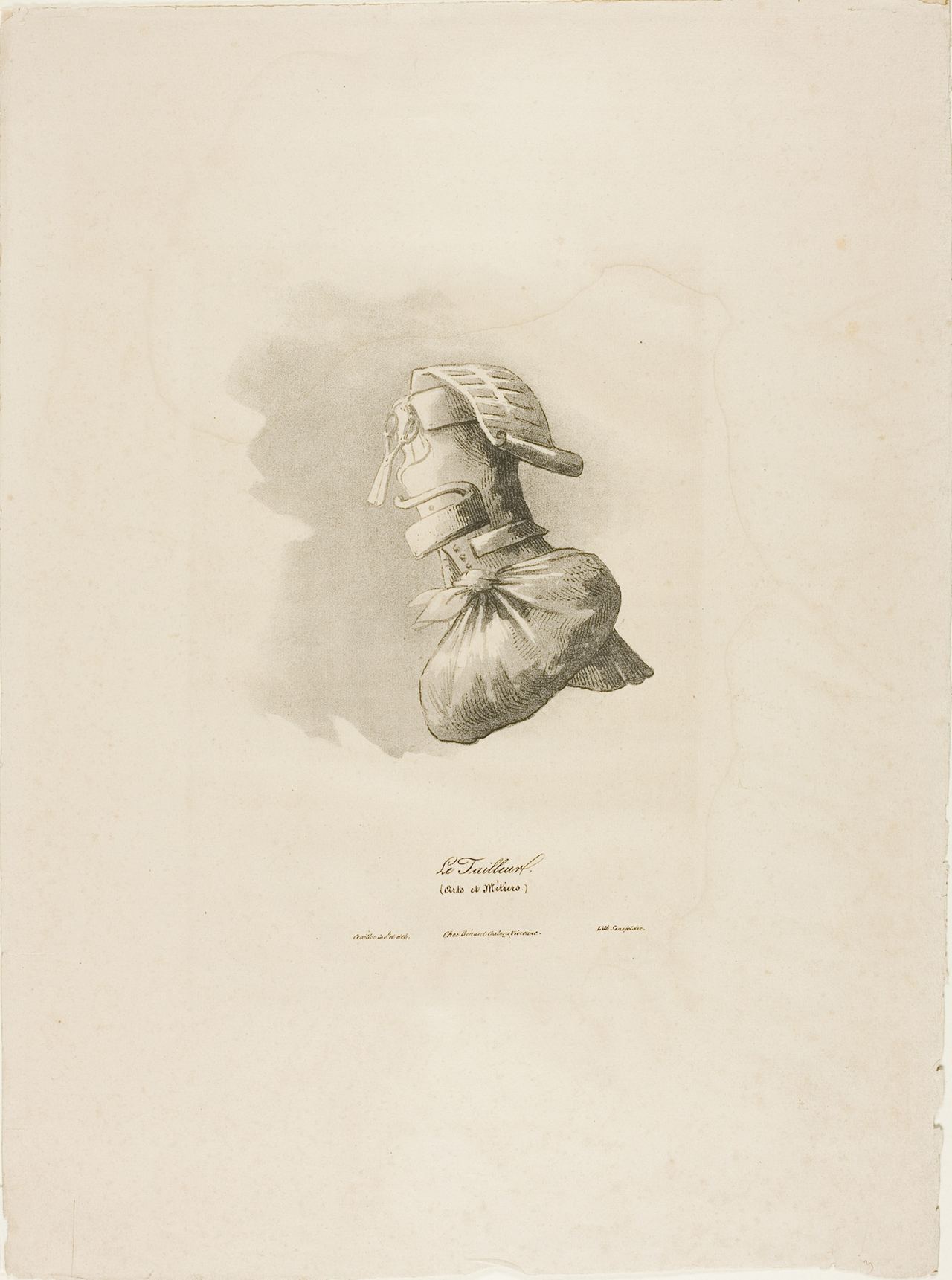
The tools follow the cloth. The diploma glossary says that in tailleur the scissors are much bigger and the irons heavier, and the inventory sheet adds that the tailleur thimble is open-ended and sturdier, for control over thick, structured fabric.
How does the flou workroom handle soft fabric?
The flou workroom works fabric that moves, so it shapes less by force than by placement: cloth is adapted on the dress form, gathered and joined with fine, discreet seams. The inventory sheet describes the aim as keeping the garment fluid without constraining it.
The inventory sheet's flou finishes include hand-rolled hems (roulotté), hand overcasting, lingerie buttonholes for light fabrics, rouleau loops (queue de rat, a fine tube of bias-cut cloth), embroidered thread bars and linings felled by hand. Gathers can be done by hand. Seams are opened "au fil," by thread rather than iron, to avoid marking the cloth, a rule the sheet applies to both workrooms. The flou thimble is closed, in silver or silicone, for precision on delicate materials.
Two terms from the diploma glossary describe how a flou model is found. Moulage is setting fabric directly on a dress form to create shapes in three dimensions and get a pattern, the method our guide to draping and drafting covers in detail. Travail au chic means starting from a basic pattern and adapting the material on the form to follow the sketch, notably for drapery. The glossary also warns that some fabrics se vident, lose their volume, above all when cut on the bias.
Gaëlle Duval of Dior put the difference in a sentence for the FHCM: "Muslin is volatile, it flies out of hand. Tailoring is much more docile." Butterick's 1921 manual gives the home version: use fine steel pins or needles on silks and chiffons, baste with silk thread because cotton leaves a mark, and stitch sheer fabrics over tissue paper torn away afterward.
The table below sets the two workrooms side by side.
| Tailleur | Flou | |
|---|---|---|
| Typical garments | Jackets, coats, trousers, some corsets | Dresses, blouses, light layered pieces |
| Typical fabrics | Thick, structured cloth | Chiffon, organza, crepe, silk satin |
| Inner structure | Canvas shaped with pad stitching; tape on lapel rolls; shoulder pads and sleeve-head rolls made and sewn by hand | No canvas in the flou list; supports added for shape are machine-stitched; grosgrain waist stays on organza |
| Shaping | Exact cut from the start, then stitching, shrinking and pressing | Fabric set and adapted on the dress form; gathers by hand |
| Pressing | Heavier irons; damp press cloth | Damp press cloth; seams opened by thread to avoid iron marks |
| Tools | Bigger scissors, open thimble | Closed silver or silicone thimble |
| Finishes | Hand-worked tailor's buttonholes, hand-felled linings, made pockets | Hand-rolled hems, lingerie buttonholes, rouleau loops, embroidered thread bars |
| Fitting | Basted fittings, many of them, for shoulders, waist and lapels | Basted fittings, repeated as needed |
Why are there two workrooms?
The split goes back to two old Paris trades. For centuries the guild of master tailors had the right to make clothes for both sexes. Seamstresses, the couturières, won their own guild only by royal letters patent of 30 March 1675, and even then the tailors kept part of women's dress.
René de Lespinasse's edition of the Paris trade statutes (1897) prints the 1675 text. Article 1 lets the mistresses make women's and girls' gowns, skirts, mantles and all other garments for women, except the corps de robes et bas de robes, the bodices and trains of formal robes. Article 2 forbids them to make men's clothes but allows children's clothes for both sexes up to age eight. Lespinasse adds that the letters patent judged it more fitting for women to be dressed by persons of their own sex. The Encyclopédie of Diderot and d'Alembert gives the same founding year in its entry "Couturiere": a woman authorized to make garments as a member of "une communauté établie en 1675." Clare Haru Crowston's study Fabricating Women (2001) treats the guild as a challenge to the all-male tailors' monopoly.
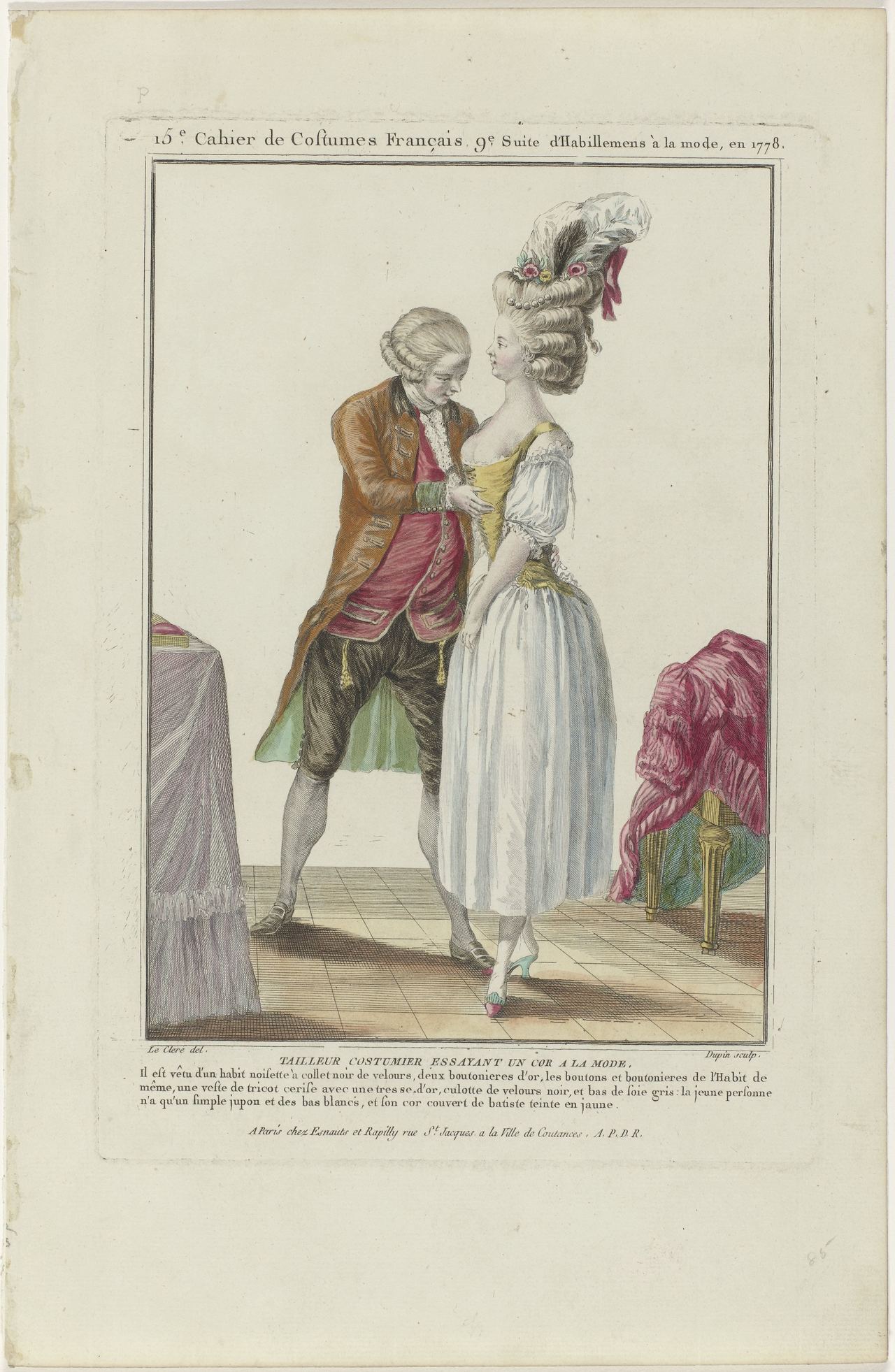
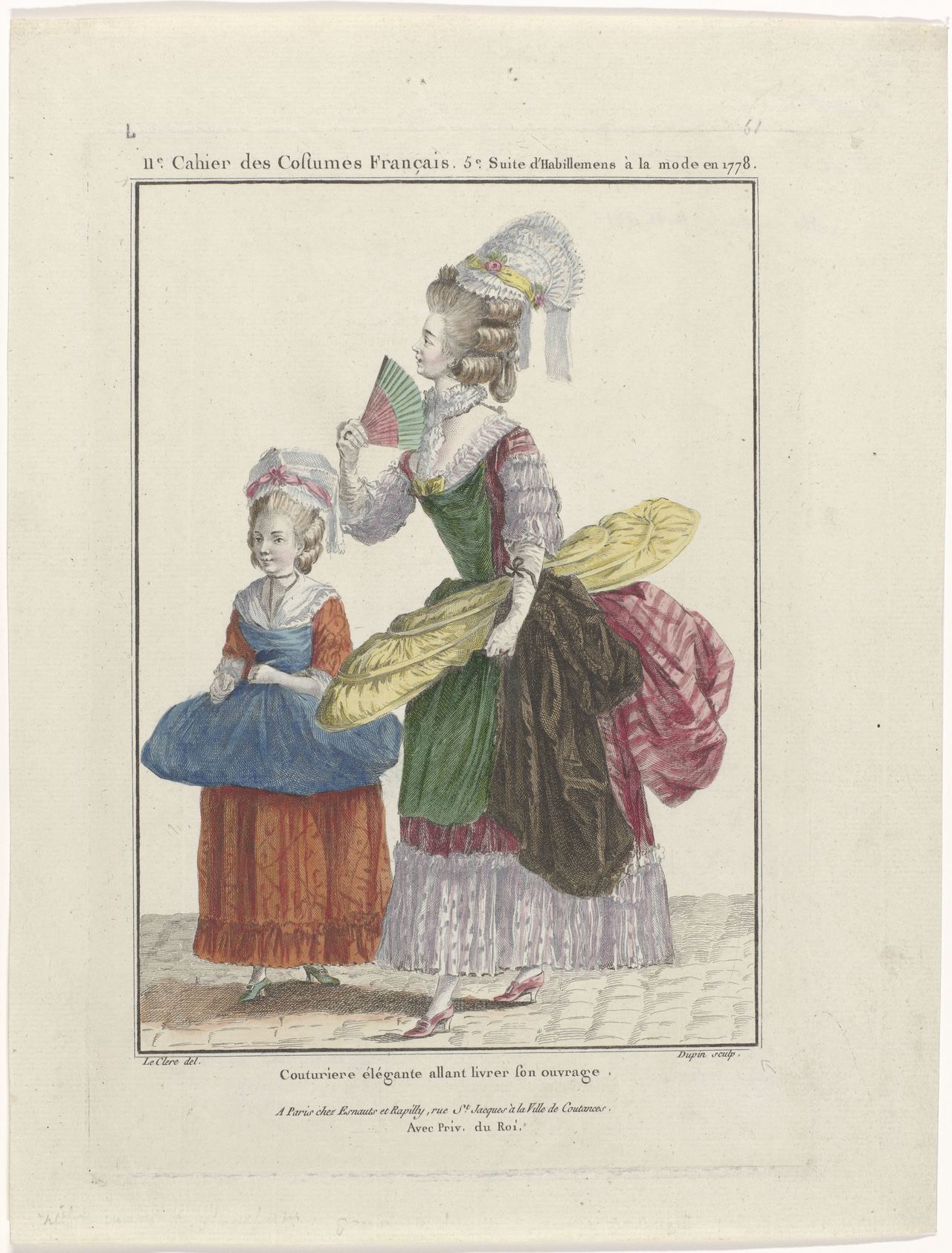
The two trades met again in the couture house. The trade body founded in Paris in 1868 was called the Chambre syndicale de la couture, des confectionneurs et des tailleurs pour dames, naming tailors for women beside the couturiers; it became the Chambre syndicale de la couture parisienne in 1911, according to both the inventory sheet and the historian Claire Wilcox. Wilcox writes that in the mansions the houses took over, the flou and tailleur workshops sat on the top floor to use the daylight, "as is still the practice today." By the time Jeanne Paquin ran her house on the rue de la Paix, women's tailoring was a fashion in its own right, the story told in our history of the tailor-made.
How can you tell which workroom made a garment?
A rough test is to ask what holds the shape. If a garment keeps its form on a hanger, with a rolled lapel, firm front and built shoulders, it was most likely made by tailleur methods. If the shape appears only when the fabric falls on a body, with gathers, drapery and hems that barely show, it points to flou. Garment type is a clue, not a rule.
Inside a tailored jacket you may feel canvas through the front and a lapel that rolls by itself, and find the sleeve lining felled by hand at the armhole. A flou dress shows hems rolled to a thread, fine overcast or French seams in sheer fabric, and loops made of bias tubing. The diploma glossary defines the couture anglaise, the French seam, as a two-step seam for fine, transparent fabric.
The boundary moves. The FHCM's January 2024 visit to Chanel's tailleur atelier found a 12-meter organza petticoat on the table and muslin sleeves coming out of a tailored jacket. Some established houses run several couture ateliers divided between flou and tailleur, the inventory sheet notes, and the 2025 diploma says a première main specializes in flou or tailleur depending on the size, history and culture of the house. If the method matters to you, look for a museum record that describes the construction, and use our guide to dating a garment from its construction for the general approach.
What does maille add?
Maille, French for the loop of a knitted fabric, is the Galliera's third technique and the one that changes the logic. A woven fabric has to be cut and then shaped with darts, canvas or drapery. A knitted fabric is built from interlocking loops and can be shaped while it is being made.
The Victoria and Albert Museum describes a silk cardigan of 1915–20 in its collection (T.51-1960) in which each section is "fully fashioned, knitted to shape on the machine." Merriam-Webster defines full-fashioned as made by a knitting process "for shaping to conform to body lines." In that sense maille sits apart from the other two: the shape can come from the knitting itself rather than from cutting, canvas or drapery.
The Galliera's own examples hint at the range: a structured 19th-century man's frock coat, the draping of Madame Grès and a supple, functional knitwear ensemble by Sonia Rykiel. Look for the patterns, toiles and opened garments too. A jacket shown open or inside out can show its canvas and hand stitching at a glance.
Further reading and where to look
- Ministry of Culture, La haute couture, intangible heritage inventory sheet (2025), the most detailed public description of both workrooms.
- Palais Galliera exhibition page, with dates, hours and tickets.
- Butterick, The New Dressmaker (1921), on archive.org, for tailoring and soft-fabric techniques taught to home sewers.
- R. de Lespinasse, Les métiers et corporations de la ville de Paris, vol. 3, with the 1675 statutes of the couturières.
Sources
- La haute couture, fiche d'inventaire du patrimoine culturel immatériel en France (no. 2025_67717_INV_PCI_FRANCE_00557). Ministry of Culture (France). PDF read in full (pdftotext). Used: flou and tailleur as two complementary specialties; flou garments and fabrics (mousseline, organza, crêpe, satin de soie), drapery, layering, fine seams; tailleur garments (vestes, manteaux, pantalons, certains corsets), exact cut from the start, many fittings for shoulders, waist and lapels; saying 'le tissu nous oblige' / 'on oblige le tissu'; atelier roles (Première d'atelier, Seconds, Premières Mains, Modélistes, Toilistes, Coupeurs); feminine-only titles; gesture lists for flou and tailleur (picotage, droit-fil lacette, épaulettes/bananes/cigarettes, roulotté, boutonnière lingère, queue de rat, bride brodée, coutures ouvertes au fil); thimbles (closed silver/silicone in flou, open in tailleur); at least one or two fittings for client orders; several ateliers by flou and tailleur in some houses; 1868 Chambre syndicale name and 1911 rename; Worth & Bobergh 1858. Sheet dated 22/10/25, included 2025. Accessed November 24, 2026.
- Arrêté du 29 août 2025 portant création de la spécialité « Première Main Haute Couture » de certificat de spécialisation (annexes). Journal officiel de la République française, 1 October 2025. Full PDF read (eduscol copy of the JO text). Used: Première Main works from a 'patron en toile' supplied by modéliste/toiliste under a Première d'Atelier; may specialize in flou or tailleur depending on size, history and culture of the house; lexicon: tailleur scissors much bigger and irons heavier, thimbles; definitions of picotage, cigarette, moulage, travail au chic, vidage (bias), couture anglaise, pattemouille. Accessed November 24, 2026.
- Crafting Volume! Embodying Fashion / En volume ! Donner corps à la mode (exhibition pages, English and French). Palais Galliera, musée de la Mode de Paris. Both language pages read in full. Used: dates 12.12.2026–17.10.2027; tailleur (tailoring), flou (draping), maille (knitwear); patterns, toiles, prototypes; pieces displayed flat or opened; frock coat, Madame Grès draping, Sonia Rykiel knitwear ensemble. Accessed November 24, 2026.
- In 3D! The fashion exhibition that explores technical craftsmanship at the Palais Galliera. Sortiraparis. Listing read: dates December 12, 2026 to October 17, 2027 (second source for the dates). Accessed November 24, 2026.
- In the Eyes of Josette Peltier – Première Atelier Tailleur for the Maison Chanel (23 January 2024). Fédération de la Haute Couture et de la Mode. Article read in full. Used: joined Chanel in May 2008 after 20 years in the Flou department at Yves Saint Laurent; organza petticoat of 12 metres and muslin sleeves from a tailored jacket in the tailleur atelier. Accessed November 24, 2026.
- In the Eyes of Gaelle Duval – Seconde d'Atelier Dior (22 January 2024). Fédération de la Haute Couture et de la Mode. Article read in full. Used: joined Madame Jacqueline's Flou atelier in 2015; 12 of 59 models for Spring-Summer 2024 made there; quote 'Muslin is volatile, it flies out of hand. Tailoring is much more docile.' Accessed November 24, 2026.
- Colette Maciet, an exceptional path in the wings of Haute Couture (26 June 2024). Fédération de la Haute Couture et de la Mode. Article read in full. Used: in 1983 at Chanel 'Mr Paquito Sala was appointed to the Tailleur department and I was called to take over the Flou.' Accessed November 24, 2026.
- Claire Wilcox, 'The Origins and Development of Haute Couture, 1858 to Now', in The Global History of Fashion, vol. 2 (2023), pp. 1292–1333. Cambridge University Press (author's accepted version, UAL Research Online). Author's PDF read. Used: flou (dressmaking) and tailleur (tailoring) workshops on the top floor for natural light 'as is still the practice today'; 1868 Chambre Syndicale de la Couture, des Confectionneurs et des Tailleurs pour Dame, renamed Chambre Syndicale de la Couture Parisienne in 1911; Worth 1858. Accessed November 24, 2026.
- René de Lespinasse, Les métiers et corporations de la ville de Paris, vol. 3 (Paris, 1897): Tailleurs d'habits; Couturières. Imprimerie nationale (archive.org scan, University of Toronto copy). Full OCR read for both titles. Used: couturières erected by letters patent of 30 March 1675, registered 7 September; article 1 (gowns, skirts, mantles etc. for women and girls except 'corps de robbes et bas de robbes'); article 2 (no men's clothes; children of both sexes to age eight); editor's summary that the letters patent judged it more fitting for women to be dressed by their own sex; tailors' long control of women's clothing. The editor's preface once misprints 1678; the statute text and title give 1675. Accessed November 24, 2026.
- Diderot and d'Alembert, Encyclopédie, 1st ed.: COUTURIERE. Wikisource (transcription of the Encyclopédie, vol. 4, p. 420). Entry read in full: 'femme autorisée à travailler différens vêtemens, en qualité de membre d'une communauté établie en 1675'; apprenticeship three years (second source for the 1675 date). Accessed November 24, 2026.
- Clare Haru Crowston, Fabricating Women: The Seamstresses of Old Regime France, 1675–1791 (2001). Duke University Press. Publisher's description read (book itself not opened). Used only for the framing: the seamstresses' guild challenged the all-male tailors' guild's monopoly in the 17th century. Accessed November 24, 2026.
- The New Dressmaker (New York, 1921). Butterick Publishing Company (archive.org, Library of Congress copy). Full OCR read. Used: tailors' canvas collar interlining; 'padding stitches' about half an inch long, rolled 'in the direction in which it is to lie'; taping lapel crease and edges; collar 'shaped by shrinking, stretching and pressing'; ham-shaped tailors' cushion for darts and curved seams; fine steel pins for silks and chiffons, silk basting thread, tissue paper under sheer fabrics. Accessed November 24, 2026.
- Trésor de la langue française informatisé: flou; tailleur; maille. CNRTL / ATILF. Entries read online. Used: flou, couture sense 'vaporeux' and noun sense for supple, airy women's garments not fitted to the body ('travailler dans le flou'); tailleur derived from tailler; maille as each loop of a textile thread interlocking to form a supple fabric. Accessed November 24, 2026.
- Cardigan, 1915–1920 (T.51-1960). Victoria and Albert Museum. Record read via api.vam.ac.uk: pink silk machine-knitted cardigan; 'each section of the garment is fully fashioned, knitted to shape on the machine.' Accessed November 24, 2026.
- Full-fashioned (adjective). Merriam-Webster. Entry read online: 'employing or produced by a knitting process for shaping to conform to body lines.' Accessed November 24, 2026.
- Jean Béraud, Sortie des ouvrières de la maison Paquin, vers 1900 (P1662). Paris Musées. Record read: Béraud (1849–1935), vers 1900, oil on wood, Musée Carnavalet P1662, CC0. Full image (4572×3500) downloaded; facade cropped and enlarged: gilded PAQUIN letters and house number 3. Accessed November 24, 2026.
- Tailleur costumier essayant un corps à la mode, Gallerie des Modes et Costumes Français, 1778 (RP-P-2009-1157). Rijksmuseum. Linked-art record read: Nicolas Dupin after Pierre Thomas Le Clerc, Esnauts & Rapilly, 1778, hand-colored; engraved caption on the tailor's dress and the young woman's 'cor' covered in yellow batiste; Public Domain Mark. Full image inspected. Accessed November 24, 2026.
- Couturiere élégante allant livrer son ouvrage, Gallerie des Modes et Costumes Français, 1778 (RP-P-2009-2102). Rijksmuseum. Linked-art record read: Dupin after Le Clerc, Esnauts & Rapilly, 1778; Public Domain Mark. Full image inspected; garments over the arm cropped and enlarged. Accessed November 24, 2026.
- Bernard Gaillot, The Tailor, from Arts et Métiers, 1838 (1940.1203). Art Institute of Chicago. Record read via the AIC API: lithograph printed by Alois Senefelder; is_public_domain true. Image inspected; head cropped and enlarged. Accessed November 24, 2026.
Glossary
- Flou
- Première d'atelier
- Pad stitching
- Tailor
- Haute couture
- Toile
- Atelier
- Interfacing
- Bias
- Chiffon
- Crêpe
- Knitting
Last updated · Markdown · Report an error