Care
Silk, Wool, Cotton or Linen? How to Identify a Fiber
How can you tell if fabric is silk, wool, cotton or polyester? Burn one yarn from a seam allowance and read the flame, the smell and the residue, then check the cues the burn test cannot give you.
To tell silk, wool, cotton and polyester apart, burn a single yarn: plant fibers flare and smell of paper, animal fibers curl away, smell of burning hair and leave a crumbly bead, and synthetics melt into a hard bead. Feel and crease give clues first; a microscope settles it.
How can you tell what a fabric is made of?
Textile fibers fall into three families: plant fibers made of cellulose (cotton, linen, and rayon, which is cellulose remade in a factory), animal fibers made of protein (wool and silk), and synthetics that melt (polyester, nylon, acrylic). A small burn test identifies the family. Identifying the fiber within the family takes magnification.
That is also how the experts frame it. The Canadian Conservation Institute (CCI) says a burn test indicates the fiber group, cellulose or protein, and that a good light microscope is needed for a definitive identification (CCI Note 13/11); neither test, its note on identification adds, is conclusive on its own (CCI Note 13/18). The textile conservators' wiki of the American Institute for Conservation puts it more bluntly: a burn test only tells you the category, protein, cellulosic or thermoplastic (AIC Wiki, Fiber Identification).
Knowing the family is still worth a lot. It tells you how to wash a thrift-shop find and whether it needs guarding in storage. Wool is damaged by soap and other weak alkalis and felts with heat, moisture and friction, while cotton and linen get stronger when wet (CCI Note 13/11). Wool, a keratin fiber, also attracts clothes moth and carpet beetle larvae, especially when soiled, which is why a wool cardigan needs the care described in our guide to clothes moths. On a modern piece, the label answers the question; our guide to yarn labels explains how to read one.
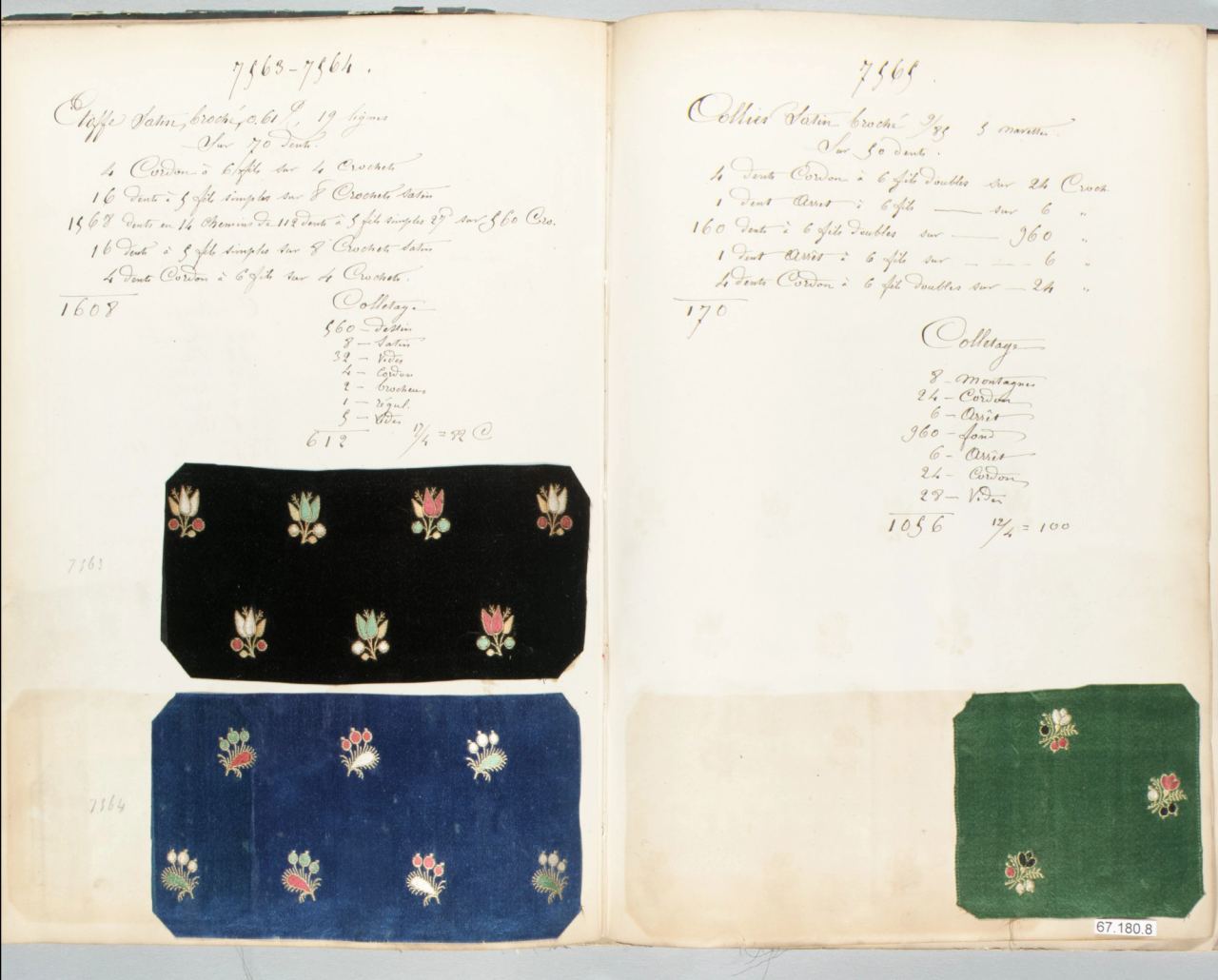
What can you learn without cutting anything?
Handle the cloth first. Crush a corner in your fist, hold it against your wrist, look at how it falls and how it shines. These cues narrow the field without damage. None of them is proof, because finishes, weaves and blends can mimic another fiber's hand.
- Crease. Linen has poor elasticity and creases readily; cotton tends to hold creases and folds. Wool springs back: CCI calls its elasticity very good (CCI Note 13/11). A 1970 consumer guide from the National Bureau of Standards rates woolens as resisting wrinkles, and rates cotton and linen only fair to poor on wrinkling (Blandford and Gurel, NBS, 1970).
- Temperature. CCI notes that silk does not conduct heat and feels warm to the touch. The textile chemist J. Merritt Matthews wrote in 1913 that linen always feels colder than cotton because flax conducts heat better (Matthews, 1913).
- Drape and sheen. The NBS guide credits silk and rayon with good drape. Shine is a weak clue: cotton that has been mercerized, treated with caustic soda under tension, gains luster, and Matthews grouped rayon with the "artificial silks", crediting viscose with a fine glossy appearance.
- Static. The NBS guide notes that acrylic has low absorbency and builds up static.
- A water drop. Cotton, linen, silk and rayon all absorb water well, while the NBS guide rates polyester's absorbency only fair to poor. But a water-repellent finish can make cotton bead water too, so test only an inside seam, and treat the result as a hint.
Old fabric adds its own traps. Matthews warned that once linen is bleached, the chemical tests of his day showed practically no difference from cotton; his answer was the microscope.
How do you do a burn test safely?
Take one short yarn, never a piece of the garment, from a hidden place such as a seam allowance or a hem. Hold it in tweezers, bring it slowly to a small flame over a sink or a ceramic dish, and watch, smell and feel the residue once it has cooled.
CCI's procedure asks for no more than about 4 mm (1/8 in) of yarn, clipped from an exposed end in good condition in an inconspicuous place. The AIC wiki asks for at least 1 cm. Use the smallest length you can see clearly, and pull warp and weft yarns separately, along with any stitching thread, since each can be a different fiber. CCI also advises working well away from combustibles, checking that the test will not set off a smoke alarm, and practicing first on fabrics whose fiber you already know.
| Step | What to do | Why |
|---|---|---|
| 1 | Pull one yarn from a seam allowance, hem or other hidden spot; take warp and weft separately | The test destroys the sample, and the two directions may differ |
| 2 | Set up over a sink or a ceramic dish, with a window open, tweezers, a candle or lighter, and no fabric nearby | Synthetics melt and drip, and the smoke needs somewhere to go |
| 3 | Bring the yarn slowly toward the flame without touching it | Protein fibers curl away; synthetics melt |
| 4 | Let it catch, then take it out of the flame | Cotton and linen keep burning with an afterglow; wool and silk tend to go out by themselves |
| 5 | Note the smell | Burning paper, burning hair, vinegar or hot plastic |
| 6 | Let the end cool, then press it between your fingers | Soft ash, a crumbly bead or a hard bead that will not crush |
| 7 | Repeat with a yarn of known fiber | The AIC wiki advises comparing with a known reference fiber |
How does each fiber burn, smell and look?
Cellulose burns fast and smells of paper, protein shrinks from the flame and smells of hair, and synthetics melt. The table gathers those reactions with the feel of the cloth and its look under a microscope.
| Fiber | Near and in the flame | Smell | Residue | Hand and crease | Under a microscope |
|---|---|---|---|---|---|
| Cotton | Ignites on contact, keeps burning, afterglow | Burning paper | Small, fluffy, white to gray ash; Matthews: burned end tufted | Holds creases and folds | Flat ribbon with twists at intervals, wide central canal |
| Linen (flax) | As cotton | Burning paper | As cotton; Matthews: burned end rounded | Creases readily; feels cool | Nodes like a bamboo cane, narrow canal, often in bundles |
| Rayon (viscose) | Ignites readily, keeps burning | Burning paper | Burns like other cellulose; scorches but does not melt under a hot iron | Drapes well; weak when wet | Even rods with fine lengthwise lines, no twist |
| Wool | Curls away, burns slowly, tends to go out | Burning hair | Small dark bead that crushes easily | Springs back from creasing | Overlapping scales; coarse wool shows a dark core |
| Silk | Curls away, burns slowly, tends to go out | Burning hair | Small dark bead that crushes easily | Drapes well; feels warm | Smooth, even, transparent filament |
| Weighted silk | Smolders rather than flaming | Burning hair | Fine ash that keeps the shape of the yarn or weave | May be crisp, but not always | As silk |
| Acetate | Ignites readily, melts | Vinegar | Melted, hardened end | Silk-like look | Not reliable for identification |
| Polyester, nylon, acrylic | Melts and drips; acrylic burns readily | Chemical, plastic-like | Hard bead | Polyester resists wrinkling | Not reliable for identification |
The table draws on CCI Note 13/18, the AIC wiki, the NBS guide, Matthews and ASTM D276, all cited in this article. The burn test does not reliably separate wool from silk, or cotton from linen from rayon: CCI gives the same reactions within each family, and smell words beyond "paper" and "hair" are, in the AIC wiki's view, too subjective to be useful.
Why can a burn test be wrong?
A burn test reads the yarn you burned, not the garment. Blends give mixed results, finishes change how cloth burns, and nineteenth-century silks were often loaded with metal salts that make them smolder like nothing else. Treat every result as one piece of evidence.
Blends. Matthews noted in 1913 that when animal and plant fibers are mixed in one yarn, the smell of burning feathers announces the wool or silk but hides the plant fiber. The AIC wiki goes further: a yarn of more than one fiber will not give useful results, unless the plies can be separated and burned one by one. The NBS guide adds that polyester in blends with cellulose burns readily.
Finishes and dyes. Flame-retardant and wrinkle-resistant treatments can change burn results, according to the AIC wiki. The NBS guide lists the resin finishes used on easy-care cotton, plus water-repellent and fire-retardant ones.
Weighted silk. Boiling off the natural gum, sericin, leaves silk lighter; makers restored that weight, and often far more, with metallic salts. Matthews wrote that black silks could be weighted to 400 percent or more, and that a heavily weighted silk will not flame but smolders away, leaving an ash that keeps the form of the fiber. CCI says the same today: only weighted silk leaves a fine ash in the shape of the yarn or fabric. That ash is a warning. Matthews reported that black silk weighted to 140 percent had less than one sixth the strength of raw silk. A 1989 study of 54 historic silks found that tin weighting above 3 percent appeared particularly damaging, and that fabrics from 1890 to 1939 may be more fragile than much older silks (Miller and Reagan, JAIC, 1989). The same study found that not every weighted silk is crisp or stiff, so the hand alone will not tell you. Weighting often ends in what conservators call shattered silk: a 1995 study of the First Ladies' gowns illustrates it with the brittle, tin-weighted lining of Edith Roosevelt's 1905 dress (Becker, Willman and Tuross, JAIC, 1995).
Is it rayon or cotton?
Rayon is cellulose dissolved and spun again, so in a flame it behaves like cotton: it burns readily and smells of paper. To separate the two, wet a yarn and pull it, look at it under magnification, or read the label. The burn test alone cannot do it.
The NBS guide calls rayon the first man-made fiber, made from cellulose that is chemically converted and then regenerated. Matthews, writing in 1913, filed it among the "artificial silks" and described viscose as glossy and weakened when wet. The NBS guide lists wet strength among regular rayon's weaknesses, while CCI says cotton is stronger wet than dry. So a damp yarn of regular rayon is likely to break more easily than a damp cotton one. The cue fails with the newer rayons that, according to the NBS guide, were developed for greater strength, particularly when wet.
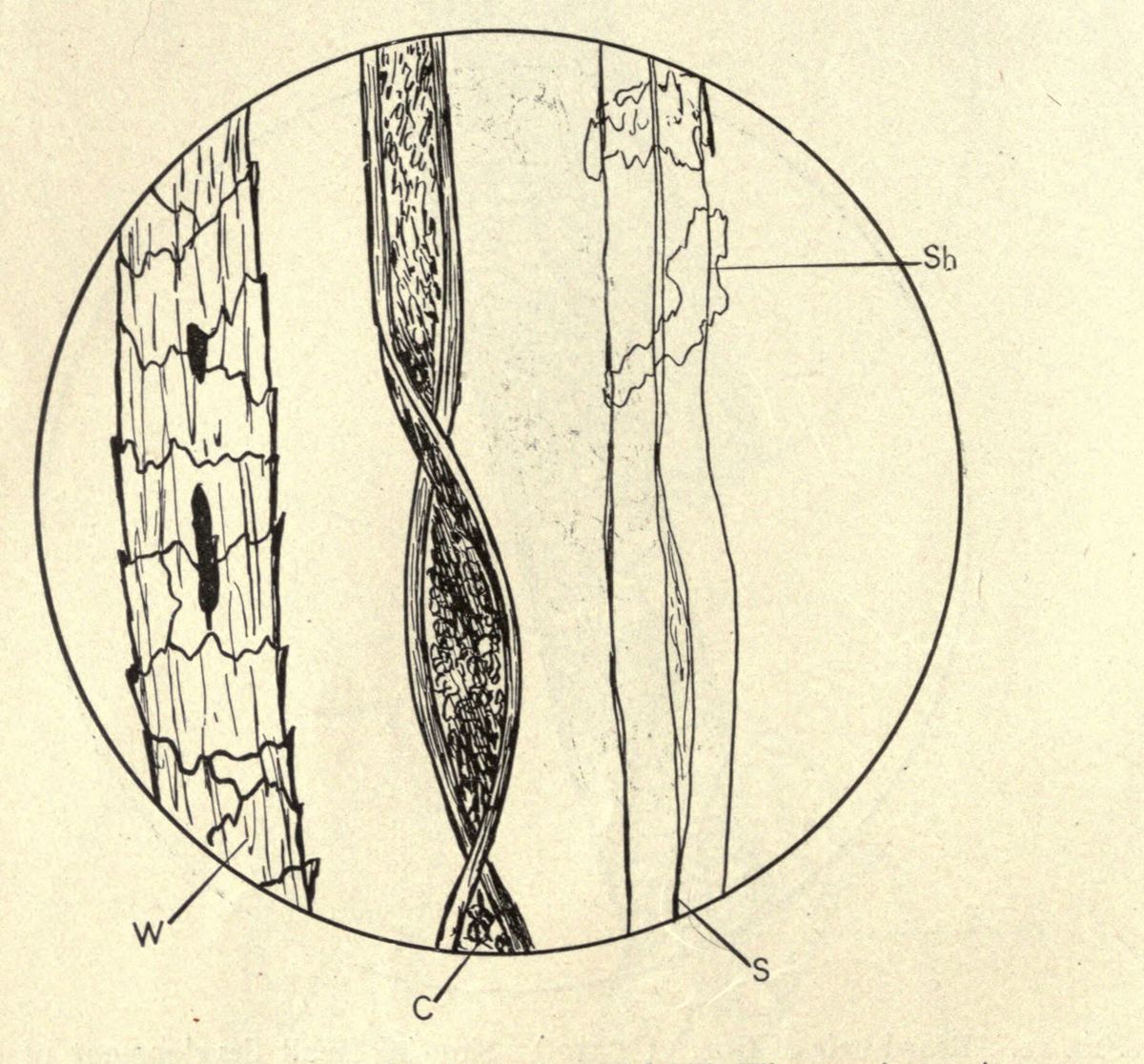
Under the microscope the difference is plain. Cotton is a flattened ribbon with regular twists, which Matthews and CCI both describe, and which the micrograph at the top of this article shows beside wool and silk. Matthews' 1913 drawing of viscose shows straight, even rods with fine lengthwise lines and no twist at all. One caution from CCI: mercerized cotton has fewer twists. Acetate is a relative of rayon with a different chemistry. The NBS guide records that it was called acetate rayon until a 1952 Federal Trade Commission ruling separated the two, and unlike rayon it melts, with the sharp smell of vinegar.
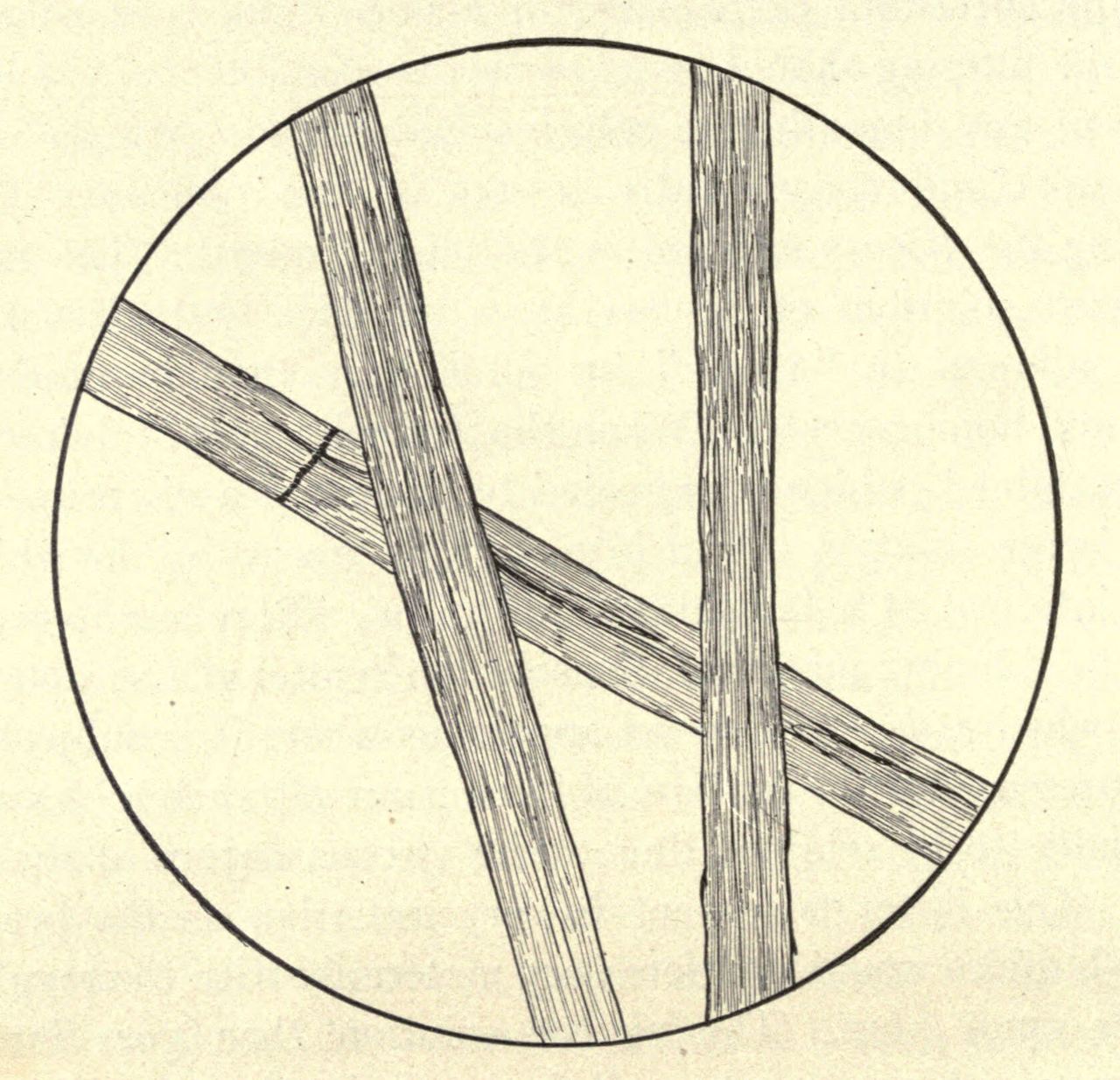
What does each fiber look like under magnification?
At a few hundred times magnification each natural fiber has a signature: cotton twists like a ribbon, flax shows joints like bamboo, wool is covered in overlapping scales, and silk is a smooth rod. These details need a microscope; a pocket loupe shows the structure of the yarn instead.
The drawings in this article come from Matthews' microscope work at 300 to 500 times, far beyond a pocket magnifier. CCI's descriptions match them closely: cotton is ribbon-like with twists called convolutions and a central canal more than half its width; flax has nodes in the shape of an I, V or X and a narrow canal; wool's surface is rough with overlapping scales; cultivated silk is a smooth cylinder, with occasional swellings. Wild silk is flatter and striped, with cross-markings that can look like flax.
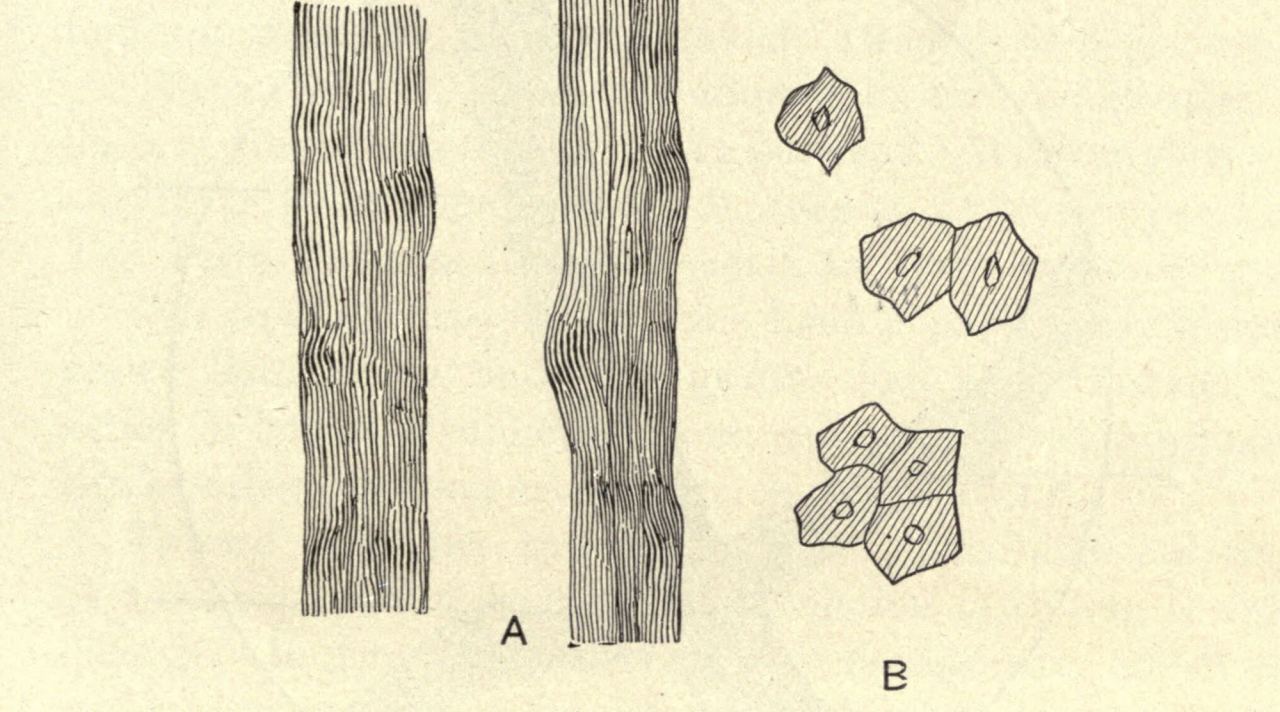
With a 10x loupe you can still learn something. Untwist a yarn. Cotton fibers are short, about 1 to 6 cm, and wool about 4 to 15 cm, while silk is a continuous filament that can run over 2 km, by CCI's figures. Short fibers that pull apart mean a spun yarn; strands running the full length of the yarn mean silk or a man-made filament. Man-made fibers come both ways: the NBS guide notes acetate is made as filament and as spun yarn. Synthetics are the hard case. ASTM D276, ASTM International's standard method for identifying textile fibers until it was withdrawn in 2021, says microscopy is generally not suitable for positive identification of most man-made fibers (ASTM D276).
When should you ask a conservator, and what do museums use?
Stop and ask a textile conservator before you snip anything from a piece that is old, fragile, valuable or not yours. Museums identify fibers with polarized light microscopy, infrared spectroscopy and solubility tests, which work on smaller samples than a burn test and can tell one synthetic from another.
Even in museums, sampling needs a reason. The AIC wiki reminds conservators that fiber identification is destructive, and CCI tells its readers to obtain curatorial permission before testing any artifact. Most textile conservators, the wiki says, use polarized light microscopy as their primary tool, confirming results with solubility or burn tests. CCI lists fiber analysis among its services and says its staff use polarizing microscopes. ASTM D276 called microscopy indispensable for telling one plant or animal fiber from another, because infrared spectra cannot, and named infrared and solubility tests as the preferred route for man-made fibers.
A recent case shows how it works. Conservators at Cooper Hewitt examined textile samples by the weaver Dorothy Liebes with polarized light microscopy and FTIR, an infrared method. They found wool by its scales and core, an acrylic, probably DuPont's Orlon, and nylons they believe to be versions of DuPont's Antron (Eng-Wilmot and Lee, Cooper Hewitt, 2023). For weighted silk, the 1989 study used neutron activation analysis to measure the metals present, tin among them.
In the United States, the American Institute for Conservation lists peer-reviewed Professional Members by specialty, including textiles, in its Find a Conservator directory. Once you know the fiber, store the piece accordingly: our guide to storing a quilt or vintage garment explains how, and why so few old clothes survive shows what is at stake.
Further reading
- Canadian Conservation Institute, The Identification of Natural Fibres (CCI Note 13/18) and Natural Fibres (CCI Note 13/11).
- American Institute for Conservation, Textile Specialty Group, Fiber Identification.
- J. Merritt Matthews, The Textile Fibres, 3rd edition, 1913, free on the Internet Archive.
- The Metropolitan Museum of Art, Textile Sample Book, 1868.
Sources
- The Identification of Natural Fibres (CCI Notes 13/18). Canadian Conservation Institute. Primary guidance, read in full: burn test procedure (about 4 mm of yarn from an exposed end, tweezers, unscented candle, away from combustibles, smoke detectors, practice on expendable textiles, curatorial permission); cellulose vs protein reactions and ash; weighted silk ash; microscopy of cotton, flax, wool and cultivated and wild silk; blends complicate results; neither test conclusive alone; sample warp, weft and stitching threads. Accessed November 13, 2026.
- Natural Fibres (CCI Notes 13/11). Canadian Conservation Institute. Read in full: cellulose vs protein families; cotton and flax stronger wet, flax creases, cotton holds creases; silk does not conduct heat and feels warm, very good elasticity for wool; wool damaged by weak alkalis, felts with heat, moisture and friction, attracts clothes moth and carpet beetle larvae; fiber lengths (cotton 1 to 6 cm, wool 4 to 15 cm, silk over 2 km); sericin 10 to 20 percent; weighted silk and metallic salts; burn test gives the group, microscope needed for definitive identification. Accessed November 13, 2026.
- TSG Chapter V, Section C: Fiber Identification. American Institute for Conservation, Textile Specialty Group. Read in full: fiber identification is destructive; polarized light microscopy is the primary tool, confirmed by solubility or burn tests; burn tests need at least 1 cm and differentiate only by category (protein, cellulosic, thermoplastic); mixed-fiber yarns give no useful result unless plies are separated; flammability and wrinkle-resistance finishes may affect results; odor categories (burning hair, burning paper, acrid vinegar, plastic-like) and bead description; compare with a known reference fiber. Accessed November 13, 2026.
- Fibers and Fabrics: A Consumer's Guide. National Bureau of Standards, Consumer Information Series 1, 1970 (Blandford and Gurel). Primary period document, fiber pages read in full (PDF): property ratings for cotton, linen, silk, wool, acetate, acrylic, nylon, polyester and rayon (wrinkling, absorbency, drapability, wet strength); ignition behavior for each; acrylic static build-up; polyester burns readily in blends with cellulosics; rayon as the first man-made fiber, viscose and cuprammonium, newer rayons stronger when wet, scorches but does not melt; acetate called acetate-rayon until a 1952 FTC ruling; silk weighting labeling rules. Accessed November 13, 2026.
- The Textile Fibres: Their Physical, Microscopical and Chemical Properties. J. Merritt Matthews, The Textile Fibres, 3rd ed. (New York: John Wiley & Sons, 1913). Primary source, full text read on archive.org: burn test distinguishing animal from vegetable fibers (empyreumatic odor of burning feathers; vegetable fibers burn off sharply, animal fibers fuse to a bead); cotton tufted vs linen rounded burned end; mixed yarns hide the vegetable fiber; linen feels colder than cotton; bleached linen indistinguishable from cotton chemically; weighting of silk up to 400 percent, ignition test, strength loss; artificial silks including viscose; figs. 12, 78 and 85 used as illustrations. Accessed November 13, 2026.
- ASTM D276-12, Standard Test Methods for Identification of Fibers in Textiles (withdrawn 2021). ASTM International. Abstract and scope read on the ASTM store page (full standard paywalled): status withdrawn 2021 with no replacement; a generally reliable means of identifying generic fiber types; microscopical examination indispensable for cellulosic and animal fibers because infrared spectra and solubilities will not distinguish species; infrared and solubility preferred for man-made fibers, microscopy generally not suitable for positive identification of most of them. Accessed November 13, 2026.
- Degradation in Weighted and Unweighted Historic Silks (Miller and Reagan). Journal of the American Institute for Conservation 28(2), 1989. Conclusions read in full: 54 historic silks, 15 weighted; tin above 3 percent particularly detrimental with yarn tenacities of 0.0 to 1.06 gf/den; neutron activation analysis used for the metals; not all weighted silks crisp or stiff, so visual examination may be inadequate; silks from 1890 to 1939 may be more fragile than much older ones. Accessed November 13, 2026.
- The U.S. First Ladies Gowns: A Biochemical Study of Silk Preservation (Becker, Willman and Tuross). Journal of the American Institute for Conservation 34(2), 1995. Results section read in full: tin-weighted linings lost 34 to 69 percent of dry weight under denaturing conditions; weighting often results in shattered silk, illustrated by a scanning electron micrograph of the brittle tin-weighted lining of Edith Roosevelt's 1905 dress. Accessed November 13, 2026.
- Synthetic Material Identification in Dorothy Liebes Textile Samples (Eng-Wilmot and Lee). Cooper Hewitt, Smithsonian Design Museum, 7 July 2023. Read in full: polarized light microscopy (Olympus BX50) and FTIR-ATR (Nicolet iS5) used; wool identified by scale pattern and medulla; pink warp and weft acrylic, probably DuPont's Orlon; purple and orange wefts believed to be versions of DuPont's Antron nylon 6,6; only through magnification and analysis do the differences become clear. Accessed November 13, 2026.
- Find a Conservator (Find a Professional Member). American Institute for Conservation. Read in full: searchable directory of AIC Professional Members whose training and experience have been peer-reviewed, filterable by specialty including Textiles, by material and service, and by location. Accessed November 13, 2026.
- Textile Sample Book, 1868, 67.180.8. The Metropolitan Museum of Art. Object record read via the Met Collection API: isPublicDomain true, CC0; sample book, 1868, 32.4 x 22.9 cm, Gift of the Estate of Benjamin E. Marks, 1967. Medium field empty, so the caption claims no fiber. Accessed November 13, 2026.
- Conservation and scientific services for textiles. Canadian Conservation Institute. Read in full: fibre analysis and identification listed among CCI's analysis and testing services; caption states CCI staff use polarizing microscopes for fibre identification. Accessed November 13, 2026.
Glossary
Last updated · Markdown · Report an error