Textiles
Woven to Shape: What 'à la Disposition' Means
What does 'à la disposition' mean on a museum garment? The cloth was decorated before it was cut, each motif placed for its pattern piece. How waistcoat shapes, woven borders and flounced dress lengths worked, and how to spot one.
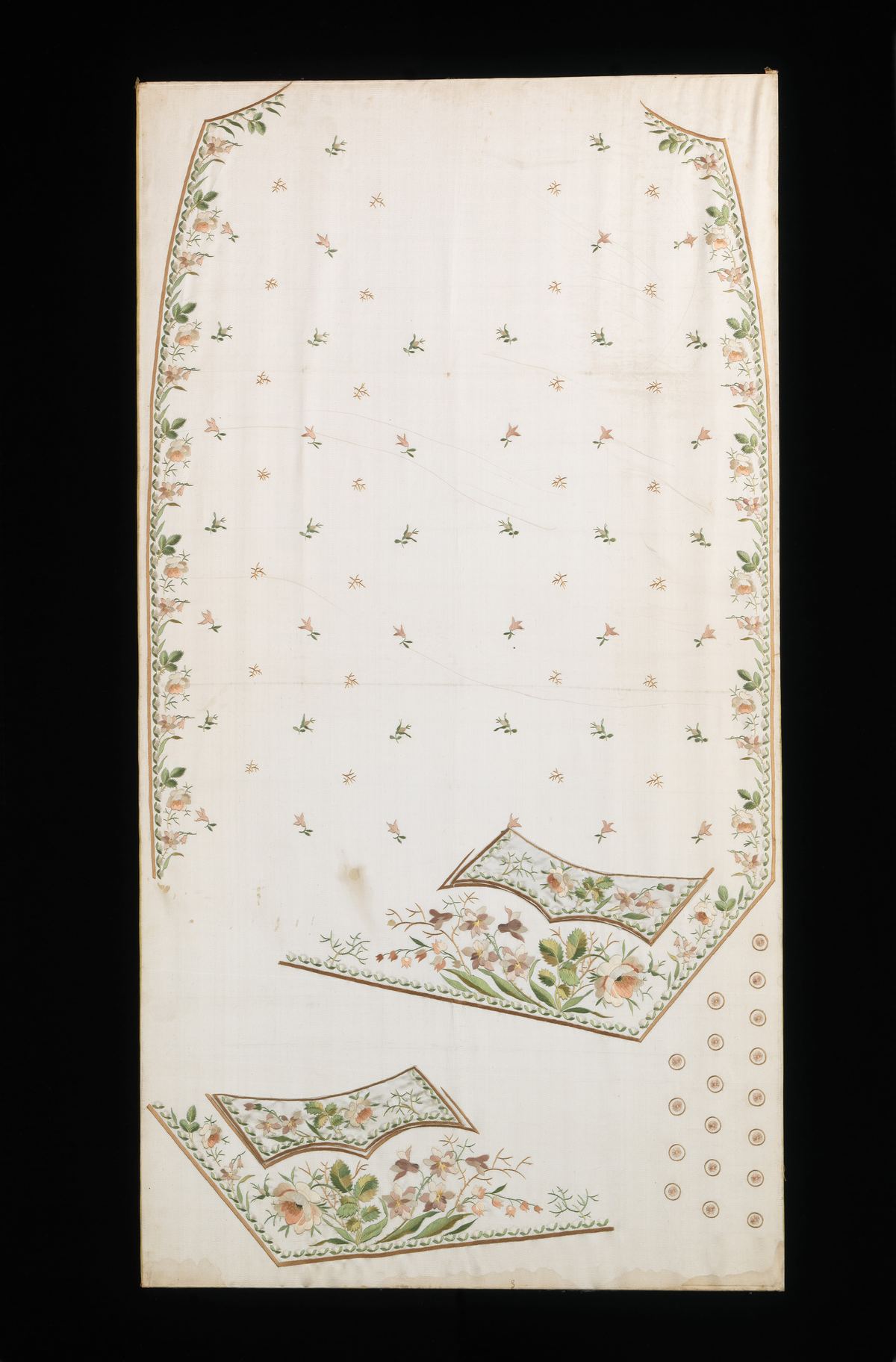
On a museum label, à la disposition (also written à disposition) means the cloth was woven, embroidered or printed with its decoration already arranged for the pieces of one particular garment, before anyone cut it. The border for the front edge, the motif for the pocket flap and the band for the hem were all placed on the flat length in advance.
What does "à la disposition" mean on a museum garment?
It means the decoration was planned around the pattern pieces rather than repeated across the whole cloth. A maker set out the shapes of a waistcoat front, a coat skirt or a dress flounce on the uncut length and decorated only those areas, leaving the rest plain or lightly sprigged for cutting and fitting.
Catalogs spell the phrase both ways: à la disposition and à disposition. The Victoria and Albert Museum (V&A) uses à disposition for a woven-to-shape velvet waistcoat of about 1790 and for a printed English dress of 1858–60. The Metropolitan Museum of Art titles several sets of uncut or partly made pieces Habit à la disposition. Here habit means a man's suit: the habit à la française of the eighteenth century paired a waistcoat with a matching coat and breeches, as Te Papa in New Zealand notes in the record of a French waistcoat of about 1780.
The phrase covers three techniques that solved the same problem. Embroiderers stitched the shapes in silk or metal thread. Weavers built them into the cloth on the loom. Printers stamped them with wood blocks or engraved rollers. What unites them is the order of work: decoration first, cutting second.
How did an eighteenth-century man buy a waistcoat?
Often as a flat panel, not a garment. A V&A record of a pair of French shapes from the 1750s explains the sequence: the embroidery was worked on two lengths of fabric, one for each front; the lengths, known as waistcoat shapes, were bought from a silk mercer or haberdasher; then they went to a tailor to be made up.
The Art Institute of Chicago gives the practical reason in its record of a French length from the 1780s. Fabric has to be kept taut while it is embroidered, so it is stretched on a rectangular frame, and that is easier before the cloth is cut into pieces. The same record says the layout was planned to save fabric. On the Met's panel above, from 1760–75, the two fronts face each other on a single length of ivory silk, their pocket flaps slotted into the space below, with two short columns of embroidered circles beside them. Records of similar shapes at the V&A and in Chicago identify such circles as button covers. Some shapes also mark the buttonholes: a French shape of 1785–95 at the V&A has eleven small rectangles worked along one front for them.
The plain silk left around the embroidery was not waste. In the V&A's words, the undecorated areas "allowed the waistcoat to be cut and fitted to whatever size was required". The back, which nobody saw under a coat, was usually made of cheaper cloth, as Chicago notes; many waistcoats at the V&A have backs of fustian, a plainer cloth than the silk fronts.
Customers chose from samples and drawings. Chicago holds embroidered salesman's samples of waistcoat pockets, cataloged as French and probably from Lyon, dated from 1780–90 into the early 1800s, and painted designs for the same part of the garment, also probably from Lyon. Its curators explain that such designs usually showed the lower edge of the waistcoat from the pocket to the hem, so that embroiderer and client could see every motif, and that numbers written on some drawings helped the merchant identify the pattern and its price.
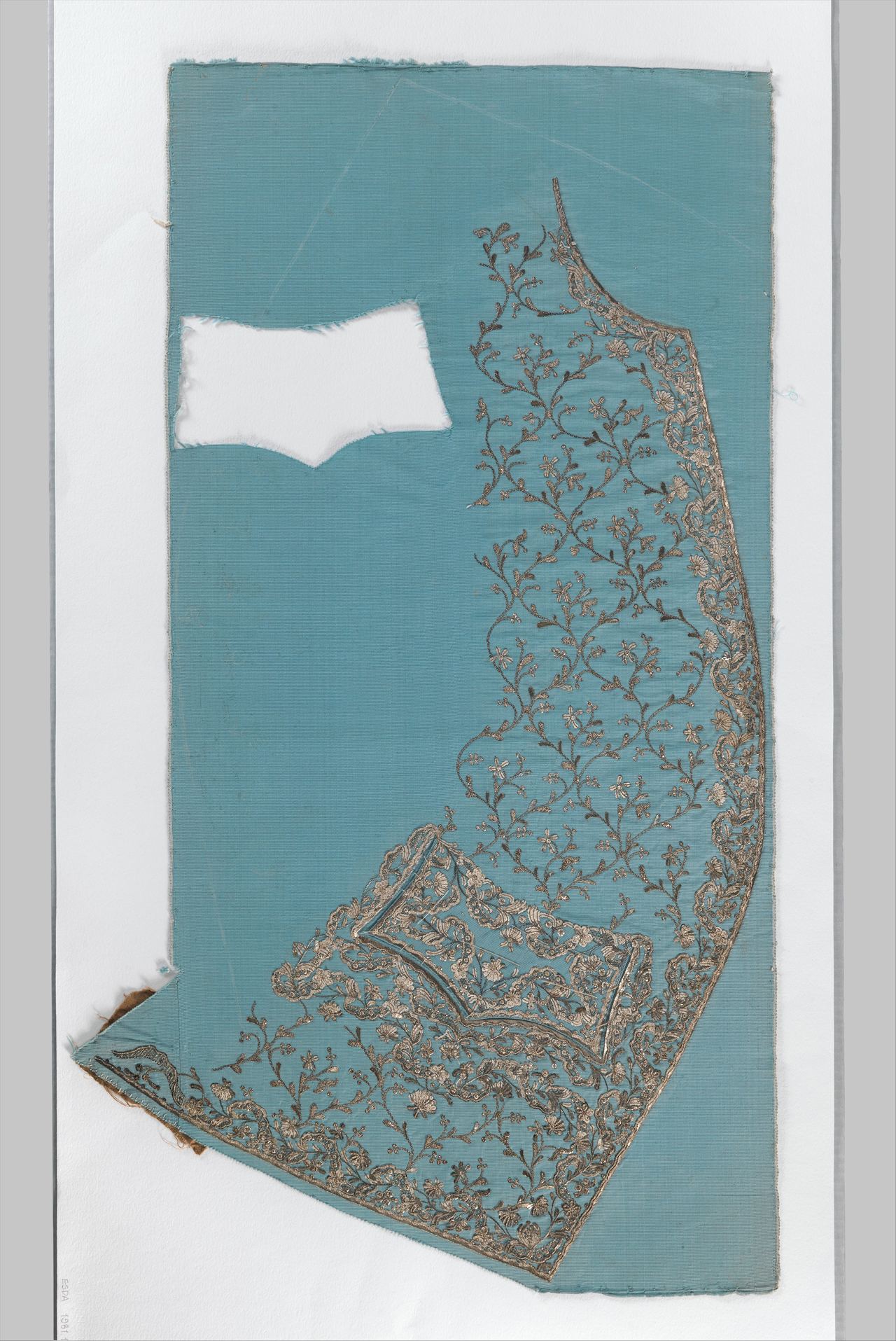
You can watch the method in progress on a pair of blue silk panels at the Met, dated to the 1760s and embroidered in metal thread and sequins. The outline of each front is complete, and on both panels a gap in the plain silk shows where a shaped piece, apparently the pocket flap, has already been cut out. The V&A describes the same step in a pair of shapes from Lyon, dated to the 1770s: the pocket flap was embroidered in a corner of the length and "then cut out, hemmed and stitched into place".
Shapes also traveled, sometimes illegally. The V&A notes that for most of the eighteenth century imported French silks and laces were heavily taxed in Britain, and that Exchequer records mention French waistcoat shapes smuggled across the Channel. One pair in its collection, tamboured with pink roses in 1750–59, carries a customs stamp on the back: "SEIZED DOVER". The museum adds that seized goods were usually burned, which makes the survival of this pair unusual.
Could the loom weave a garment to shape?
Yes. Patterned silks could be woven with the motifs placed for particular pieces, which makes woven-to-shape cloth the loom's version of the embroidered shape. The design had to be worked out before weaving began, since a brocade pattern, made with extra wefts that run only where a motif needs color, cannot be moved once it is woven into the cloth.
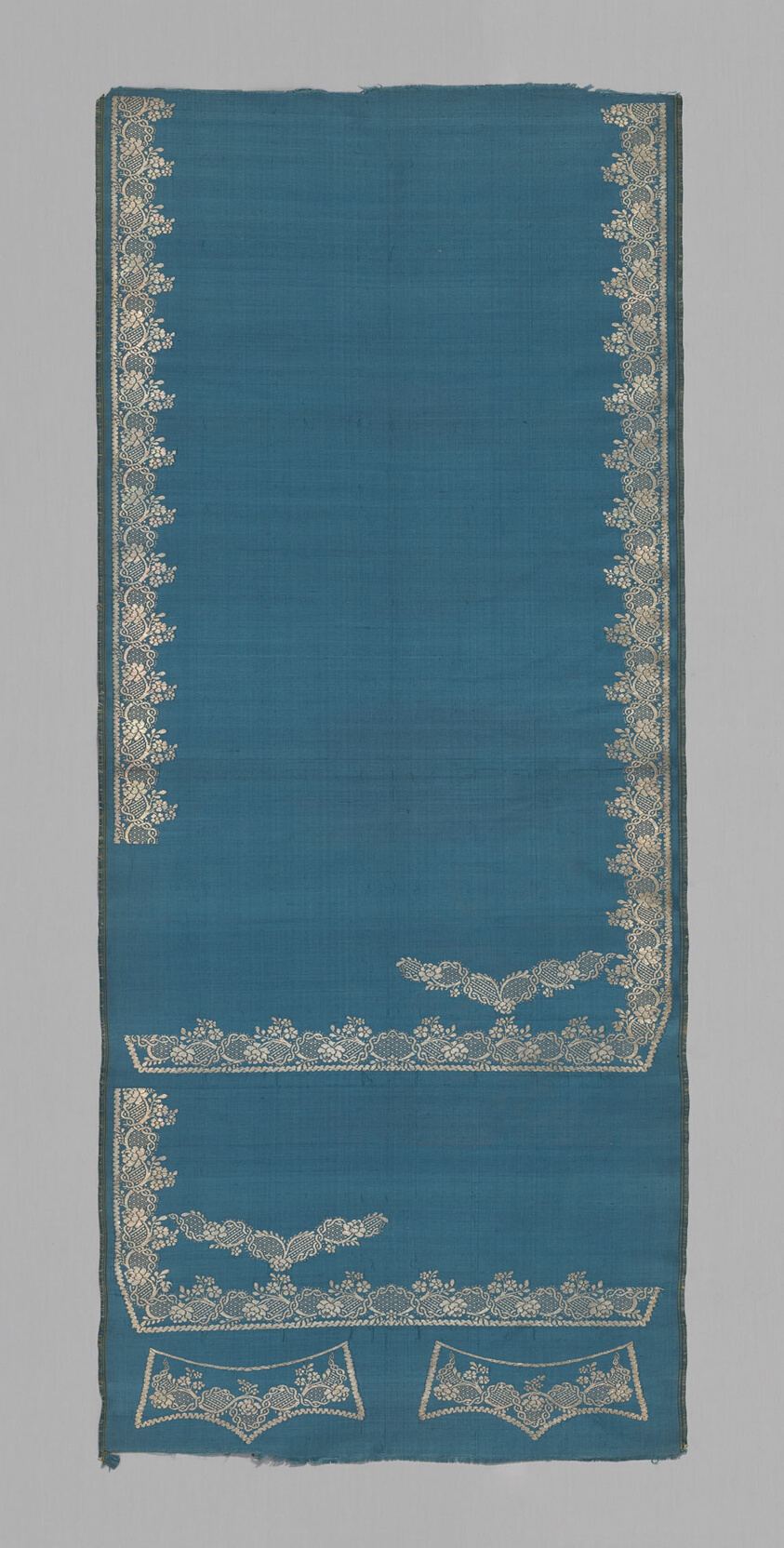
The clearest example in an open collection is an uncut waistcoat at the Art Institute of Chicago, French, from the 1750s or 1760s, cataloged as plain-weave silk with supplementary brocading wefts of silk and silvered metal strip. The length, 131.2 by 56 centimeters, carries floral borders down both front edges and along both hems, with the two pocket flaps woven as separate motifs at the bottom. Everything else is plain blue silk.
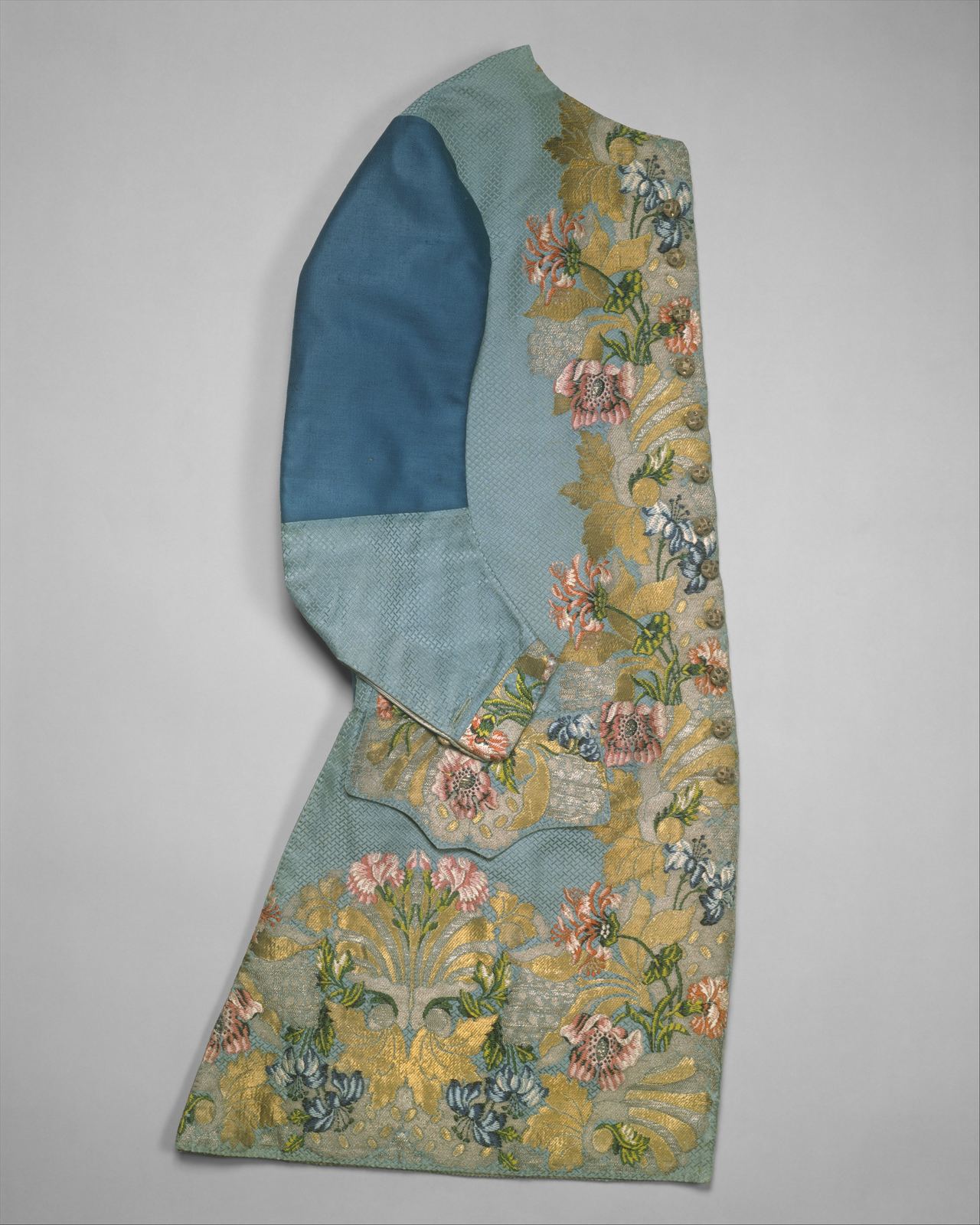
London's Spitalfields weavers worked the same way. The V&A holds Anna Maria Garthwaite's 1747 design for a waistcoat silk, squared up for the loom, with a key to the three kinds of metal thread it needed. A waistcoat woven from it is at the Met, which credits the weaving to Peter Lekeux. On that waistcoat the large flowers and metallic leaves run down the front edge, around the pocket flap and across the hem, while the area toward the side seam shows only the small ground pattern. Teazle's profile of Anna Maria Garthwaite follows the drawing from paper to cloth.
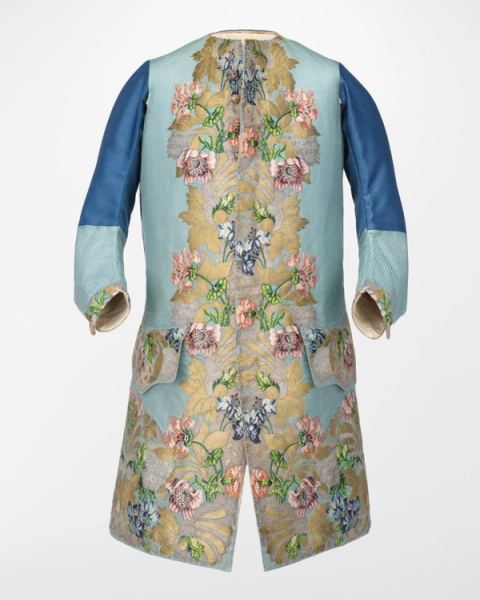
French weavers applied it to other techniques. A V&A waistcoat of about 1790 has fronts, collar, pocket welts and revers of cut silk velvet woven to shape, à disposition in the museum's words, with a border of swagged drapery in chiné, a technique in which the threads are resist-dyed before weaving so that the pattern looks clouded. The record notes that designing such silks was difficult enough to earn a chapter in Le dessinateur pour les étoffes d'or, d'argent et de soie, a silk-design manual published in Paris in 1765. Another French waistcoat at the V&A, dated 1775–85, is cataloged as silver-gilt tissue "woven-to-shape", brocaded with flowers along its front edges, hems and pocket flaps. For the looms that made such patterns possible, see Dobby, Jacquard, Plain; for one of Lyon's leading silk designers of the period, see Philippe de Lasalle.
Printers adopted the same logic. The V&A has a Swiss man's waistcoat of 1750–59 in cotton block-printed to shape in blue, with the pattern placed around the neck and pockets, along the fronts and hems, and on the pocket flaps. An English cotton collar of about 1825–35 in the same museum has a brown floral border roller-printed to its shape. How blocks and rollers put color on cloth is explained in Printed Cloth, Block to Screen.
What happened to the idea in the nineteenth century?
It moved to women's dresses, and especially to skirts with flounces, the deep gathered tiers of the 1850s. Fabric for a dress could be woven or printed à disposition, with borders for the tiers and a smaller all-over pattern for the body, so that each part of the dress had its own decoration before it was made up.
Three museum records show the arrangement in different materials. The V&A's English summer dress of 1858–60, in lilac and beige printed cotton, has an all-over sprig on the body and a more formal floral design on the flounces; the museum says the fabric was printed with a decorative border "expressly for use as tiers of a dress". The McCord Stewart Museum in Montreal describes a dress of 1854–55 in lightweight printed wool with two widths of border: the wide ones form the skirt flounces and the narrow ones trim the bodice. In silk, the Museum of Fine Arts, Boston holds an American day dress of 1855 in black taffeta whose four flounces each carry a rose and white striped border. The Fashion History Timeline of the Fashion Institute of Technology, discussing that dress, quotes Jan Glier Reeder's 2010 catalog of the Brooklyn Museum costume collection, High Style: fabrics for tiers were woven à la disposition, with the design configured to the shape of the pattern piece it was intended for.
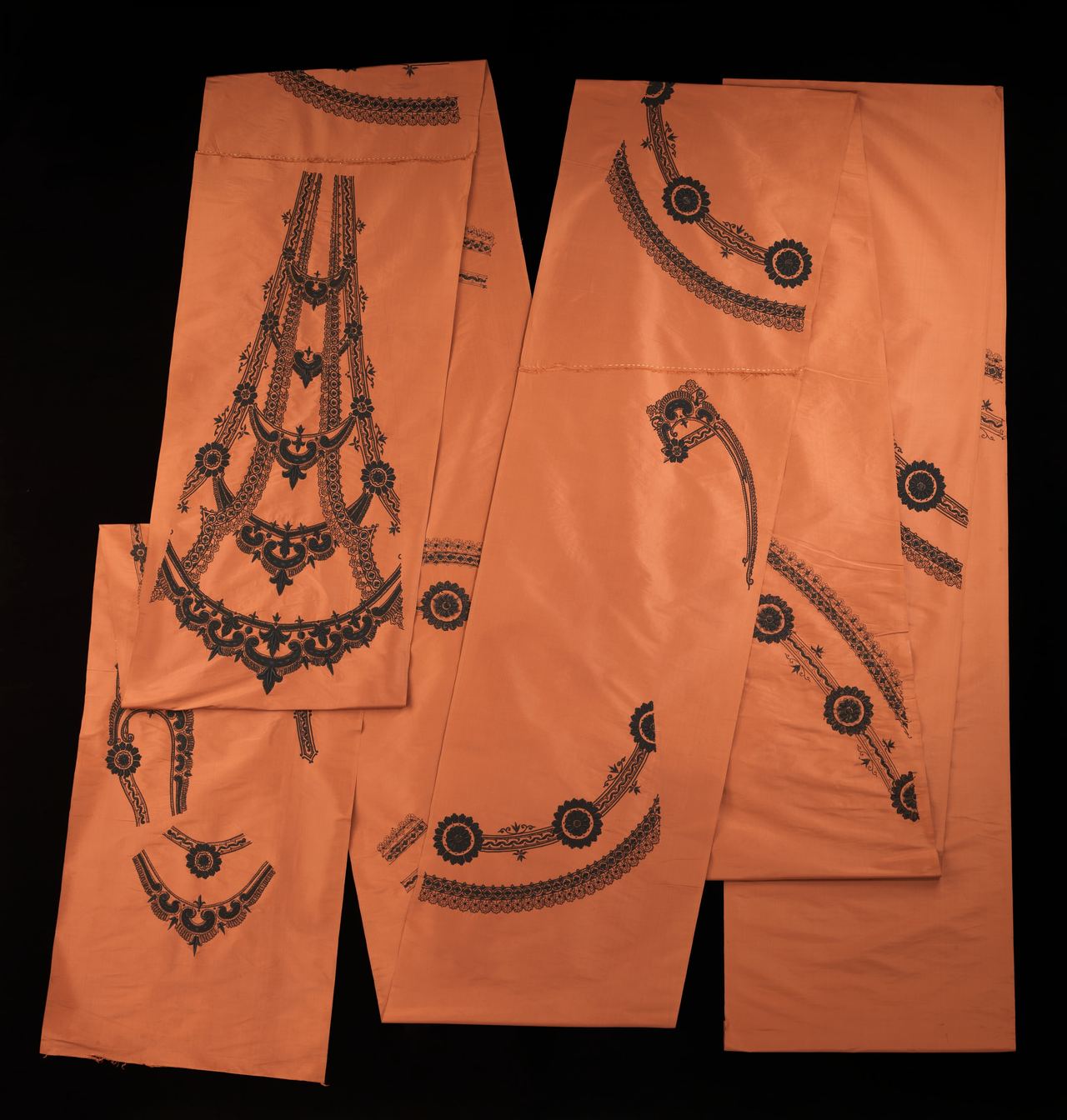
Embroidery to shape continued too. A set at the Met dated 1870, again titled Habit à la disposition, consists of long uncut lengths of salmon-colored silk. Seen up close, the ornament is worked in black silk and beads, and each length carries its own arrangement: a tapering panel of hanging swags and medallions, curved bands of rosettes that follow the edge of the cloth, smaller curves on narrower strips. The Met uses the same title for objects dated as late as the 1920s, though those records are not open access.
How do you spot it on a garment in a display case?
Look for decoration that knows where the seams are. A cloth patterned by the yard runs its repeat straight across a garment and is cut through wherever the pattern piece ends; a cloth decorated to shape stops and turns exactly at the edges. Five clues, drawn from the records above, help:
- Borders follow curved edges. A band that bends with a curved waistcoat front or the hem of a skirt was placed, not cut from a straight stripe.
- Mirror images. On a pair of fronts, the motifs reverse from left to right; the V&A records "mirror-imaged" scenes on a French shape of 1785–95.
- Matching parts. Pocket flaps, cuffs and collars carry their own complete motif rather than a random slice of the repeat.
- Embroidered buttons. Buttons covered with the same embroidery as the fronts were probably cut from the same shape.
- Plain zones. Decoration fades out toward side seams and shoulders, where the tailor needed room to fit.
| Object | Date | How the decoration was placed | Holder |
|---|---|---|---|
| Waistcoat, Spitalfields silk by Garthwaite and Lekeux | 1747 | Brocaded on the loom | The Met, C.I.66.14.2 |
| Waistcoat shapes, tamboured, with Dover customs stamp | 1750–59 | Embroidered | V&A, T.12&A-1981 |
| Man's waistcoat, Swiss | 1750–59 | Block-printed to shape | V&A, 1583-1899 |
| Uncut waistcoat, French | 1750s/60s | Brocaded on the loom | Art Institute of Chicago, 2001.876 |
| Habit à la disposition, French | 1760–75 | Embroidered | The Met, 2009.300.2932 |
| Waistcoat, velvet with chiné border | about 1790 | Woven to shape | V&A, T.173-1966 |
| Summer dress, English | 1858–60 | Printed border for flounces | V&A, T.702-1913 |
| Habit à la disposition, French | 1870 | Embroidered | The Met, 2009.300.2334 |
Alterations can hide the evidence. Several V&A waistcoats were cut down or given new backs in the nineteenth century for fancy dress or the stage, so a garment may combine decoration placed in the 1780s with seams sewn a century later. Seams, linings and fastenings carry their own dating evidence, explained in How to Date a Garment from Its Construction.
Is a modern placement print the same thing?
In principle, yes. Today's term is an engineered or placement print: a design laid out to fit a pattern piece instead of running as a repeat. The V&A holds a 1950s children's garment designed by Joyce Clissold for Footprints and cataloged simply as "printed to shape". A 2018 article on digital textile printing in the Journal of Textile and Apparel, Technology and Management describes engineered design layouts as breaking the limits of the repeat and of the number of colors per design.
This is useful to keep in mind at the Fashion and Textile Museum in London, where Ossie Clark + Celia Birtwell runs from 2 October 2026 to 11 April 2027. The exhibition, drawn from a private collection, follows Clark's designs together with the prints Birtwell designed for them. The museum's page does not say how her prints were placed on his patterns, and Teazle has not found two sources that do, so here is a question to take with you rather than an answer. Look at where each motif lands. Does a print stop at a seam, turn a corner at a cuff, or change scale between collar and body? In the V&A's own Clark coat of 1970, the museum records two Birtwell prints in one garment: "Floating Daisy" for the coat and a complementary grid pattern on the collar, cuffs and bodice. That is a decision about which cloth goes where, made before cutting, which is the oldest question in this story.
Where can you see it?
These records can be studied online; the Met and Chicago images are open access:
- The Met: Habit à la disposition, 1760–75; Habit à la disposition, 1780–90, Italian, yellow silk embroidered for a suit; Habit à la disposition, 1805–10, fifteen parts; Habit à la disposition, 1870; waistcoat front panels, 1760s; waistcoat of Garthwaite silk, 1747.
- Art Institute of Chicago: uncut waistcoat, 1750s/60s; salesman's sample of a waistcoat pocket, 1780/90; embroidered fabric for a man's waistcoat front, 1780s.
- V&A, London (records online, some objects by appointment): waistcoat shapes seized at Dover; waistcoat shapes, Lyon, 1770s; woven-to-shape velvet waistcoat; dress with border printed for tiers, 1858–60.
Sources
- Habit à la disposition, French, 1760–75, 2009.300.2932. The Metropolitan Museum of Art. Primary. Met Collection API record read in full (isPublicDomain true; silk, paper; credit line). Full-size image downloaded and inspected at zoom: two waistcoat fronts, pocket flaps, two columns of embroidered circles. Accessed November 26, 2026.
- Habit à la disposition, Italian, 1780–90, 1998.191a–d. The Metropolitan Museum of Art. Primary. Met API record (isPublicDomain true; silk); 16 images viewed (embroidered yellow silk panels, curved front edge). Accessed November 26, 2026.
- Habit à la disposition, French, 1805–10, 1984.591a–o. The Metropolitan Museum of Art. Primary. Met API record (isPublicDomain true; silk, metal thread, cotton; 15 parts a–o); images viewed. Accessed November 26, 2026.
- Habit à la disposition, French, 1870, 2009.300.2334. The Metropolitan Museum of Art. Primary. Met API record (isPublicDomain true; medium given as silk). Full-size detail image cropped and enlarged: ornament is embroidered in black silk with black beads. Accessed November 26, 2026.
- Waistcoat front panels, 1760s, 1981.14.6a, b. The Metropolitan Museum of Art. Primary. Met API record (isPublicDomain true; metal thread embroidery and sequins on silk; lengths 106.7 and 102.9 cm). Images viewed: shaped piece cut out of the plain silk beside the embroidered front. Accessed November 26, 2026.
- Waistcoat, British, 1747, C.I.66.14.2 (textile by Anna Maria Garthwaite, Peter Lekeux). The Metropolitan Museum of Art. Primary. Met API record: constituents list Garthwaite as designer and Peter Lekeux as manufacturer; isPublicDomain true. Front view image inspected. Accessed November 26, 2026.
- Habit à la disposition, French, 1920–29, 2009.300.3544. The Metropolitan Museum of Art. Met API record read: same title used for a 1920s object; isPublicDomain false (image not used). Accessed November 26, 2026.
- Uncut Waistcoat, France, 1750s/60s, 2001.876. Art Institute of Chicago. Primary. AIC API record read: medium, dimensions 131.2 × 56 cm, is_public_domain true. Image inspected. Accessed November 26, 2026.
- Embroidered Fabric for a Man's Waistcoat Front, France, 1780s, 1984.1008a-c. Art Institute of Chicago. AIC API record, full description read: layout planned to save fabric; embroidery delineates the cut and button covers; frame kept taut, easier before cutting; back of cheaper cloth. Accessed November 26, 2026.
- Salesman's Sample (Waistcoat Pocket), France, probably Lyon, 1780/90, 1956.155. Art Institute of Chicago. AIC API record read (attribution, date, medium); related samples 1956.156–158 dated 1780/90 and 1780–1810. Image viewed. Accessed November 26, 2026.
- Design for a Waistcoat Pocket, France, probably Lyon, 1770–1810, 1969.104. Art Institute of Chicago. AIC API record, description read: designs show the lower edge from pocket to hem; numbers helped merchant identify patterns and prices. Accessed November 26, 2026.
- Pair of waistcoat shapes, France, 1750–1759, T.12&A-1981. Victoria and Albert Museum. V&A API record read in full: sequence (embroider, buy from mercer/haberdasher, take to tailor), heavy duties on French silks, 'SEIZED DOVER' stamp, seized goods usually burned. Accessed November 26, 2026.
- Pair of waistcoat shapes, Lyons, 1770s, T.26&A-1961. Victoria and Albert Museum. V&A API record read: shapes bought then sewn by a tailor; undecorated areas for fitting (quoted); pocket flap cut out, hemmed, stitched in place (quoted); Exchequer records of smuggled shapes; 13 button covers. Accessed November 26, 2026.
- Waistcoat shape, French, 1785–95, 878-1891. Victoria and Albert Museum. V&A API record read: mirror-imaged design; eleven buttonhole rectangles; thirteen button covers. Accessed November 26, 2026.
- Man's waistcoat, French, ca. 1790, T.173-1966. Victoria and Albert Museum. V&A API record read: cut velvet woven-to-shape ('à disposition'), chiné border, 1765 manual Le dessinateur pour les étoffes; fustian back; later alteration. Accessed November 26, 2026.
- Man's waistcoat, French, 1775–85, T.1056-1913. Victoria and Albert Museum. V&A API record read: silver-gilt tissue woven-to-shape, brocaded-to-shape on pocket flaps, front edges, hems; back replaced late 19th century. Accessed November 26, 2026.
- Man's sleeved waistcoat, Swiss, 1750–1759, 1583-1899. Victoria and Albert Museum. V&A API record read: cotton block-printed-to-shape in blue around neck, pockets, fronts, hems, pocket flaps. Accessed November 26, 2026.
- Collar, roller printed cotton, ca. 1825–1835, T.1760-1913. Victoria and Albert Museum. V&A API record read: brown floral border printed to shape. Accessed November 26, 2026.
- Dress, English, 1858–1860, T.702-1913. Victoria and Albert Museum. V&A API record read: fabric printed with a border expressly for use as tiers, known as à disposition (quoted); sprig body, formal floral flounce. Accessed November 26, 2026.
- Design for a woven silk by Anna Maria Garthwaite, Spitalfields, 1747. Victoria and Albert Museum. V&A API record read: squared up for cords and dezines; colour key for three metal threads for this waistcoat; a waistcoat woven from it is at the Met. Accessed November 26, 2026.
- Man's waistcoat, French, 1795–1800, T.212-1972. Victoria and Albert Museum. V&A API record read: embroidered-to-shape; altered in the 19th century for fancy dress or theatre, back replaced. Accessed November 26, 2026.
- Man's waistcoat, French, 1790s, 358-1905. Victoria and Albert Museum. V&A API record read: embroidered-to-shape; fustian back; altered for theatre costume. Accessed November 26, 2026.
- Woman's coat, Ossie Clark, 1970, T.98-2001. Victoria and Albert Museum. V&A API record read: Clark chose Birtwell's 'Floating Daisy'; complementary grid pattern on collar, cuffs and bodice. Accessed November 26, 2026.
- Children's garment, printed to shape, Joyce Clissold for Footprints, 1950s, T.72-1990. Victoria and Albert Museum. V&A API record read (brief description only). Accessed November 26, 2026.
- Waistcoat, circa 1780, PC000042. Museum of New Zealand Te Papa Tongarewa. Record page read: waistcoat would have been part of l'habit à la française, a suit with complementary coat and breeches. Accessed November 26, 2026.
- Dress of wool mousseline de laine, 1854–55 (McCord Stewart Museum, M973.1.1.1-2). Google Arts & Culture / McCord Stewart Museum. Museum's object text read on Google Arts & Culture: printed à la disposition, two border widths; wide for skirt flounces, narrow for bodice trim. Accessed November 26, 2026.
- 1855 – Black Taffeta Day Dress with Rose and White Stripes. Fashion History Timeline, Fashion Institute of Technology. Page read in full: MFA Boston 51.322a-b, American, 1855; taffeta with weft-float patterning à la disposition; rose and white border on four flounces; quotes Reeder, High Style (2010), p. 22. The MFA record itself returned 403 to the session; Reeder's book is not open online (archive.org loan only), so the Reeder point is attributed through FIT. Accessed November 26, 2026.
- Engineered Digital Textile Print Design for Customized Curves (Kisalaya Choudhary, vol. 10, no. 3, 2018). Journal of Textile and Apparel, Technology and Management. PDF read (pp. 1–3): engineered design layouts break the limitations of repeat and number of colors per design (citing Ujiie 2006). Accessed November 26, 2026.
- Ossie Clark + Celia Birtwell (2 Oct 2026 – 11 Apr 2027). Fashion and Textile Museum. Exhibition page read: dates; Clark's designs featured prints by Birtwell; drawn from a private collection. No statement on how prints were placed. Accessed November 26, 2026.
Glossary
Last updated · Markdown · Report an error