Needlework
White on White: How American Whitework Bedcovers Were Made
How white-on-white bed covers of the early 1800s were stitched, corded and stuffed, what "Marseilles" really meant, and how to read one in a gallery, before the Saint Louis Art Museum opens its whitework show.
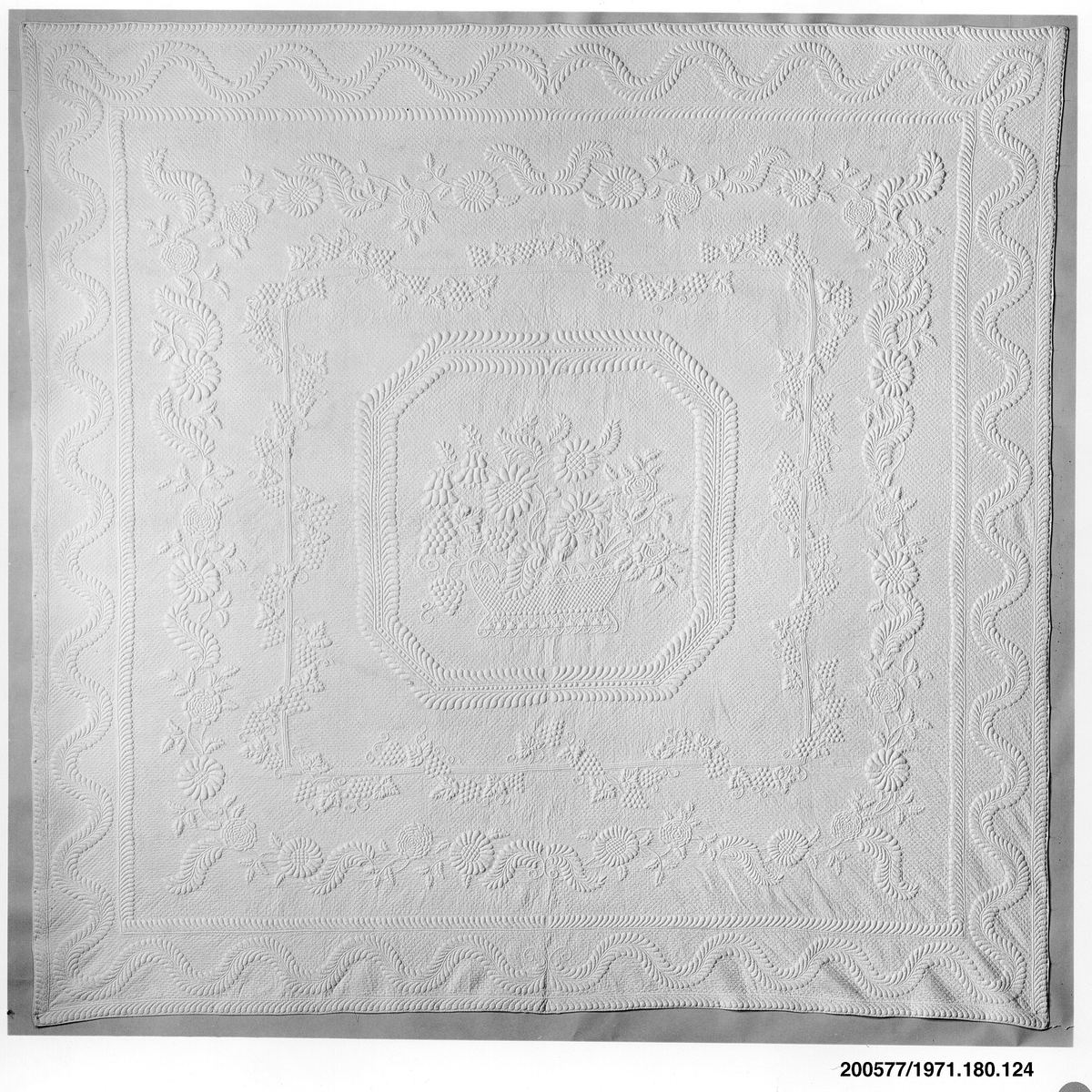
Whitework quilting is bed-cover needlework in which the pattern is made only of texture. A maker stitched white thread through white cotton and the layers beneath it, then raised grapes, petals and baskets with cord and stuffing, so that the design shows only as light and shadow. The American examples cataloged as wholecloth quilts have a plain top with no patchwork, and the pattern is all in the stitching.
What is whitework quilting?
Whitework is an umbrella word, and quilting is one of the ways to do it. The Saint Louis Art Museum (SLAM) defines whitework textiles as "embroidery done in white thread on white fabric." The Kentucky Museum at Western Kentucky University, in a 2021 exhibition, used the same word for embroidered counterpanes and wholecloth quilts alike, so a museum label may mean either.
A wholecloth quilt has a top of plain cloth instead of patchwork. The Kentucky Museum describes such quilts as two layers of woven cloth stitched together, typically with a loose cotton filling between. The V&A's general definition of quilting is the same sandwich: two layers of fabric with padding, called wadding, between them, held together by lines of stitching.
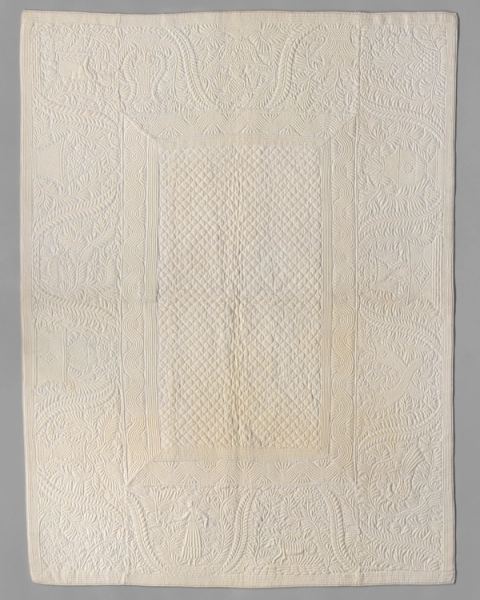
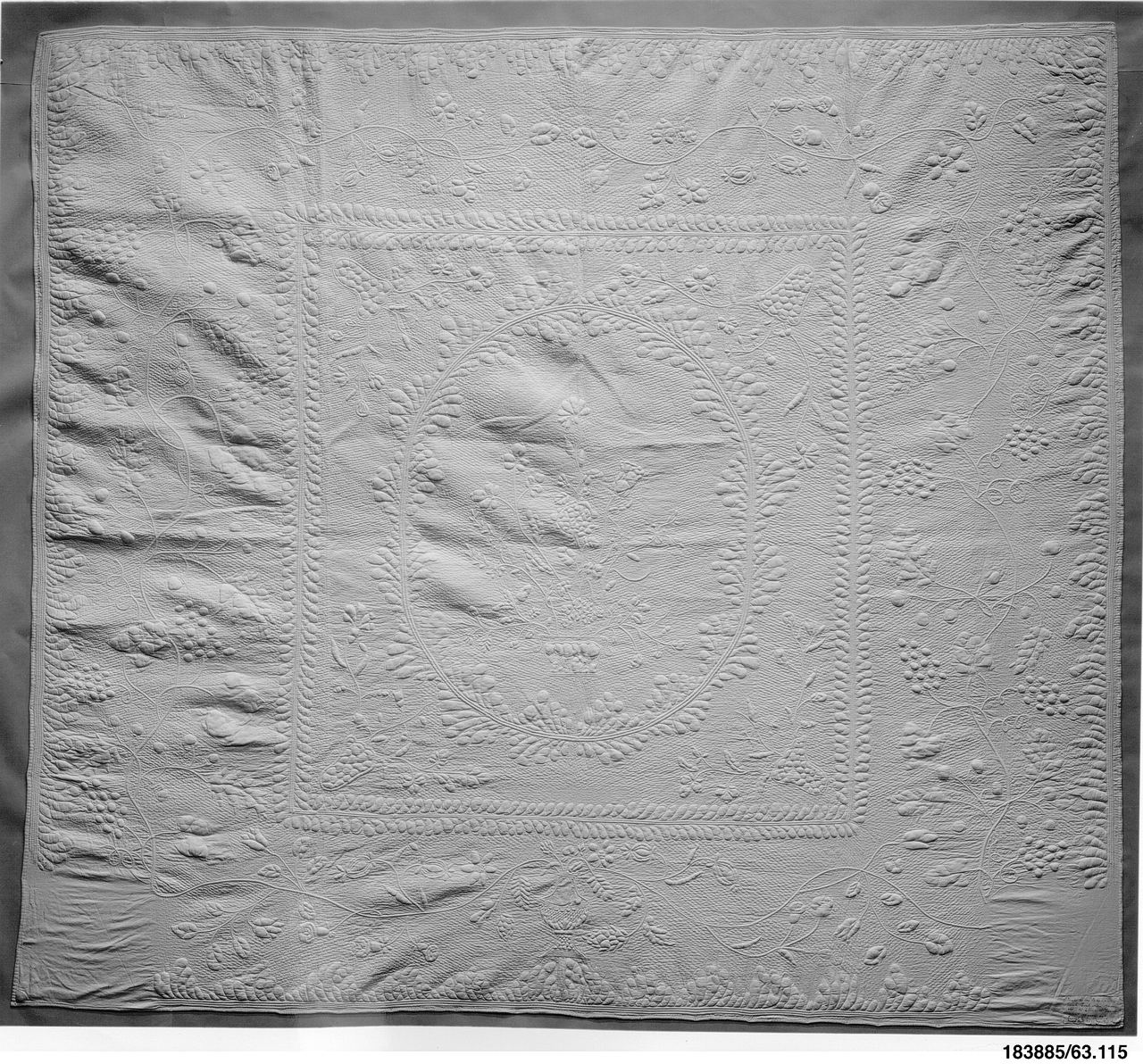
The Metropolitan Museum of Art catalogs several American pieces under the title "Wholecloth whitework quilt." Three are in its open-access collection. One is by Sarah Cook, made in Litchfield, Connecticut, about 1800. One was probably made in Colchester, Connecticut, about 1815. One is by J. Wright, made in Massachusetts, also about 1815. The names and places come from the Met's records. Dates for the fashion as a whole vary by source: the International Quilt Museum says whitework quilts were found throughout much of the nineteenth century and very fashionable between 1815 and 1850, while the Kentucky Museum says many surviving pieces date from between the Revolution and the War of 1812.
How was a white quilt made?
Start with fine white cloth, a filling and a backing. The pattern is drawn on the top and outlined in small stitches. The raised parts are then filled from the back: cord is threaded through narrow channels, and small pieces of stuffing are tucked into larger shapes. The result is a pattern you can feel but barely see.
The clearest period description we could open is French, and it concerns corded work. The International Quilt Museum gives the account that Charles Germain de Saint-Aubin published in 1770 of what was then called broderie de Marseille:
- Draw the pattern on a piece of fine cotton or linen.
- Lay it over a more loosely woven backing and stretch both on a frame.
- Sew along the pattern lines with small running or back stitches, forming narrow channels and tiny compartments.
- Turn the frame over and make small holes behind each channel and compartment.
- Draw cord through the channels and tuck tiny bits of cording into the compartments.
The Minneapolis Institute of Art describes the same family of work in one sentence: white designs embroidered on a white ground, quilted to a second layer, and stuffed with batting to raise them. Neither source describes an American workroom, so treat the steps as the method behind the look, not as a record of any one American quilt.
| Technique | What you see | How it was made | An example |
|---|---|---|---|
| Wholecloth quilting | Plain top, pattern in stitched lines | Small stitches through top, filling and backing | The Met's quilt of about 1815 from Colchester, Connecticut |
| Corded work | Narrow raised ridges | Cord drawn from the back through stitched channels | Described in Saint-Aubin's 1770 method above |
| Stuffed work ([trapunto](glossary:glossary-trapunto)) | Soft, rounded shapes such as grapes and petals | Stuffing tucked from the back into stitched compartments | The raised grapes on J. Wright's quilt, about 1815, appear to be this |
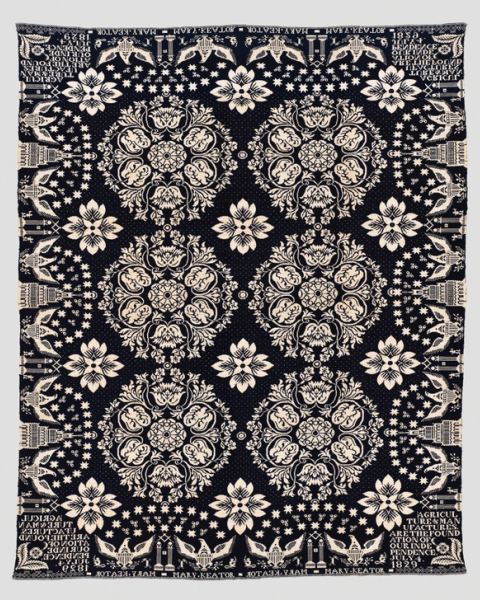
| Woven "Marseilles" or [Marcella](glossary:glossary-marcella) | The same raised look, but no needlework | Double cloth woven on a loom | The Met's woven quilt of about 1800 to 1820 |
The Met's records use the vocabulary of the table. A quilt of about 1835 is titled "Stuffed and corded quilt," and its medium line reads cotton, "whitework," stuffed and corded. It is in the museum's European Sculpture and Decorative Arts department, part of a gift the Met catalogs as a group of six examples of European quilt-work, so it is a comparison and not an American example. A corded quilt of about 1700 in the same gift is corded only.
Is a "Marseilles quilt" stitched or woven?
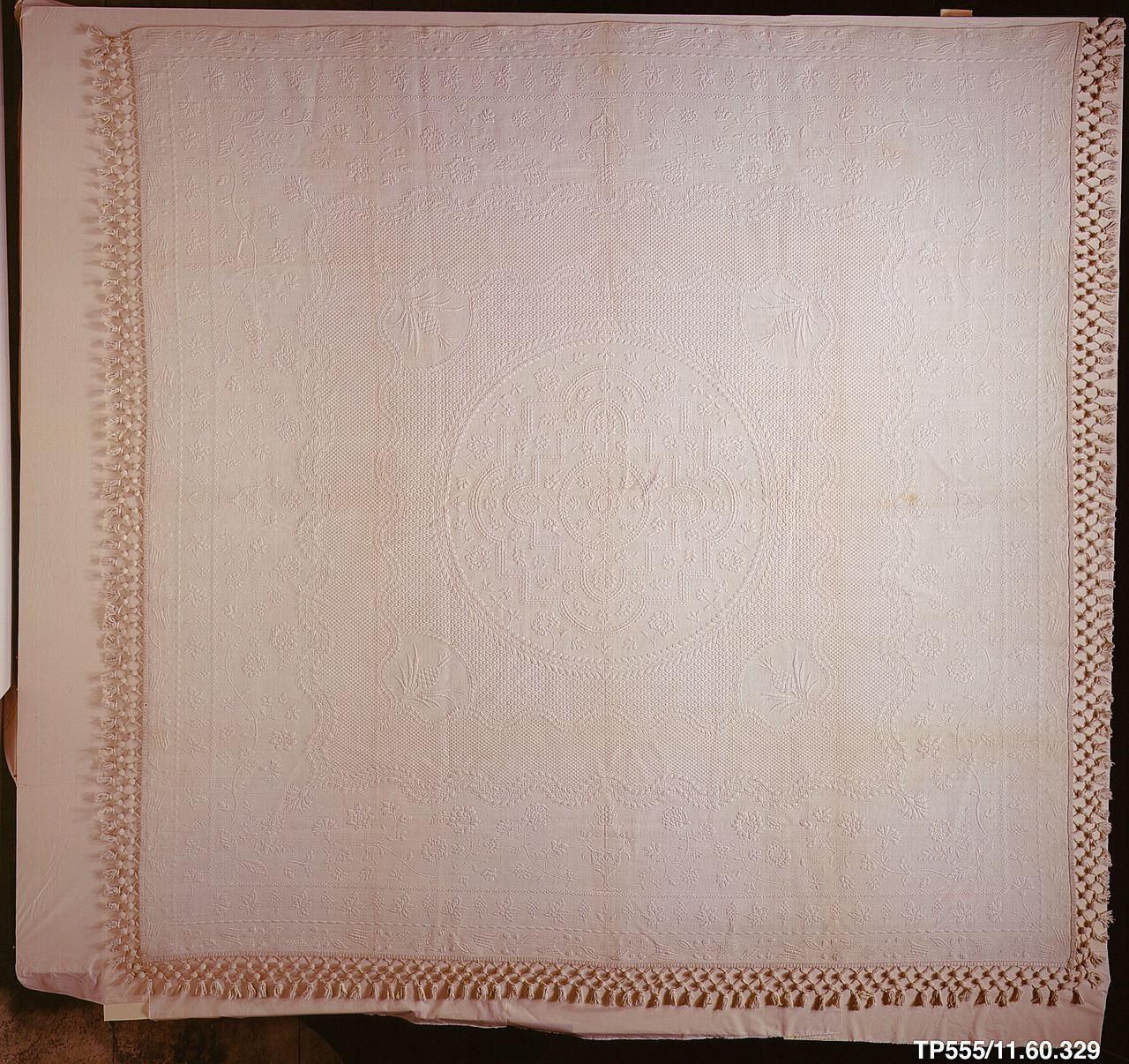
Both, and the label usually tells you which. Marseilles work was hand-stitched corded needlework from the port of Marseilles. A woven imitation followed, and museums call it "Marseilles type" or Marcella. Every "Quilt, Marseilles type" we found in the Met's records is cotton, woven.
The International Quilt Museum says ships left Marseilles carrying quilted and corded furnishings and garments from the last decades of the 1600s, goods that were known as piqués de Marseille. It adds that the term broderie de Marseille was not commonly used until about 1770.
The woven version has a date and an inventor, according to the Minneapolis Institute of Art. Its catalog text says the British weaver Robert Elsden developed woven quilting in 1763, as a way to match hand-worked Marseilles coverlets that were much admired in England but difficult to obtain and very expensive. By the middle of the nineteenth century, it says, Marcella counterpanes were readily available to middle-class English households. The Dictionary of Needlework of 1882 agrees on the relationship, calling Marcella a lighter and cheaper variety of the Marseilles quilt, sold by the yard for toilet covers and dressing-table mats.
Whether American women copied the French needlework directly is a claim we could not confirm in the records we could open, so we do not make it. What the records support is narrower: hand-stitched white quilts and woven white cloth with the same raised look were both in use in the early nineteenth century. The International Quilt Museum notes that machine-made versions today are often called matelassé. For how these labels overlap with "coverlet" and counterpane, see Quilt, Coverlet, Counterpane: What Is the Difference?.
Why white, and why texture?
White was fashionable, hard to keep clean and costly to make, and a relief pattern in white shows skill without color. The sources we read point to a neoclassical taste, to the display of cleanliness and means, and, in SLAM's account, to the cotton trade. The Minneapolis museum says white bedroom furnishings became fashionable in England by the late eighteenth century, after centuries of colorful bed covers. The International Quilt Museum ties the stark white, and motifs such as cornucopias, urns, baskets of flowers and feathered wreaths, to a neoclassical design taste. It adds that white, very difficult to keep clean, signified cleanliness and the wealth to keep it clean.
SLAM's framing goes further, and it is SLAM's own. The museum's exhibition text says American whitework was predominantly made by women with ample time and technical skill, who also had the means to select and buy "pristine" cotton cloth. It says the show investigates cotton as the product of a transatlantic textile trade that boomed alongside American plantation slavery. In its press release, SLAM says that whitework was produced primarily by white women, that by 1802 the United States was England's most important cotton supplier, and that almost all of the finished cloth went back to America or to Africa as payment for enslaved people. The curator, Sarah Berg, is quoted there: white objects "also frequently represented racialized standards of beauty, purity and virtue."
A different reading comes from the 2021 Kentucky Museum exhibition. It argues that many surviving pieces date from between the Revolution and the War of 1812, and that making them was a patriotic act, part of women's boycott of British goods that included white embellished bedcovers. Both readings are interpretations by museums, and we report them as such.
Texture is the reason the white works at all. The International Quilt Museum describes Marseilles work as revealing its patterns through "the play of light and shadow" over the cloth. With color removed, relief carries the whole design.
How do you read a whitework quilt?
Read three things: the stitch density, the motifs and the ground. Density gives a sense of the labor involved, the motifs place the taste of the period, and the contrast between flat ground and raised figures shows how the maker planned the surface.
Stitch density. Count the stitches along one inch of a line, if the gallery lets you lean close without touching. Our sources give no standard figure for American quilts, so compare pieces with each other. For scale, the International Quilt Museum records 24 stitches per inch on a miniature-scale French pillow cover of about 1700 to 1720.
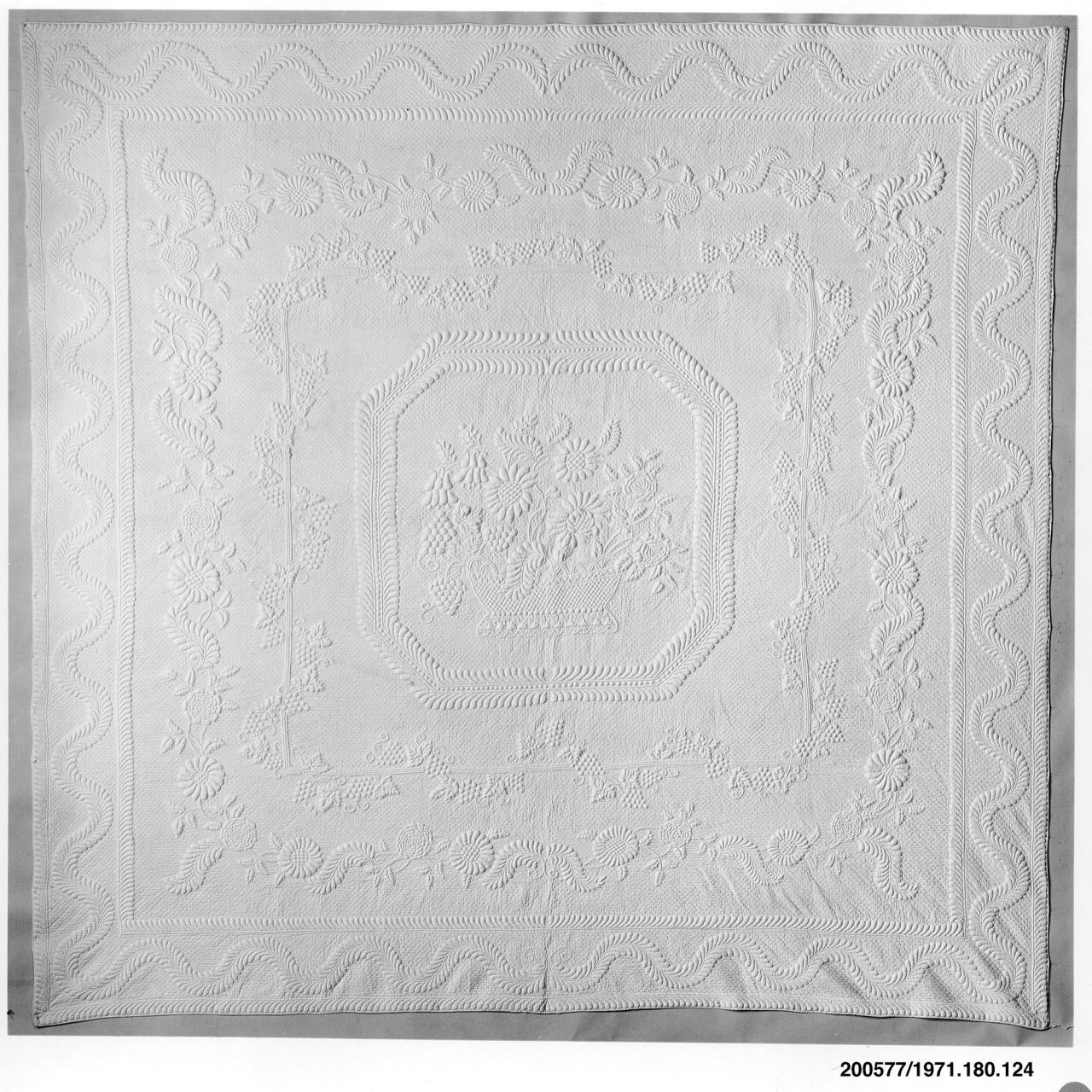
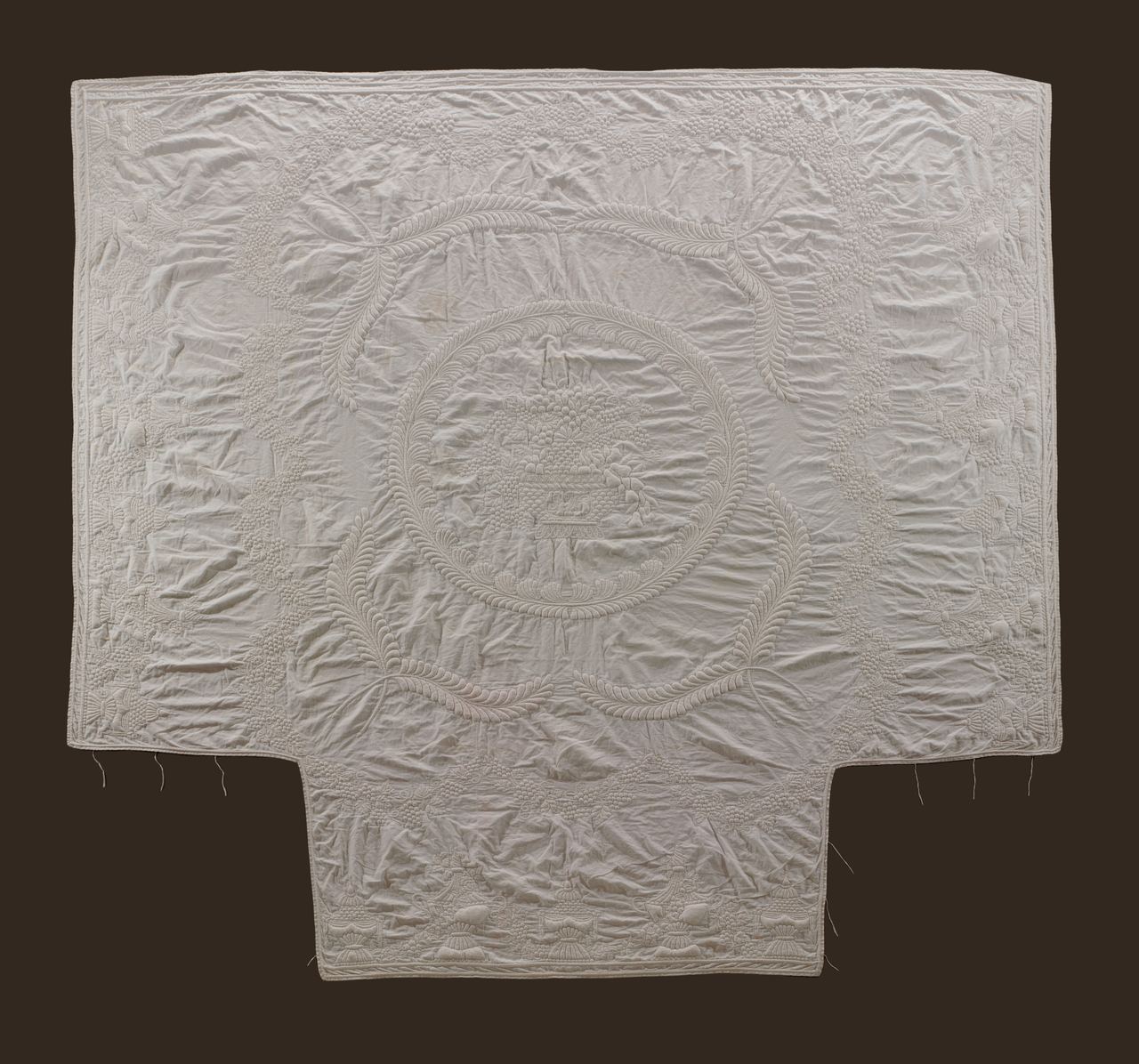
Motifs. The Met's photographs show the vocabulary the International Quilt Museum describes. The quilt from Colchester has a central octagon with a feather-shaped border around a basket of flowers and grapes, then borders of vines, grapes and blossoms, and a wavy band at the outer edge. J. Wright's quilt has a footed urn heaped with rounded grapes and what look like pears, inside a circular wreath of feather-shaped leaves. What look like script initials sit on the urn's base. Sarah Cook's quilt scatters raised grapes and leaves across the field around an oval wreath.
The ground. On the Colchester quilt, the area around the basket appears to be filled with very fine, closely spaced quilting. Our reading is that a ground stitched flat makes the raised figures read as higher, so it is worth looking for. Also look for seams. A vertical line left of the urn in the Wright photograph appears to be a seam, so even a "wholecloth" top can be joined from more than one width of cloth.
Stitched or woven. A stitched piece has a separate backing, and its stitch lines show. A label that says "woven" or "Marseilles type" tells you the pattern came off a loom.
How should you look at one in a museum?
Stand at an angle, read the technique line, look for names, and expect low light. This is the practical answer, and it is also what the SLAM show invites. That show, Quilts and Coverlets: American Needlework in White, is on view from October 2, 2026 through April 18, 2027 in the Carolyn C. and William A. McDonnell Gallery 100, with free admission. We have not seen it. SLAM says it features whitework bedcoverings from the museum's own collection, made in the early to mid-1800s, shown with ceramics, printed fabrics and needlework, and curated by Sarah Berg with Genny Cortinovis. Its closing question is the one to carry in: "What histories remain visible in needlework done in white on white?"
- Move sideways. Relief reads by shadow. A straight-on view flattens it.
- Expect limits on light and time. The International Quilt Museum says damage caused by light is cumulative and irreversible, and it displays its quilts for a maximum of one year out of every 10. Our storage guide covers the same advice for quilts at home.
- Read the technique line. Wholecloth, stuffed, corded, embroidered and woven mean different amounts of handwork. "Coverlet," a word in SLAM's title, can also mean a woven cover in American usage.
- Look for names. SLAM's press release says textiles were often signed with the maker's name, from samplers to the finest stuffed-work quilts. The Met's records name Sarah Cook and J. Wright.
- Check the edges. Fringe, thread ends and the outline of the cover tell you how it was finished. The Met's woven quilt has a knotted fringe along its edges, and the outline of J. Wright's quilt is stepped, not a plain rectangle.
- Ask about the cloth. SLAM puts cotton's history at the center of its framing, so the label is a good place to ask where the cotton came from.
Where can you see one, and what should you read next?
The Met's open-access records for the Colchester quilt, Sarah Cook's quilt, J. Wright's quilt and the woven Marseilles-type quilt carry full photographs. SLAM's own page is Quilts and Coverlets: American Needlework in White. The International Quilt Museum's Marseille: White Corded Quilting page is an open account of the French tradition. For definitions, start with whitework and the other terms linked above.
Sources
- Quilts and Coverlets: American Needlework in White (exhibition page). Saint Louis Art Museum. Full page read directly (no bot block today): dates 2 Oct 2026 to 18 Apr 2027, Gallery 100, free admission, whitework definition, cotton and plantation-slavery framing, curators. Both SLAM pages give 18 April 2027, so the other listing's 28 March is not used. Accessed October 27, 2026.
- Textile exhibition features whitework bedcoverings, examining complex moment in material history (press release, 8 Sept 2026). Saint Louis Art Museum. Full release read: cotton supply by 1802, curator Sarah Berg quotation, signed textiles, on view through 18 April 2027. SLAM's claims are attributed to SLAM in the text. Accessed October 27, 2026.
- Met Open Access records: 13862, 14827, 18956 (wholecloth whitework quilts); 13617, 13630, 13625 (Marseilles type); 864830, 864831, 864833, 894329 (stuffed and corded group). The Metropolitan Museum of Art. Titles, makers, places, dates, media, dimensions, credit lines and the public-domain flag read from the Met Open Access API; all images inspected (originals downloaded and enlarged). The Met web pages return 429 to bots, so the catalogue essays were not read and nothing is claimed from them. Accessed October 27, 2026.
- Marseille: White Corded Quilting (exhibition page). International Quilt Museum. Full page read: Saint-Aubin 1770 method, piques de Marseille, term not common until 1770, matelasse note, 24 stitches per inch on a French pillow cover of about 1700-1720, light and shadow. Accessed October 27, 2026.
- Marcella Counterpane (90.136), catalog text. Minneapolis Institute of Art. Catalog text read through the museum's search API (search.artsmia.org/id/26454): white bedroom furnishings fashionable in England by the late 18th century; Marseilles work; Robert Elsden 1763 (the museum's claim, attributed); Marcella counterpanes by the mid-19th century. Accessed October 27, 2026.
- The Dictionary of Needlework (1882), entry Marcella. S. F. A. Caulfeild and B. C. Saward, via Internet Archive. Full text downloaded and the Marcella entry read: lighter and cheaper variety of Marseilles quilts, sold by the yard. Also read the Quilting entry. Accessed October 27, 2026.
- An introduction to quilting and patchwork. Victoria and Albert Museum. Full page read: definition of a quilt as two layers with wadding held by stitching; trapunto glossed as stuffed quilting. Accessed October 27, 2026.
- Whitework: Women Stitching Identity (exhibition page, 2021). Kentucky Museum, Western Kentucky University. Full page read: whole-cloth quilts as two layers with loose cotton filling; embroidered counterpanes; Revolution to War of 1812 dating and patriotism reading (attributed to the exhibition). Accessed October 27, 2026.
- Quilt record 2006.053.0001, pattern Whole Cloth. International Quilt Museum, World Quilts: The American Story. Record read: whitework quilts found throughout much of the 19th century, fashionable 1815-1850; neoclassical aesthetic; white signified cleanliness and the wealth to keep it clean. Accessed October 27, 2026.
- Care and Conservation. International Quilt Museum. Page read: light damage cumulative and irreversible; quilts displayed a maximum of one year out of every 10. Accessed October 27, 2026.
Glossary
Last updated · Markdown · Report an error