Dress
Rosa Bonheur and the Police Permit to Wear Trousers
Was it illegal for women to wear trousers in France? Not quite: an 1800 Paris police ordinance required a permit, renewed every six months. What Rosa Bonheur's permit said, what it did not, and what to know before Palais Galliera.
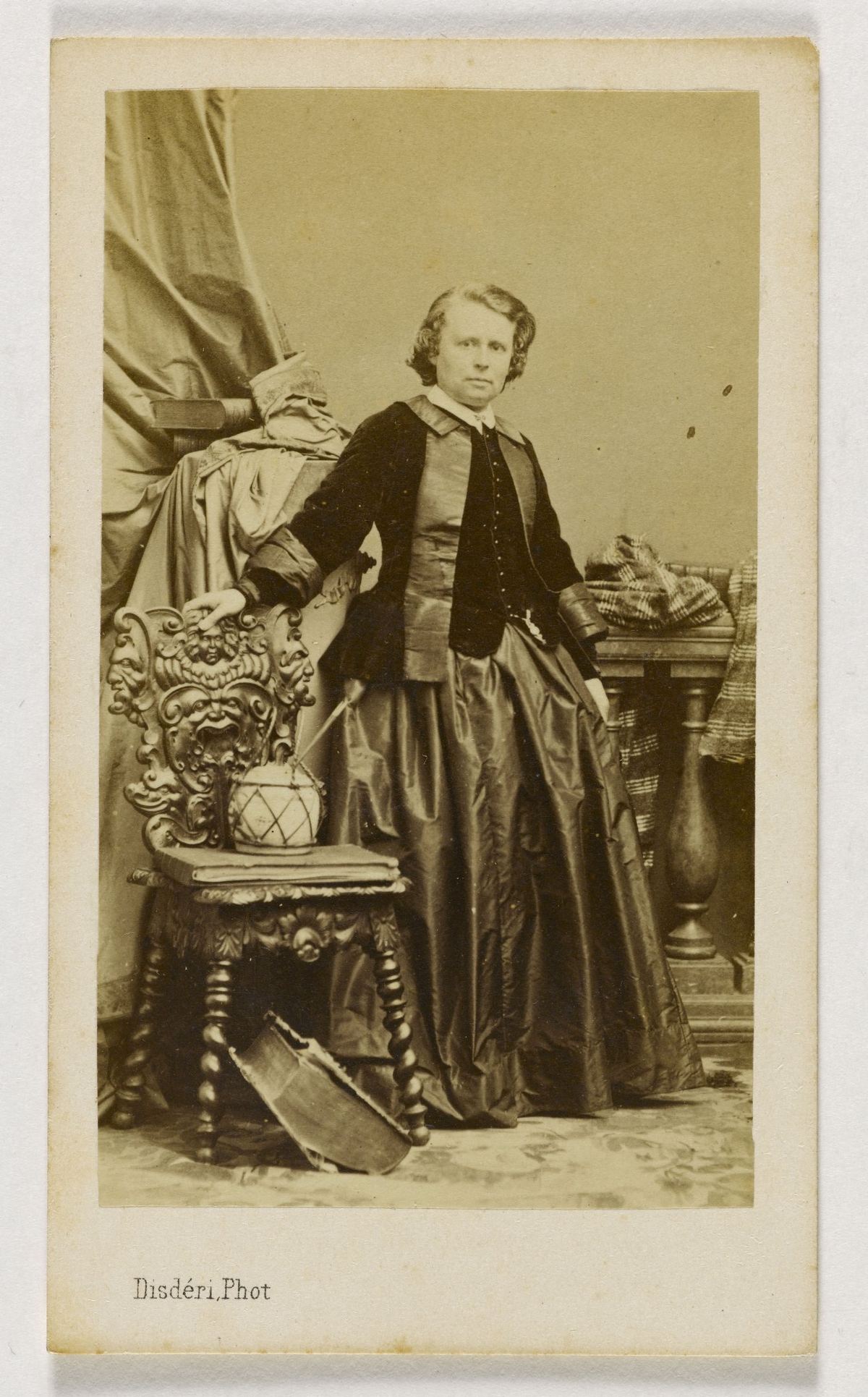
Not exactly, and not everywhere. From 7 November 1800 a Paris police ordinance required any woman who wanted to dress as a man to obtain written permission from the prefecture, on a health officer's certificate. It was a police rule for Paris and three neighboring communes, not a national law. The painter Rosa Bonheur (1822–1899) held such a permit, and a dated copy shows it was good for six months at a time.
Was it illegal for women to wear trousers in France?
Not in the way the legend says. The ordinance of 16 brumaire year IX (7 November 1800), signed by Paris police prefect Louis-Nicolas Dubois, did not ban trousers. It made dressing as a man a matter of permission: a woman had to apply to the prefecture, and a permit could be granted only on a health officer's certificate.
The historian Christine Bard gives the operative text as a rule that any woman wishing to dress as a man must present herself at the prefecture of police to obtain authorization, which could be given only on a health officer's certificate. The Napoleon Foundation's Chantal Prévot adds the limits: it was not a law, Napoleon did not issue it, and it covered Paris and the communes of Saint-Cloud, Sèvres and Meudon.
It was not new either. A decree of the Convention of 29 October 1793 had declared everyone free to wear any clothing of their own sex while treating cross-dressing as a disturbance of the public peace. Prévot reads the 1800 text as a tidying-up of an older prohibition, and Bard calls it the continuation of an old civil and religious one that allowed exceptions. In 2013 the women's rights ministry gave its own reading: the ordinance aimed above all to limit women's access to certain functions and trades by stopping them from dressing like men.
How many women were affected is unknown. The prefecture's file on the subject is, in Prévot's word, very incomplete. The earliest surviving request, number 167, is dated 17 September 1806 and came from a Mademoiselle Catherine-Marguerite Mayer, who wanted to ride a horse. The Musea project at the University of Angers says hundreds of authorizations were issued in Paris in the nineteenth century, the exact number being unknown, and that in 1890 the press counted only a dozen.
How did a permit work?
A woman applied to the prefecture with a medical certificate and a statement from the mayor or police commissioner of her neighborhood. On the one surviving permit of Bonheur's that could be read, the permit cites the ordinance, states a reason, bars the holder from public entertainments, and lasts six months. A second source says permits had to be renewed every six months.
Bonheur's dated permit, shown below, is a renewal: under the printed heading "Permission de travestissement" a handwritten word marks it as such. It is reproduced in facsimile in Theodore Stanton's 1910 collection of recollections of her.
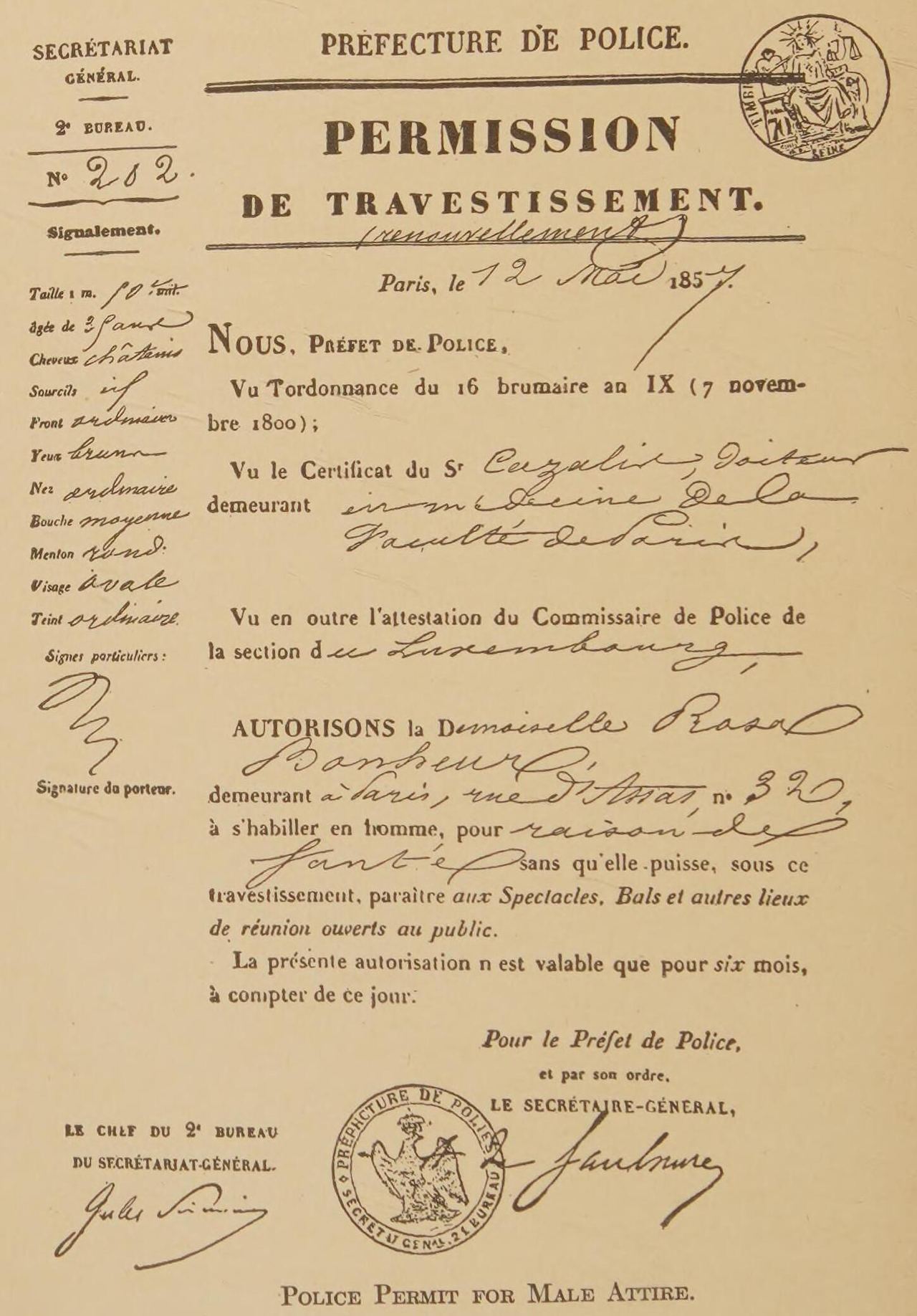
| Element | On the form |
|---|---|
| Authority | Préfecture de Police, Paris |
| Legal basis cited | The ordinance of 16 brumaire year IX (7 November 1800) |
| Supporting papers | A physician's certificate; an attestation from the police commissioner of the Luxembourg district |
| Reason stated | "pour raison de santé" (for reasons of health) |
| Restriction | Not to appear in men's dress at theaters, balls "and other places of assembly open to the public" |
| Validity | Six months from the date |
Sources disagree about the penalty for going without one. Prévot writes that a woman found dressed as a man could be arrested and that the commissioner decided between a reprimand and prison. Bard, who studied the archive, says the stories of women jailed under the ordinance are exaggerated: they risked a fine and an unpleasant hour at the station. Women who passed as men to work in male trades risked more, according to Musea and Bard: prosecution, and the loss of the job once discovered. Musea adds that it helped to put forward a medical reason, because that was what the ordinance asked for.
Who was Rosa Bonheur?
Rosa Bonheur was a French painter and sculptor of animals, born in Bordeaux on 16 March 1822 and dead at her home in By, near Thomery, on 25 May 1899. Her work was popular in Britain and the United States, and her home and studio at By is now a museum.
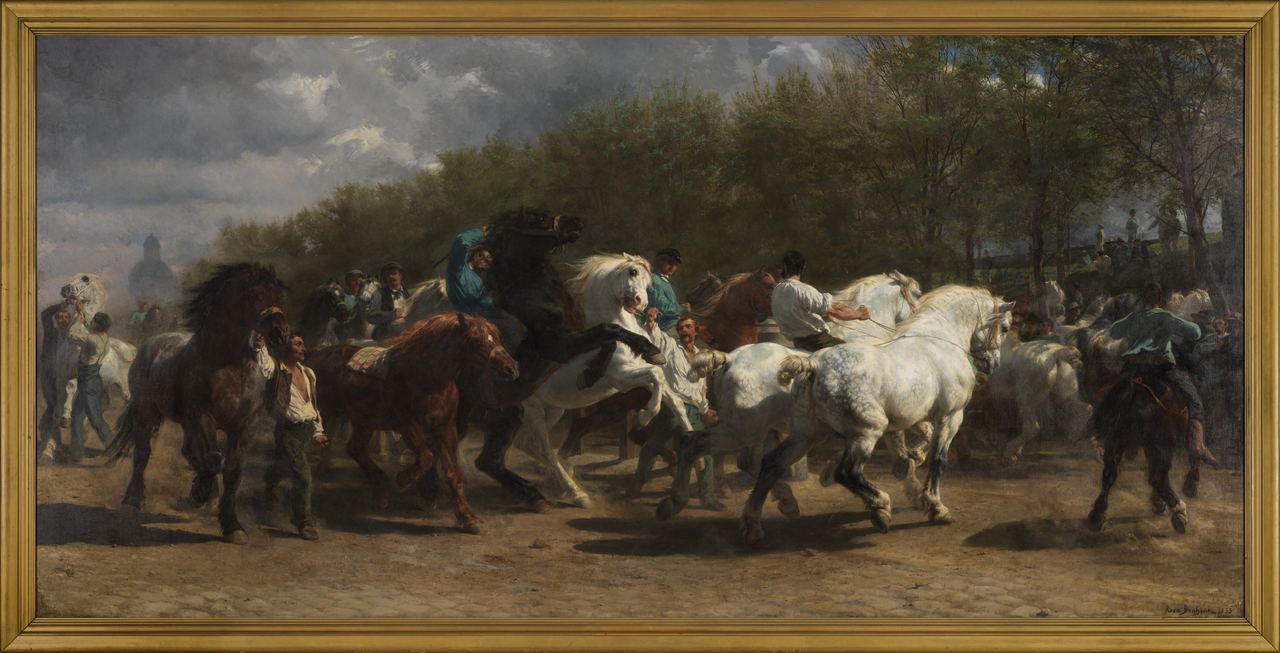
She grew up in a family of artists; Musea credits her Saint-Simonian education, in the reform movement her father belonged to, for the freedom she took from convention. She studied animals where they were: in slaughterhouses and at horse markets. The Metropolitan Museum dates The Horse Fair to 1852–55; Bonheur recalled working among horse dealers and drawing countless studies for it. She took possession of the château at By on 12 June 1860, having paid the first installment the previous August.
Official honors followed. On 10 June 1865 Empress Eugénie, then acting as regent, came to By and pinned the Legion of Honour on her; the decree, published in the Moniteur on 11 June, named "Mlle Rosa Bonheur, painter of landscapes and animals." As Bonheur told Klumpke, the Empress said she wanted her last act as regent to show that "genius has no sex." In 1894 Bonheur was promoted to officer of the Order.
| Date | Event |
|---|---|
| 29 Oct 1793 | Convention decree: freedom to wear the clothing of one's own sex; cross-dressing punishable (Prévot) |
| 7 Nov 1800 | Paris police ordinance no. 22 on "the cross-dressing of women" |
| 17 Sep 1806 | Earliest surviving request in the prefecture's file |
| 16 Mar 1822 | Bonheur born in Bordeaux |
| 1852–55 | *The Horse Fair* painted (Met dating) |
| 12 May 1857 | Date of Bonheur's surviving permit, a six-month renewal |
| 12 Jun 1860 | Bonheur takes possession of the château at By |
| 10–11 Jun 1865 | Legion of Honour from Empress Eugénie as regent |
| 1887 | Marie-Rose Astié de Valsayre writes to deputies asking for abrogation (Bard) |
| Jun 1889 | Death of Nathalie Micas |
| 1890 | Last year with recorded requests (Prévot) |
| 1894 | Bonheur promoted to officer of the Legion of Honour |
| 9 Nov 1898 | Date of Bonheur's will |
| 25 May 1899 | Bonheur dies at By |
| 31 Jan 2013 | Ministry declares the ordinance "implicitly abrogated" |
Why did Bonheur ask for a permit?
Her own explanation was work. In the biography Anna Klumpke wrote in her voice, Bonheur says she spent whole days in slaughterhouses and loved horses, which meant studying them among dealers at fairs, and that women's clothes were "a hindrance at every moment." She then applied to the prefect of police. She says she wore the clothes "simply to make my work easier."
A friend, Hippolyte Peyrol the elder, told a similar story in Stanton's 1910 book: while she was painting The Horse Fair she often went to Paris's Tattersall's, the horse market of the day, where the disagreeable experiences of the slaughterhouses were repeated, and she asked a police commissioner she knew to help her obtain a permit.
The form itself says something different. It grants permission "for reasons of health." Musea notes that Bonheur applied for reasons "anything but medical." The mismatch fits what Musea says about the process: a medical reason was the one the ordinance recognized.
The year of the first permit is less settled than popular retellings suggest. The only dated document found for this article is the renewal of 12 May 1857, which proves an earlier permit existed. The year 1852 appears in later retellings but could not be traced to a primary record.
Did she wear men's clothes everywhere?
No. By her own account and those of friends, trousers were working dress for the studio, the countryside and horseback. For Paris, visitors and official occasions she wore a woman's dress. The permit itself said she could not appear in men's dress at theaters, balls or public gatherings.
Paul Chardin, a family friend, wrote that when she received company or went to Paris she resumed a woman's dress, a black skirt and a velvet cloak. Peyrol says she dressed as a man almost continuously at home and on horseback, though in the streets of Paris she wore a gown. Another friend, Louis Passy, recalled that when he visited she always wore a skirt. Henri Cain remembered the peasants of By and Thomery bowing to the "little gentleman" in her trousers and blue blouse on her evening walks. The accounts differ in detail, but they agree on skirts for town and company, and trousers for work and the countryside.
Bonheur's own comments, as Klumpke recorded them, point the same way. She blamed women who gave up their usual dress in order to pass for men, and said her outfit was a work uniform and nothing more. On the day of the Empress's visit in 1865 she says she barely had time to hide her men's clothes. In 1898, when Klumpke wanted to paint her in a work blouse, she declined: she did not want to appear at the Salon in a blouse, she said, because "it is in my women's clothes that I want my image handed down to posterity."
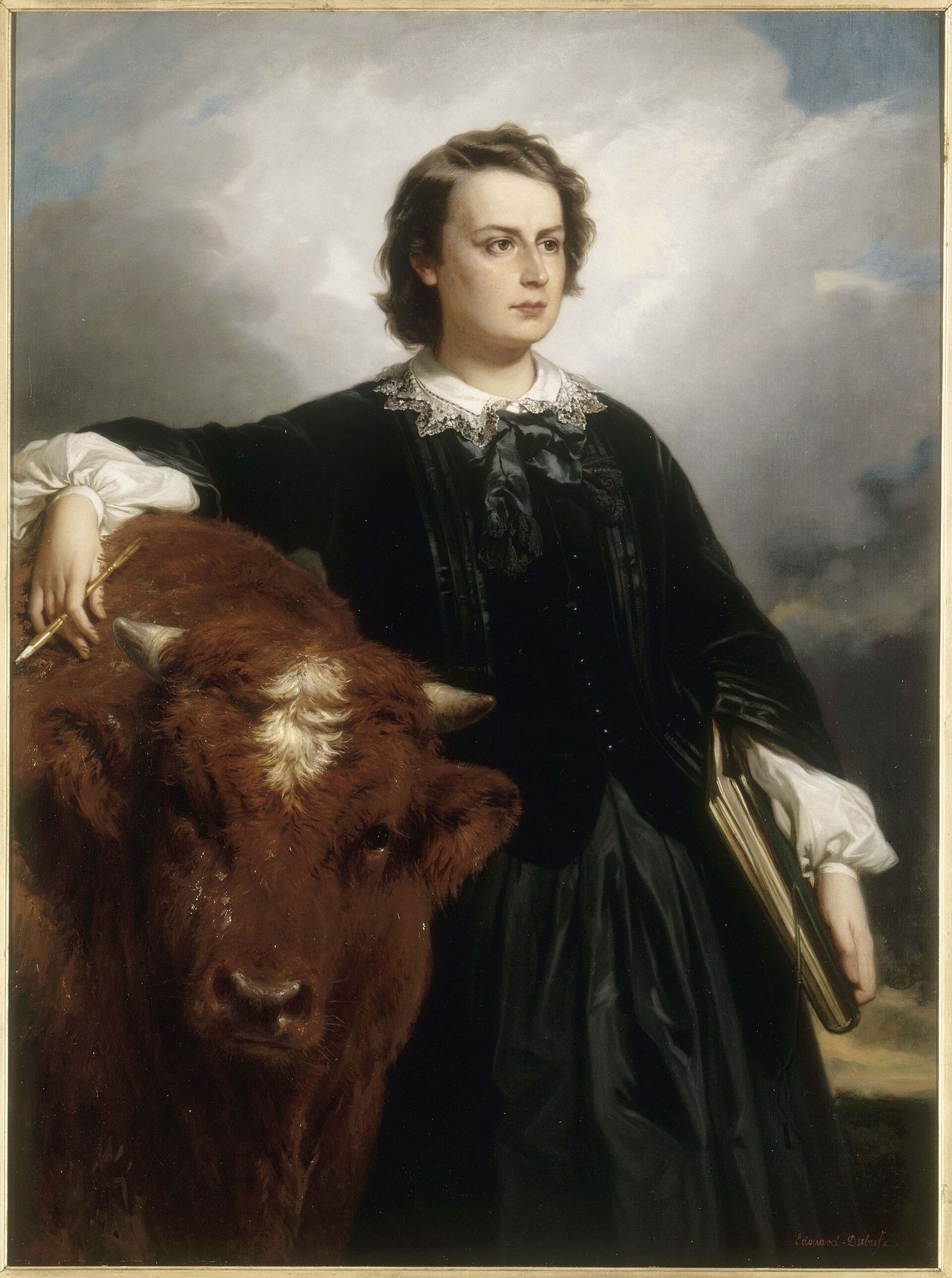
That is how the early portraits show her. Édouard Dubufe painted her in a dark jacket and long skirt, leaning on a bull she painted herself; the picture was shown at the Salon of 1857, the year of the permit renewal above. In Klumpke's account Dubufe first posed her at a table, and she asked for a living bull's head instead. The Disdéri card photograph at the top of this page shows her in a skirt as well.
Who were Nathalie Micas and Anna Klumpke?
Nathalie Micas and Anna Klumpke were the two women who shared Bonheur's later life. Micas, a painter, lived with her for decades until she died in June 1889. Klumpke, an American painter born in 1856, was close to her in the last years and became her heir. Only what the documents record is stated here.
Stanton's 1910 collection says the two met as children and became friends, a friendship that lasted until Micas's death. Klumpke's biography gives 21 June 1889; other sources give 24 June, so only the month is stated here.
Klumpke painted Bonheur's portrait in 1898, now at the Metropolitan Museum, and, at Bonheur's wish, began writing her life. Bonheur's will, dated 9 November 1898, asks to be buried in the Micas family vault at Père-Lachaise, calls Micas "mon amie," and names "Mademoiselle Anna-Élisabeth Klumpke, ma compagne et collègue peintre et mon amie" her universal legatee. Museum texts use words such as partner and companion; this article keeps to the documents.
Klumpke's book appeared in Paris in 1908 and is written in Bonheur's first-person voice, so quotations from it are Klumpke's rendering of what Bonheur said.
Was the ordinance ever repealed?
Not by a vote, and not clearly. On 31 January 2013 the women's rights ministry answered a senator's written question by declaring the 1800 ordinance "implicitly abrogated" because it conflicts with equality principles in the 1946 constitutional preamble, the constitution and the European Convention on Human Rights.
The ministry added that the ordinance was therefore without legal effect and only "a piece of archives" kept by the Paris prefecture. Bard points out the limits. A ministry has no power to abrogate a prefect's ordinance, so "implicit abrogation" is an opinion about its effect. Explicit abrogation would belong to the prefect, who declined to act in 2010, and she suggests a court could confirm that it no longer applies.
The requests came in waves, according to Bard and the parliamentary record. Astié de Valsayre wrote to deputies in 1887. In 1969 a Paris councilor, Bernard Lafay, asked the prefect to end the threat; the prefect declined, saying fashion could make such texts topical again. In 2004 the minister Nicole Ameline wrote that falling into disuse could do more than a symbolic repeal. Deputy Pierre Morange asked in 2009, and in 2010 the Paris city council passed a resolution to the prefect, who said he had more serious matters to handle. On 14 June 2011 socialist senators led by Maryvonne Blondin filed a bill to drop "obsolete provisions" on women's rights, and on 12 July 2012 Senator Alain Houpert asked for repeal.
The text could still be turned against someone. Bard recalls the athlete Violette Morris, expelled from a women's sports federation after a notorious 1930 lawsuit over her right to wear trousers, when the ordinance gave one more argument for her exclusion.
| What gets repeated | What the sources show |
|---|---|
| "Napoleon banned trousers for women" | A Paris police prefect issued a permit rule in 1800; Napoleon was not involved (Prévot) |
| "It was a French law until 2013" | A police ordinance for Paris and three communes, never a statute (Bard, Prévot) |
| "Women in trousers were jailed" | The commissioner chose between a reprimand and prison; Bard says fines and a bad hour were the usual result |
| "Trousers were allowed on a bicycle or a horse by circulars of 1892 and 1909" | The Senate question of 2012 cites them; Bard calls them "urban legend, 1900 version" and none of the sources read quote either text |
| "Repealed in 2013" | A ministry declared it "implicitly abrogated"; Bard notes this is not a formal repeal |
For the reform costumes that came next, the bloomer of the 1850s and the divided skirt of the 1890s, see Trousers, Bicycles and the Divided Skirt. Bloomers and rational dress belong to the same argument about what women's clothes were for.
What should you know before you visit the Palais Galliera?
The Palais Galliera's Un vestiaire à soi (in English, A Wardrobe of One's Own: Non-conformist Female Identities in the 19th Century) runs from 26 September 2026 to 14 February 2027. The museum's French page says it presents Rosa Bonheur's wardrobe "in its entirety." Bonheur's château says the wardrobe was kept there for over a century and is being restored for the show. This article is not a review of the exhibition.
Three facts from above help in the galleries. A permit named a reason, and the reason on hers was health, although she asked for work. It restricted where the clothes could be worn. And friends describe two wardrobes, a working one and a public one, which is a useful thing to look for among her clothes.
The Château de Rosa Bonheur at By-Thomery shows her atelier by guided tour, by reservation, with her blouse, hat and brushes left in place, according to the château's site. The Met holds The Horse Fair and Klumpke's 1898 portrait of her. For what women's dress long lacked, see Tied On, Not Sewn In: The Lost Pocket.
Sources
- Christine Bard, « Le droit au pantalon. Du pittoresque au symbolique ». La Vie des idées, 1 March 2013. Primary-scholarly. Read in full: ordinance text, permit history, 1892/1909 circulars as 'urban legend', 2013 ministry answer, repeal requests, Violette Morris. Accessed October 17, 2026.
- Question écrite n° 00692 (Houpert) and ministry answer, JO Sénat 12 July 2012 / 31 Jan 2013. Sénat. Primary. Read in full: question citing the 1892/1909 circulars; answer calling the ordinance implicitly abrogated. Accessed October 17, 2026.
- Proposition de loi n° 602 visant à supprimer des dispositions obsolètes relatives aux droits des femmes. Sénat. Primary. Cover page read: registered 14 June 2011, first signatory Maryvonne Blondin. Accessed October 17, 2026.
- Question écrite n° 61302 (Pierre Morange). Assemblée nationale. Primary. Read in full: published 20 Oct 2009, withdrawn 19 June 2012. Accessed October 17, 2026.
- Chantal Prévot, « Pantalon et jupon, quand le vêtement faisait le sexe ». Fondation Napoléon. Read in full: ordinance scope, 1793 decree, earliest surviving request (1806), no requests after 1890, Napoleon not involved. Accessed October 17, 2026.
- Autorising (Un vestiaire à soi / Musea). Musea, Laboratoire TEMOS, Université d'Angers. Read in full: certificates, hundreds of permits, a dozen in 1890, Bonheur's non-medical reasons. Accessed October 17, 2026.
- Anna Klumpke, Rosa Bonheur: sa vie, son œuvre (Paris, 1908). Internet Archive. Primary (written in Bonheur's voice by Klumpke). Full text read: permit reasons, Legion of Honour 1865 and 1894, Dubufe portrait, 1898 portrait remark, will, Micas death, her death. Accessed October 17, 2026.
- Theodore Stanton (ed.), Reminiscences of Rosa Bonheur (New York, 1910). Internet Archive. Primary-contemporary recollections. Full text read; facsimile of the 12 May 1857 permit (p. 364) viewed; Chardin, Peyrol, Passy, Cain on her dress. Accessed October 17, 2026.
- Permission de travestissement Rosa Bonheur, 12 May 1857. Wikimedia Commons. File page read for transcription and licence; wording checked against the Stanton facsimile. Accessed October 17, 2026.
- Un vestiaire à soi (EN: A Wardrobe of One's Own). Paris Musées / Palais Galliera. English and French pages read: dates, title, wardrobe shown 'dans son intégralité' (French page). Accessed October 17, 2026.
- Château de Rosa Bonheur. Château de Rosa Bonheur. Read: guided studio visits by reservation; wardrobe being restored for the Galliera show. Accessed October 17, 2026.
- The Horse Fair, Rosa Bonheur, 87.25. The Metropolitan Museum of Art. Primary. Object record via Open Access API: 1852–55, CC0. Accessed October 17, 2026.
- Portrait de Rosa Bonheur, Disdéri, PH38056. Paris Musées Collections, Musée Carnavalet. Primary. Record read: albumen carte de visite, before 1889, CC0. Accessed October 17, 2026.
- Rosa Bonheur's Permission to Wear Pants (Matthew Wills). JSTOR Daily. Opened; used only to locate Gretchen Van Slyke, 'The Sexual and Textual Politics of Dress', Nineteenth-Century French Studies 26 (1998). Accessed October 17, 2026.
Glossary
Last updated · Markdown · Report an error