Craft
Harriet Powers: The Quilter Who Stitched Scripture and Sky
Born into slavery in Georgia, she appliquéd Bible scenes and falling stars onto two quilts that survive. What the panels meant comes largely from her own explanations, as one buyer wrote them down.
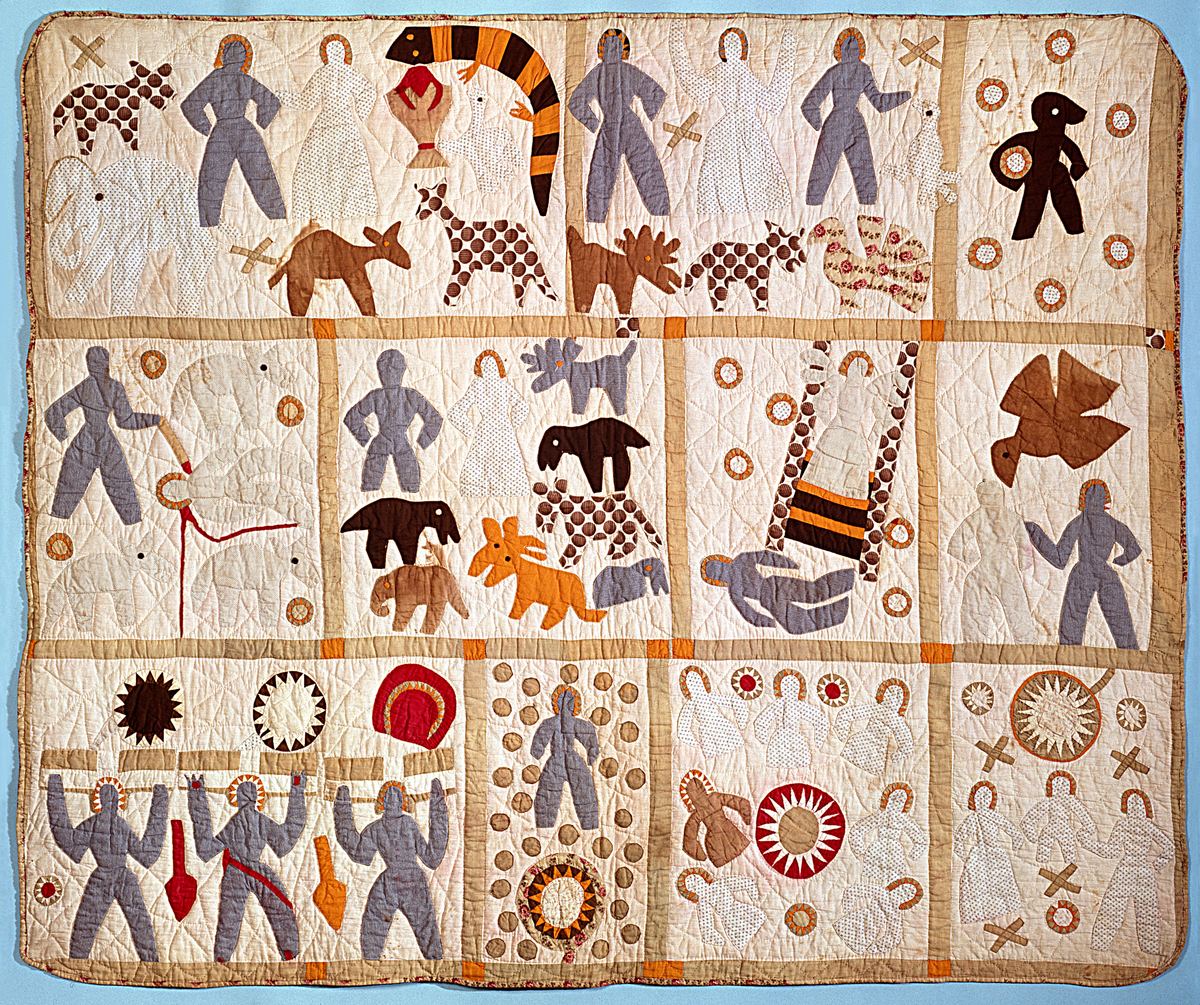
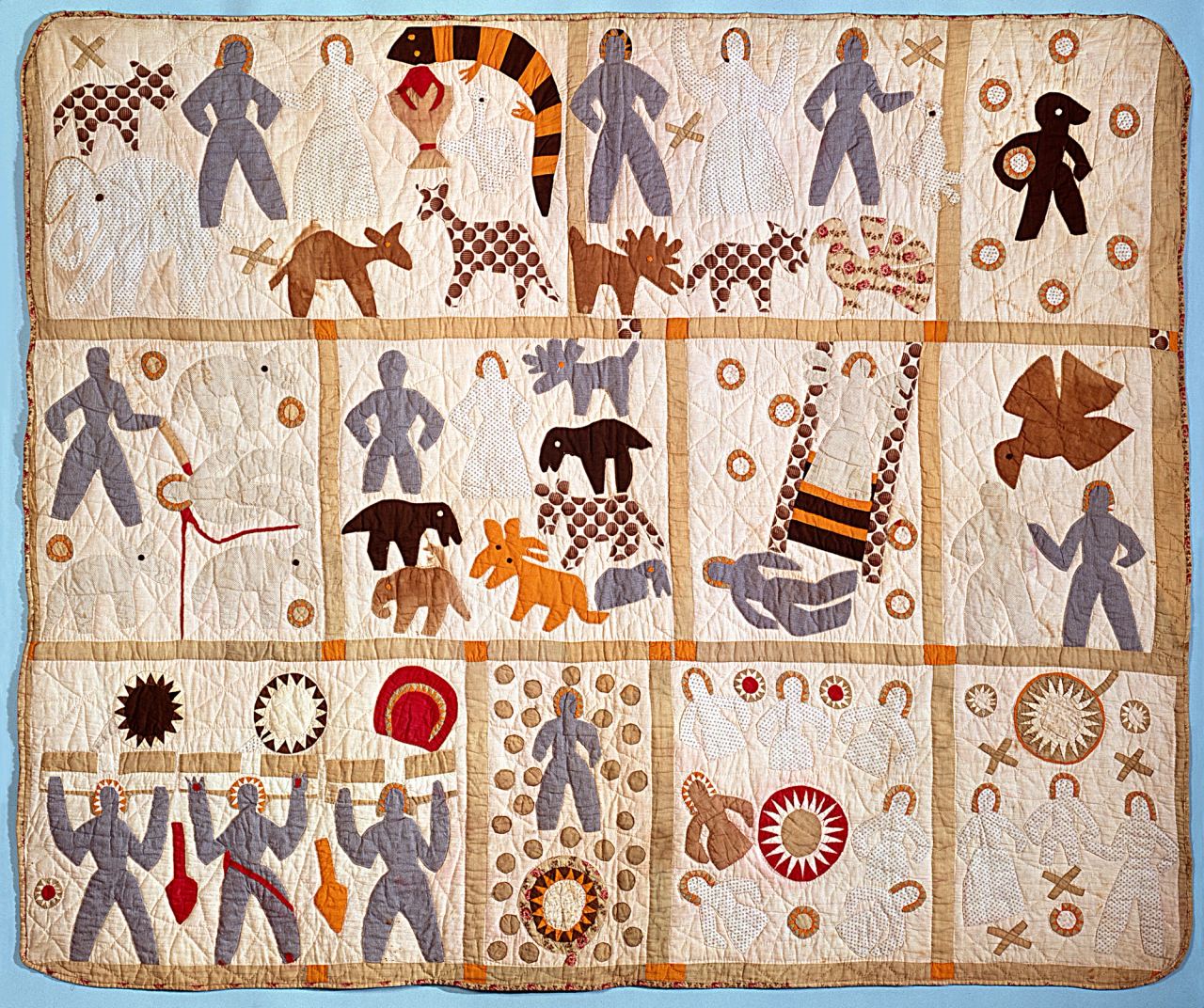
Harriet Powers (1837–1910) was a Georgia farm woman, born into slavery, who appliquéd Bible stories, local legends and natural wonders onto quilts. Two survive: the Bible Quilt (1885–86) at the Smithsonian and the Pictorial Quilt (1895–98) at the Museum of Fine Arts, Boston. Much of what we know about the Bible Quilt's meaning comes from her own panel-by-panel explanations, written down by the woman who bought it.
Who was Harriet Powers?
Powers was born on October 29, 1837, according to the Georgia Women of Achievement biography. The Athens Historical Society, citing Kyra Hicks's 2009 book, gives her own wording: "Born in Madison Co. 8 miles from Athens on the Elberton road in the year Oct. 29, 1837." The Smithsonian and National Geographic give the year only.
The Georgia Women of Achievement biography says she spent her early life on a plantation owned by John and Nancy Lester in Madison County, where girls typically learned to sew from other enslaved women or from the mistress of the house. She married Armstead Powers in 1855, at 18, and the couple had nine children. After emancipation the couple bought four acres at Sandy Creek, near Athens in Clarke County, and raised cotton and vegetables, according to the U.S. Postal Service's account of her life.
Quilting ran through her adult life. The Smithsonian's record says she won prizes for quilts as early as 1872, and that joining Mount Zion Baptist Church led her to combine scripture with quilting, beginning with a Lord's Supper quilt in 1882. It also states plainly that she was literate. That correction matters, because some published biographies still say she could not read. Hicks found a copy of an 1896 letter in which Powers herself describes learning to read, her church, her husband and nine children, and her quilts.
| Date | Event |
|---|---|
| Oct. 29, 1837 | Born near Athens, Georgia, in Madison County by her own account |
| 1855 | Marries Armstead Powers |
| 1872 | Earliest quilt prizes noted by the Smithsonian |
| 1886 | Shows the Bible Quilt at a fair in Athens, where Jennie Smith tries to buy it |
| c. 1890–91 | Sells the Bible Quilt to Smith for $5; sources differ on the year |
| 1895 | Smith exhibits the quilt at the Cotton States and International Exposition in Atlanta |
| 1895–98 | Powers makes the Pictorial Quilt |
| Jan. 1, 1910 | Dies; buried at Gospel Pilgrim Cemetery, Athens |
| 1960s | Pictorial Quilt enters the MFA collection as a Maxim Karolik bequest (accession 64.619) |
| 1968 | Bible Quilt reaches the Smithsonian, mailed by the donor, per the USPS |
| 2021 | Both quilts shown together for the first time, at the MFA |
How did the Bible Quilt reach a museum?
Jennie Smith, an art teacher at the Lucy Cobb Institute in Athens, saw the quilt at a fair in 1886. She wrote later that she offered to buy it, "but it was not for sale at any price." Her account is the main record of the sale; as Powers's descendant Alyse Minter has put it, "we only have Jennie Smith's word to rely on."
Which fair is uncertain. Smith called it a Cotton Fair. The Smithsonian record names the Northeast Georgia Fair, and the Postal Service calls that "most likely." The Athens Historical Society reports that Hicks found no trace of a Clarke County Cotton Fair in the 1886 Athens newspaper, and that Powers's name does not appear in the Northeast Georgia Fair coverage. The fair is one of several details the record leaves open.
The sale came years later. Smith's account, as quoted by the quilting site Mary Go Round Quilts, says Powers first offered the quilt four years after the fair, but Smith could not afford it. The following year, Smith sent word that she would buy it. National Geographic and WBUR agree on the rest: Powers arrived in an oxcart with the quilt wrapped in a flour sack, inside a second sack, and asked $10; Smith had $5, and Powers accepted. Smith wrote that Powers returned several times to visit what Smith called "the darling offspring of her brain," and that Smith promised to save her scraps. On Smith's own timeline the sale fell about five years after the fair, which fits the 1890 or 1891 that modern accounts give.
Smith showed the quilt in the Negro Building at the 1895 Cotton States and International Exposition in Atlanta. The Smithsonian record gives the later chain only in outline: the credit line reads "Gift of Mr. and Mrs. H. M. Heckman," the museum acquired it after Smith's death, and the Postal Service says the donor mailed it to the museum in 1968. None of the sources I read explains how the quilt passed from Smith to the Heckmans.
How was it made?
The Smithsonian's catalog entry is the most precise description. The quilt measures 75 by 89 inches (191 by 227 cm). Its eleven blocks are joined by both hand and machine stitching. The appliqué, meaning shapes cut from cloth and stitched onto a ground, is machine-stitched, except for the animals' eyes, halos and suns, which are hand-stitched. The quilting through the cotton filling follows the outlines of the figures, with random intersecting straight lines in the open spaces, at five to six stitches per inch. A strip of floral printed cotton binds the edge.
The Georgia Women of Achievement entry counts 299 separate pieces. The Smithsonian record says the ground was once a bright pink with green borders; light exposure during a long exhibition history has faded the cloth. Writing in 1914, Lucine Finch described the quilt as made of gay-colored calico, and the surviving animals show why: dots, stripes and small prints stand in for fur and pattern. For how printed cottons like these were made, see Printed Cloth, Block to Screen.
Some writers link her flat, silhouetted figures to West African appliqué traditions. The Georgia Women of Achievement biography makes that case, citing a 1993 source, but the Smithsonian record does not, and what Powers herself learned from whom is not documented in the sources I read. For the vocabulary of layered cloth, see Quilt, Coverlet, Counterpane: What Is the Difference?.
What do the eleven panels show?
The panels read in three rows. The Smithsonian record lists them from the top left:
| Row | Panel | Scene |
|---|---|---|
| 1 | 1 | Adam and Eve in the Garden of Eden |
| 1 | 2 | Paradise continued; Eve has borne a son |
| 1 | 3 | Satan |
| 2 | 4 | Cain killing Abel |
| 2 | 5 | Cain going into the land of Nod to get a wife |
| 2 | 6 | Jacob's dream |
| 2 | 7 | The baptism of Christ |
| 3 | 8 | The Crucifixion |
| 3 | 9 | Judas Iscariot and the thirty pieces of silver |
| 3 | 10 | The Last Supper |
| 3 | 11 | The Holy Family |
Smithsonian curators write that Powers "insisted that Smith record exactly what each panel depicted." Finch's 1914 article in The Outlook, one of the earliest published descriptions, repeats what Powers reportedly said. In the first panel the serpent has feet, which Powers is reported to have explained as the creature's equipment for getting around humans in those days. In the Jacob's dream panel, she said, the animals' calico ran over into the ladder because there was no other way. Finch gives Powers's speech in heavy dialect, never names her, and frames the quilt as the product of a "primitive mind." The report is useful but sits inside a condescending frame, so it is paraphrased here rather than reproduced.
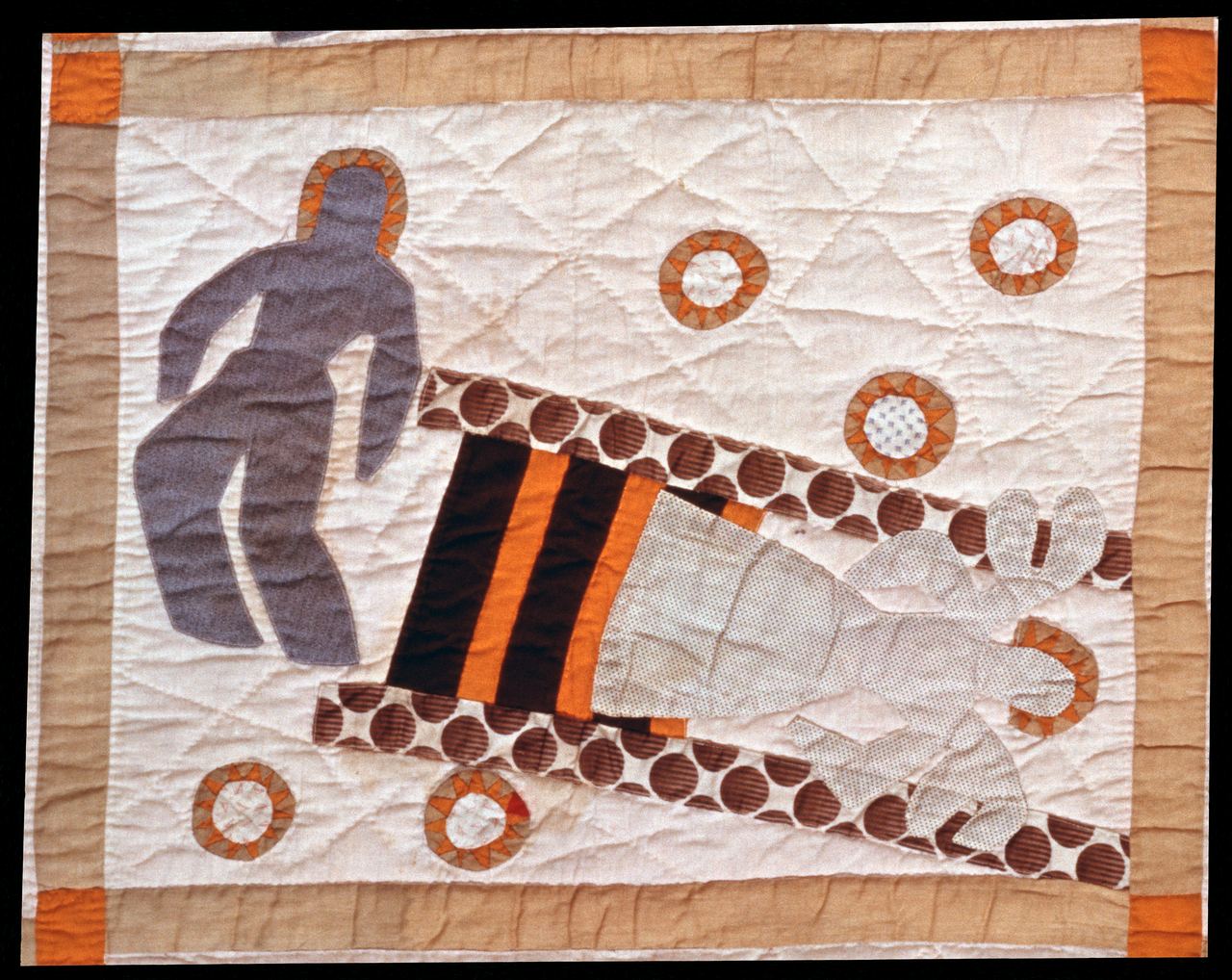
Readers have found structure in the arrangement. James Romaine, writing for ArtWay, notes that Cain appears in three panels and suggests that the bottom row may be meant to read from right to left, a reversal he sees as marking Christ's entrance into history. The Smithsonian does not number them that way. Treat it as one reader's argument, not a documented intention.
What does the Pictorial Quilt add?
The Pictorial Quilt, now at the Museum of Fine Arts, Boston (accession 64.619), has fifteen panels. They set Bible scenes beside events from nature and local memory. According to the Postal Service, Powers explained each panel when she delivered it in 1898, as she had for the Bible Quilt; National Geographic adds that a description of each panel by Powers herself was handed down with the quilts.
Two panels show how she handled the sky. One illustrates the night of November 13, 1833, the Leonid meteor storm. Her description reads, in part, "God's hand staid the stars. The varmints rushed out of their beds." She was born four years after it, so she was drawing on testimony. National Geographic puts the storm at 50,000 to 150,000 meteors an hour. Another panel records "Cold Thursday," February 10, 1895, a sub-zero day in Athens, which was within her own living memory.
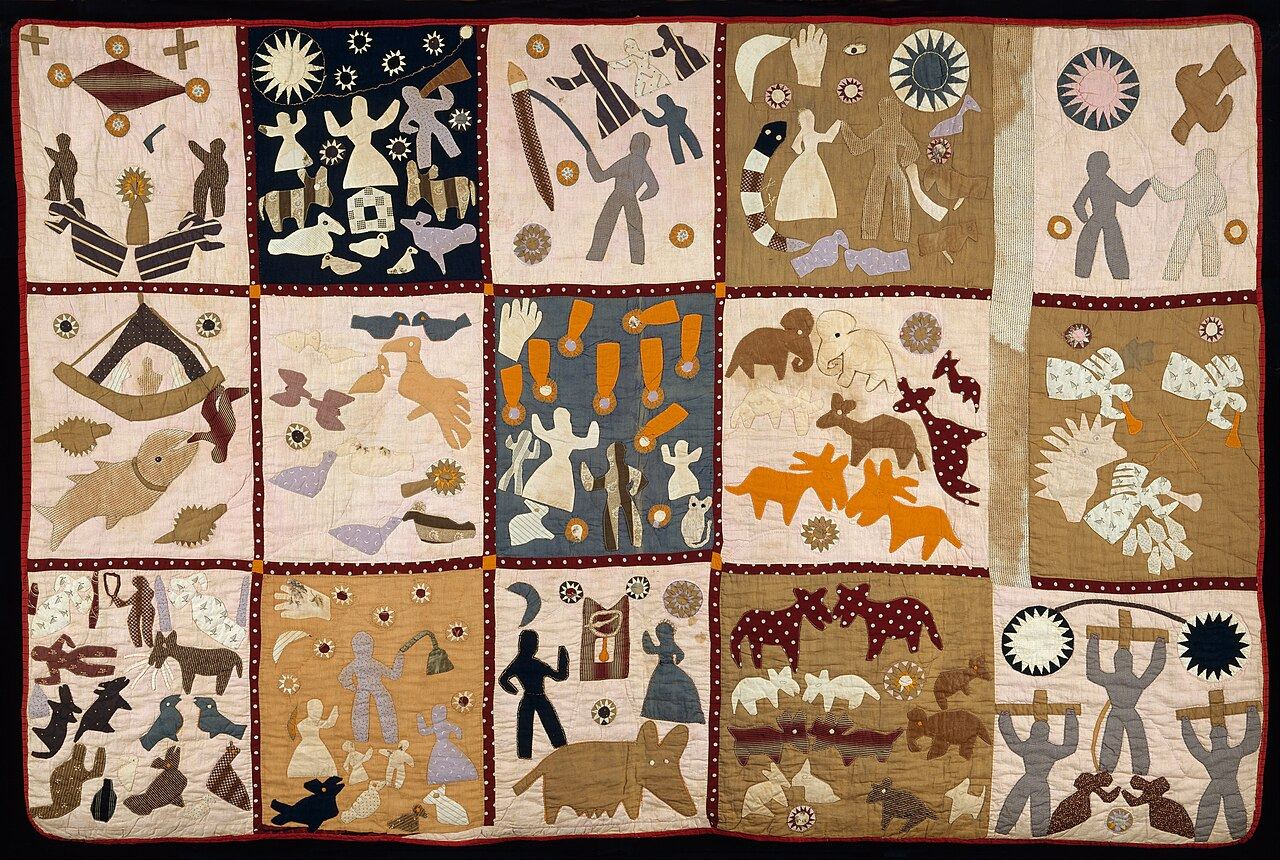
How the quilt came to be made differs by source. According to the Postal Service and the Georgia Women of Achievement entry, Atlanta University faculty women saw the Bible Quilt in 1895 and commissioned a second quilt as a gift for Charles Cuthbert Hall, a trustee of the university. National Geographic reports instead that the quilt was shown at a Nashville exposition and bought there. It stayed with the Hall family for about six decades before Maxim Karolik acquired it; the credit line reads "Bequest of Maxim Karolik."
What is known, and what is not?
Known: two quilts survive, and each has a museum record. The Smithsonian says she made at least five. Her 1896 letter lists a quilt of 4,050 diamonds from 1872, a Lord's Supper quilt of 2,500 diamonds, and a star quilt shown at a colored fair association in Athens in 1887. National Geographic notes that the whereabouts of three of them remain unknown. Only one photograph of Powers is confirmed.
Not known: how the Bible Quilt passed from Smith to the Heckmans, the exact year of the sale, which fair she attended, and how much of the Bible Quilt text is Powers's wording and how much is Smith's. WBUR spoke with Alyse Minter, Powers's great-great-great-granddaughter, who has read Smith's entire account. Minter says Smith clearly admired the quilt but did not see Powers as her equal, and that relying only on Smith's word "takes away some of the agency" from Powers. That is the central caution for reading the panel list above.
How do scholars read her work?
Hicks's research changed the picture: finding the 1896 letter, kept at the Lee County Historical Society in Keokuk, Iowa, put Powers's own voice beside Smith's. The letter was addressed to Lorene Diver, an Iowa woman who also wanted to buy the quilt. The Smithsonian says Diver saw it in 1886, while National Geographic says she saw it at the 1895 exposition.
The folklorist Gladys-Marie Fry, as National Geographic tells it, sat in front of the Bible Quilt asking who Powers was. Laurel Thatcher Ulrich wrote that Powers explained her quilts to anyone who would listen, which is one reason they survived. The historian Tiya Miles has written that "it is not through Powers's intentional will" that the quilts hang in major museums, and she points to the difficult dynamics of race in museum collecting. Jennifer Swope, an MFA curator, calls the panels' order a cycle "like a renaissance fresco."
For makers, the lesson is practical. Powers worked with printed cotton, a sewing machine and hand stitching, and made flat shapes carry whole stories. For another tradition of narrative stitching built from humble cloth, see Nakshi Kantha: Quilts Stitched from Worn Cloth. The Postal Service issued four stamps from panels of the Pictorial Quilt in 2026.
Where can you see her work?
The Bible Quilt belongs to the Smithsonian National Museum of American History in Washington, D.C.; its online record currently lists it as not on view. The Pictorial Quilt belongs to the Museum of Fine Arts, Boston, which showed it beside the Bible Quilt in 2021. Check each museum's site before a visit.
- Smithsonian record for the Bible Quilt
- MFA Boston record for the Pictorial Quilt
- WBUR: Harriet Powers' quilts leave a complicated legacy for her descendent
- National Geographic: This Black artist's vibrant quilts inspired generations
- Athens Historical Society: Stitching Stories
- Hicks, This I Accomplish (2009), on the Internet Archive
Sources
- 1885 - 1886 Harriet Powers's Bible Quilt (object record). Smithsonian National Museum of American History. Full record read via the Smithsonian Open Access API (edanmdm:nmah_556462): panel list, materials and construction, credit line, ID TE.T14713, accession 283472, curatorial text on Powers, Smith and the Diver letter; image media flagged CC0 per item. The dashboard page itself returns 403 to bots. Accessed October 24, 2026.
- Harriet Powers' quilts leave a complicated legacy for her descendent. WBUR. Full text read: Smith's quoted words, $10/$5 price, Alyse Minter's comments, 2021 MFA exhibition of both quilts, Pictorial Quilt description. Accessed October 24, 2026.
- This Black artist's vibrant quilts inspired generations of U.S. artisans. National Geographic (Cathy Newman, Feb. 2, 2023). Full text read: 1896 letter to Lorene Diver and the quilts it lists, the falling-stars panel and quote, Smith's quoted words, Fry, Ulrich, Miles, Swope, Hicks. Accessed October 24, 2026.
- Who Was Harriet Powers? Formerly Enslaved Quilter Now on a U.S. Postage Stamp. U.S. Postal Service, Stamps Forever (Mar. 5, 2026). Full text read: biography, Northeast Georgia Fair, Cotton States Exposition 1895, Pictorial Quilt commission and 1898 delivery, Hall family, MFA credit line and accession 64.619, 1968 mailing of the Bible Quilt. Accessed October 24, 2026.
- Harriet Powers, artist and quilter (2009 inductee). Georgia Women of Achievement. Full text read: birth date Oct. 29, 1837, Lester plantation, marriage, nine children, 299 pieces, Cold Thursday and falling-stars panels, death date and burial. Its statement that she could not read is contradicted by the Smithsonian record and Hicks's find. Accessed October 24, 2026.
- Stitching Stories: Harriet Powers and Georgia Quilters. Athens Historical Society. Read via WebFetch summary only (the site blocks curl): Powers's own wording of her birth from Hicks (2009); Hicks's finding that no 1886 Clarke County Cotton Fair is recorded in the Athens newspaper. Used only for those two points. Accessed October 24, 2026.
- A Sermon in Patchwork (Outlook, vol. 108, Oct. 28, 1914, pp. 493-495). The Outlook, by Lucine Finch. Full OCR text read on the Internet Archive: panel-by-panel account, calico, the serpent with feet, spotted ladder; text never names Powers and uses dialect and condescending framing. Used as a period source with that caveat. Accessed October 24, 2026.
- History Corner: Harriet Powers and the Bible Quilt. Mary Go Round Quilts. Read in full; quotes Jennie Smith's account at length (four years later; the following year; ox-cart). Secondary, used only for Smith's timeline; the oxcart, sacks and $10/$5 are confirmed by NatGeo and WBUR. Accessed October 24, 2026.
- Harriet Powers - Pictorial quilt - Google Art Project.jpg (Commons file page). Wikimedia Commons. File page read: MFA 64.619, 1895-1898, PD-Art / PD-1923 tags with stated basis. Accessed October 24, 2026.
- Harriet Powers: Bible Quilt. ArtWay (James Romaine). Full text read: reading of panel order and Cain's three appearances; presented as one reader's interpretation. Accessed October 24, 2026.
- This I Accomplish: Harriet Powers' Bible Quilt and Other Pieces. Kyra E. Hicks, Black Threads Press, 2009. Not read (lending copy). Cited only as quoted by the Smithsonian record, NatGeo, Wikipedia (used to locate references) and the Athens Historical Society. Accessed October 24, 2026.
Glossary
Last updated · Markdown · Report an error