Quilting
Nakshi Kantha: Quilts Stitched from Worn Cloth
What is kantha embroidery and how is it made? Worn saris layered, quilted in running stitch and drawn over in colored thread: the patterned quilts of Bengal, and how they differ from sashiko and boro.
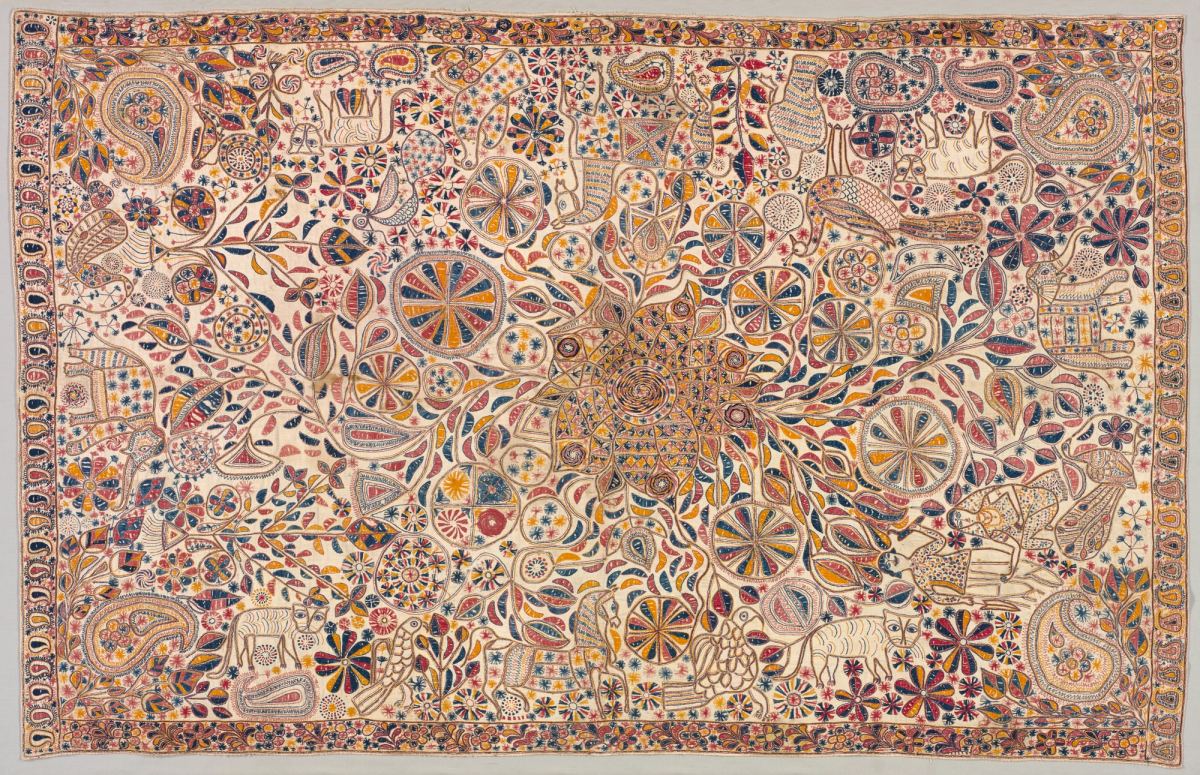
Kantha is flat, unwadded quilting from Bengal, in Bangladesh and West Bengal: layers of cloth, traditionally worn sari lengths, held together by rows of running stitch. In nakshi kantha, the "patterned" kind, women also stitched flowers, animals, gods and household objects across the surface, often in thread pulled from the borders of the same old saris.
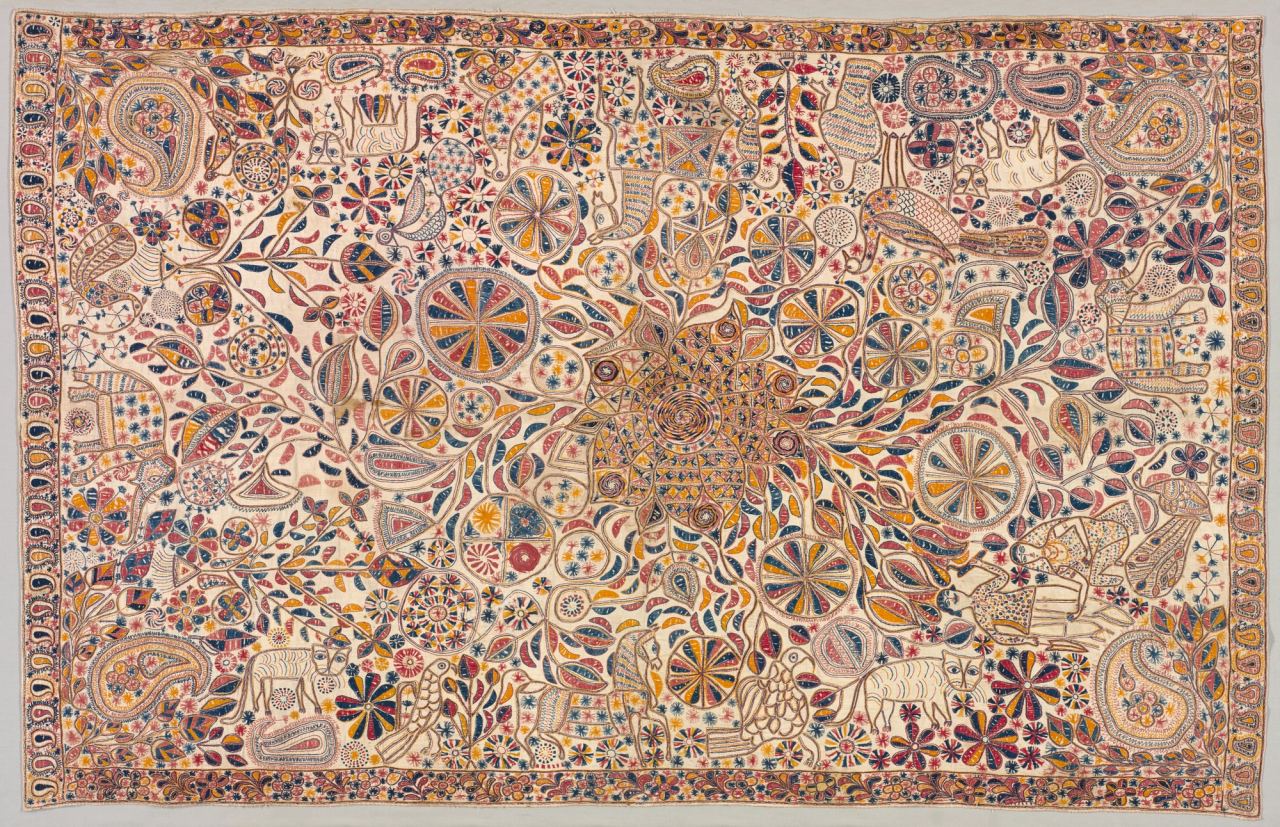
What is kantha, and what makes it "nakshi"?
Kantha names both a stitching method and, in everyday speech, the quilt made with it. The Victoria and Albert Museum notes that the word now refers to the stitching style rather than the object. Bengali kanthas were made by women for their own homes, as bedcovers, mats and all-purpose wrappers, according to the V&A, and the Philadelphia Museum of Art adds that they marked births, weddings and other family occasions.
Nakshi means patterned. The Daily Star traces it to naksha, an array of colorful patterns embroidered on cloth. Niaz Zaman, writing in Banglapedia, says literate Bengalis took up the name nakshi kantha after Jasimuddin's poem "Nakshi Kanthar Math," published in 1929; a Daily Star feature by Maheen Khan and Selim Ahmed gives the same year. The origin of the word kantha itself is less settled: that feature lists a Sanskrit word for recycled fabric, the word for a field, and the word for words or speech as possibilities, and says none is certain. Regional names differ too. Zaman records kheta and kentha in East Bengal dialects and sujni in Bihar and parts of West Bengal.
The Southeastern Quilt and Textile Museum has a dated reason to look: its exhibition "Nokshi Notions: Expressing Love With Bengali Folk Art" runs from November 21, 2026, to February 16, 2027. The museum says it highlights pieces from Bengali communities in Atlanta and Bangladesh, whose members were gifted deeply sentimental works. The page does not say what techniques the show covers, so this article stays with the museum records below.
How is a kantha made?
A kantha is made by stacking worn cloth, quilting the stack with running stitch, and drawing the design in colored thread. Zaman says that three to seven saris are layered depending on the thickness wanted. The V&A adds that the fabric was often worn sari lengths, softened by washing, and that already-worn cloth was colorfast.
| Step | What happens | Source |
|---|---|---|
| 1. Gather | Old saris, dhotis and lungis supply the cloth | Banglapedia (Zaman); V&A |
| 2. Layer | Three to seven saris, depending on the thickness wanted | Banglapedia (Zaman) |
| 3. Pull thread | Colored threads are drawn out of the woven sari borders; embroidery skeins are common today | V&A; Banglapedia (Zaman) |
| 4. Quilt | Rows of running stitch bind the layers, in a thread matching the ground, and make a rippled surface | V&A; Banglapedia (Zaman) |
| 5. Draw in thread | Motifs are outlined and filled, in running stitch and in other stitches | Philadelphia Museum of Art; V&A |
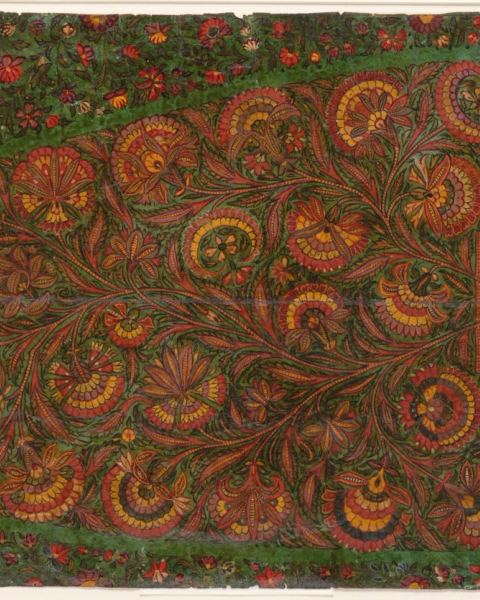
Step four is the heart of the object. The V&A describes kantha as "flat" quilting with no batting between the layers, worked in a thread that matches the background, and says that older quilts use echo quilting, in which the quilting lines run around the embroidered motifs. Look closely at the pale ground of Cleveland's 1996.350 and you can see fine wavy lines of quilting stitches running across the cloth between the colored motifs.
How long it takes depends on who you ask. A 2016 Daily Star feature says a sizeable quilt with intricate patterns might take 10 to 15 days, while the 2012 Daily Star feature says pieces were often made spontaneously and could take years to finish.
Which stitches are used?
Running stitch is the basic stitch, for the quilting and for the motifs. The Philadelphia Museum of Art says kanthas use it for textured backgrounds and to outline and fill motifs, and that the patterns often imitate woven sari borders. The same museum's record for a nineteenth-century kantha notes that front and back can mirror each other, a quality called dorukha.
Other stitches join it. The V&A's record for an early twentieth-century coverlet from Bangladesh lists running stitch, pattern darning, satin stitch and buttonhole stitch. Banglapedia names further stitches: a mat stitch and a "bending" stitch for motifs or borders, a rippling stitch that fills areas without motifs, and a thick-yarn, close-darning type called lohori or lohira.
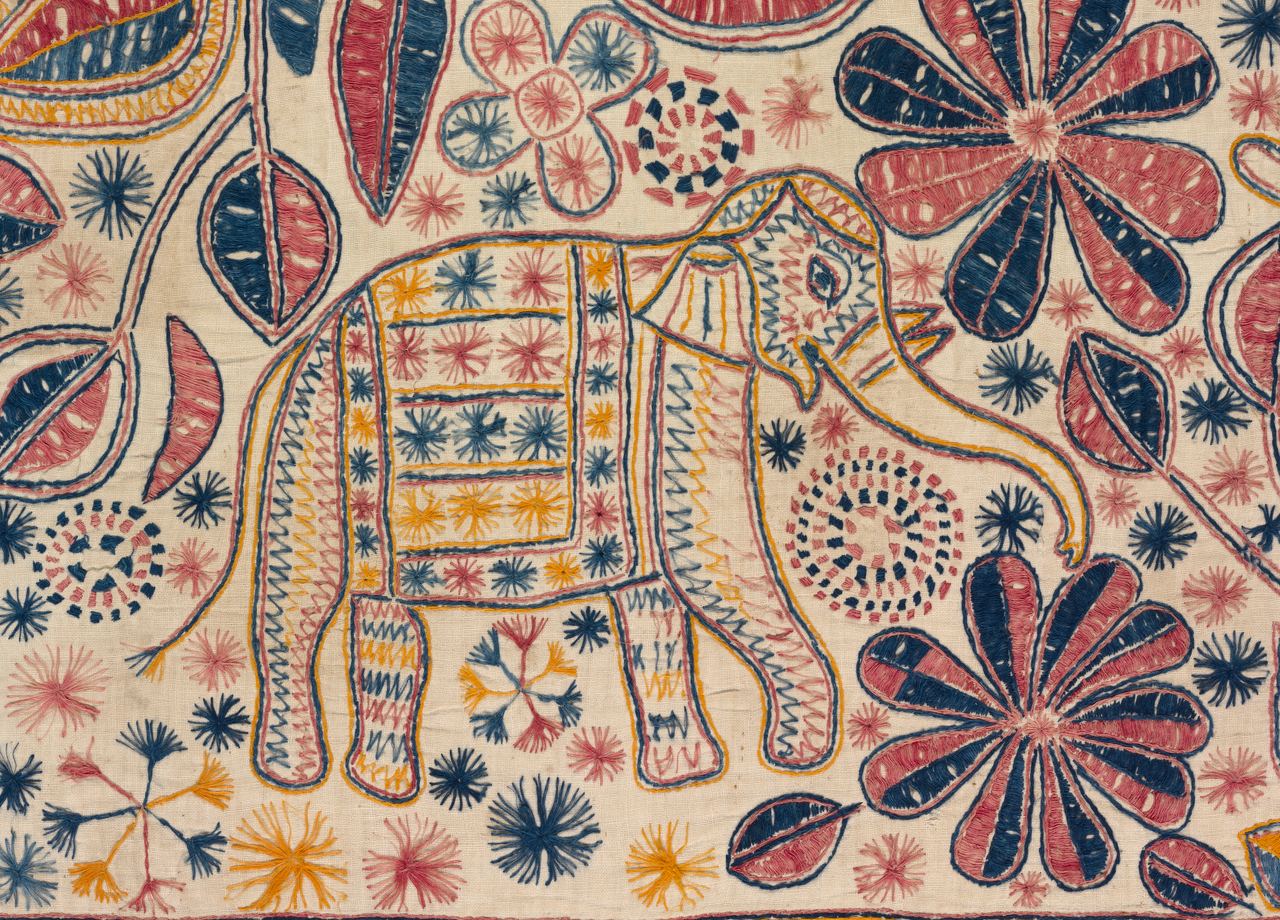
You can see some of this in the elephant above, a detail of the Cleveland quilt. It is outlined in lines of colored thread, its body and blanket are filled with bands that look like zigzag and straight stitching, and the flower petals are filled in alternating colors. Small starburst tufts fill the gaps. These descriptions come from looking at the photograph; the museum's record names only the cotton thread and cotton ground.
What do the pictures show?
The designs mix flowers, animals, daily life and religion. According to Zaman, most kanthas center on a lotus ringed with concentric circles of vines or sari-border patterns, with a tree of life or kalka in the corners. She lists elephants, tigers, horses, peacocks, boats, palanquins, kitchen utensils and ornaments among the recurring motifs, alongside scenes from Hindu mythology and of dancing, hunting and boating. Some quilts carry proverbs, blessings or captions, and some are signed.
Museum records show how specific the stories can be. A V&A sitting mat, probably made in Khulna in the early twentieth century, shows the goddess Devi Chandi on her lion, Krishna with Radha, and Rama and Sita with Hanuman, with the gods dressed as urban Bengalis. The maker's name, Basanta Kumari, is embroidered around the central roundel. A coverlet in the same museum, made around 1920–1923 in Faridpur district, carries the name Kadambini in Bengali in one corner.
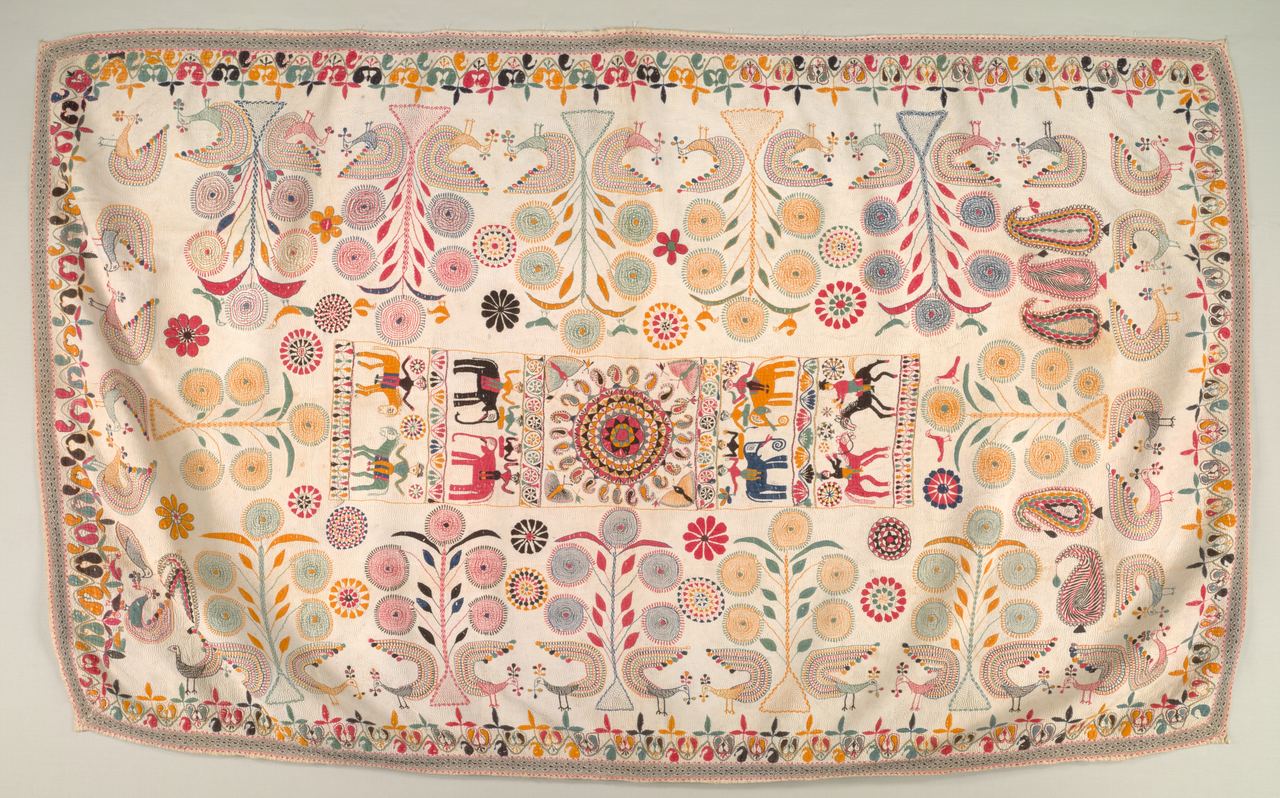
The second Cleveland quilt, 1996.350, shows a more formal layout. Facing pairs of peacocks and tall trees with round flower heads fill the field, and a central panel shows riders on elephants and horses around a circular medallion ringed with curved shapes. The V&A uses the terms boteh and "paisley" for such teardrop motifs; Teazle's note on Kashmir shawls and the word paisley follows that shape's travels.
Zaman also reports that old cloth was believed to ward off the evil eye, and that motifs carry hopes for happiness, prosperity, marriage and fertility. Treat those as the beliefs Zaman records, not as a key to any single quilt.
How do kantha, sashiko and boro compare?
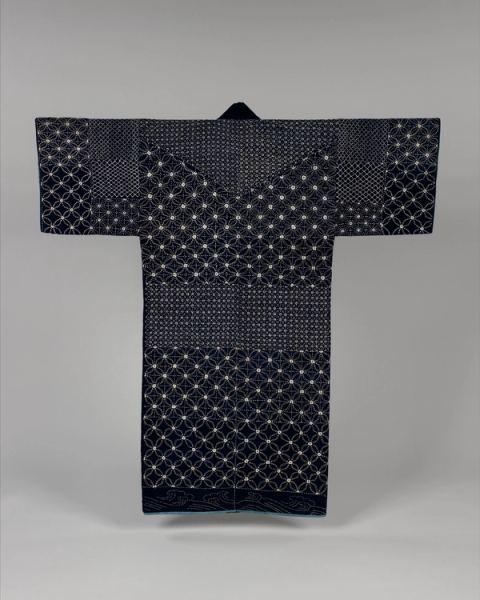
All three are built on running stitch, and kantha and boro are both traditions of reusing worn cloth. They differ in intent. Sashiko and boro are Japanese, and Teazle's sashiko versus boro guide explains that sashiko is a stitching technique and boro the patched cloth that repeated mending leaves behind. Kantha names both the stitching and the object, and its stitches are not confined to quilting: they carry pictures.
| Nakshi kantha | Sashiko | Boro | |
|---|---|---|---|
| Where | Bengal (Bangladesh and West Bengal) | Rural Japan, especially the north | Northern Japan |
| What the name means | Patterned kantha; *kantha* is now also the stitch | "Little stabs," a stitching technique | Rags or scraps; a kind of object |
| Cloth | Worn saris, dhotis and lungis, layered | Often indigo-dyed cotton or hemp | Patched indigo cotton and hemp |
| Thread | Colors pulled from sari borders, or skeins | Traditionally white cotton | Running stitches that hold patches |
| Design | Pictorial: figures, flowers and borders | Named geometric patterns, marked on a grid and counted | Not drawn in advance; shaped by what wore out |
The Japanese entries come from Teazle's published sashiko and boro entries; the kantha column comes from the sources in this article. A caution: pictorial and geometric are tendencies, not rules. Zaman notes that varying stitch length can reproduce the woven patterns of sari borders, and sashiko can be purely decorative.
What happened to the tradition?
Zaman writes that political upheavals, manufactured goods and changing tastes led to a decline in richly embroidered kanthas in the early twentieth century, though utilitarian ones continued. Not all kantha production was domestic, even then. The V&A's record for the Faridpur coverlet says it was made on a commercial basis and bears a label of the Bengal Home Industries Association, in a period when village cooperatives encouraged cottage industry.
Kantha also developed other forms. The Philadelphia Museum of Art describes "carpet" kanthas, called galicha, worked in cross-stitch (a European-derived technique first taught to Bengali schoolgirls in the colonial period, it says) and made especially after 1947 in the northwest of what was then East Pakistan. It dates the nakshi kanthas in its show to about 1870–1930, and notes that it is often hard to say where one was made: girls typically married in their early teens and moved to their husband's village, blending their needlework with local practice.
Today's kantha often uses new fabric. Zaman describes a revival in both Bangladesh and West Bengal as interest in folk crafts grew, and the V&A says projects now use the work to preserve skills and give communities an income, and that the style is regarded as a symbol of Bangladeshi culture. For the age of the tradition, the Daily Star feature and a University of Chicago page by Manjari Mohanty both point to a mention in the Sri Sri Chaitanya Charitamrita; neither gives a date for the earliest quilts, and the pieces in the museum records used here date from the 1800s onward.
Where can you see one?
Cleveland Museum of Art's two kanthas are in its open-access collection: 1960.274 and 1996.350, both catalogued as 1800s. The V&A has several, including a coverlet from Bangladesh (IS.61-1981), the sitting mat (IS.16-2008) and a Bengal coverlet (IS.6-2011), and its article on kantha is a good short introduction. The Philadelphia Museum of Art holds Stella Kramrisch's kanthas, collected in the 1920s and 1930s, and published a catalogue edited by Darielle Mason in 2009. If you are curious about the broader family of layered, stitched cloth, Teazle's guide to quilt, coverlet and counterpane is a short way in, and the entry on quilting defines the wadded version.
Sources
- Nakshi Kantha. Niaz Zaman, Banglapedia. Full entry read: definition, names (kheta, kentha, sujni), 1929 Jasimuddin poem, materials, three to seven layered saris, thread from sari borders, stitches, motifs, uses, early twentieth-century decline, revival. Accessed October 23, 2026.
- Kantha: a South Asian quilting tradition (article, updated 17 April 2024). Victoria and Albert Museum. Full article read: flat unwadded quilting, worn sari lengths, threads pulled from borders, colorfast, echo quilting, matching quilting thread, kantha now names the stitching, revival projects. Accessed October 23, 2026.
- Coverlet (kantha), IS.61-1981, Bangladesh, early 20th century. Victoria and Albert Museum. Object record read via the V&A API: recycled cotton saris and dhotis, layers, stitches (running, pattern darning, satin, buttonhole), thread extracted from borders. Accessed October 23, 2026.
- Kantha (coverlet), IS.41-1976, Faridpur, ca. 1920-1923; Kantha (sitting mat), IS.16-2008, probably Khulna. Victoria and Albert Museum. Object records read via the V&A API (O112388, O166421): maker inscriptions Kadambini and Basanta Kumari, Bengal Home Industries label and commercial production, deities dressed as urban Bengalis. Accessed October 23, 2026.
- Kantha: The Embroidered Quilts of Bengal (exhibition page, 2009-2010). Philadelphia Museum of Art. Page read: embroidered quilts from remnants of worn garments, made for births, weddings and family occasions; Kramrisch collection assembled in the 1920s and 1930s; exhibition dates. Accessed October 23, 2026.
- A Century of Kanthas: Women’s Quilts in Bengal, 1870s-1970s (press page). Philadelphia Museum of Art. Page read: nakshi and galicha types, about 1870-1930 for nakshi, cross-stitch taught to schoolgirls in the colonial period, difficulty of locating where a nakshi was made. Accessed October 23, 2026.
- Kantha (Embroidered Quilt), 19th century, object 88622. Philadelphia Museum of Art. Object page read: running stitch for backgrounds, outlines and fills; patterns imitate sari borders; dorukha (front and back mirror). Accessed October 23, 2026.
- Kantha (Life & Style, 5 June 2012). The Daily Star (Maheen Khan and Selim Ahmed). Full article read: possible origins of the word, 1929 poem, threads pulled from borders, pieces could take years, literary mention in the Sri Sri Chaitanya Charitamrita (attributed). Accessed October 23, 2026.
- The Nakshi Kantha heritage of Bengal (21 November 2016). The Daily Star (Mehrin Mubdi Chowdhury). Full article read: naksha etymology, 10 to 15 days for a sizeable quilt, regions. Accessed October 23, 2026.
- Quilt (Kantha) Art of Bengal. University of Chicago South Asia (Manjari Mohanty). Page read; used only for the pointer to the Sri Sri Chaitanya Charitamrita and the layered-dhoti description. Treated as a weak, attributed source. Accessed October 23, 2026.
- Kantha (Ceremonial Quilt), 1960.274. The Cleveland Museum of Art. Open Access API record read: CC0, tombstone data, images; image inspected at zoom. Accessed October 23, 2026.
- Kantha, 1996.350. The Cleveland Museum of Art. Open Access API record read: CC0, tombstone data; image inspected at zoom. Accessed October 23, 2026.
- Nokshi Notions: Expressing Love With Bengali Folk Art. Southeastern Quilt and Textile Museum. Page read: title, dates (Nov 21 to Feb 16, 2027), curator, description. The page does not say which techniques are shown; cited only for the dated exhibition. Accessed October 23, 2026.
Glossary
Last updated · Markdown · Report an error