Weaving Warp Calculator
Work out the warp and weft for a weaving project: width in the reed, warp ends, warp length with take-up, shrinkage, fringe and loom waste, then the yards or meters of warp and weft and the skeins to buy, in inches or centimeters. Everything runs in your browser and nothing is uploaded.
Project
Decimals or fractions: 63, 63.5, 63 1/2. The size you want after washing, without fringe.
Towels, scarves or panels woven one after another.
Woven cloth that is turned under, so it counts as woven length. 0 for a fringed piece.
Unwoven warp left between pieces for fringes or cutting. The fringe at the very start and end usually comes out of the loom waste.
Warp
From the pattern, a sett chart or a wraps-per-inch test.
Percent of the finished width. From a sample: (width in reed − finished width) / finished width x 100. 10–15 % is a common guess for a balanced weave.
Warp used up bending over and under the weft, as a percent of the woven length. About 10 % for a balanced weave.
Relaxing and wet finishing, as a percent of the finished length. Leave at 0 if your take-up figure already covers it.
Optional. A sample at least as long as it is wide tells you your real take-up and shrinkage.
Warp you cannot weave: tie-on at the front and the length behind the shafts. Handwoven allows at least 27 in (69 cm); most looms need 15–30 in (38–76 cm). Measure your own.
Weft
Extra weft for each pick bending around the warp and laid in at an angle. About 10 %.
From the label. 0 or empty: no skein count.
How it is calculated
This is plain arithmetic, written out so you can check it. Every allowance is a percentage of the finished size, added on top: the ratio method, which comes out exact. A percentage taken from the on-loom size is a different number (see below).
| Step | Formula | Example |
|---|---|---|
| Width in reed | finished width x (1 + width allowance %) | 8 x 1.10 = 8.8 in |
| Warp ends | width in reed x sett, rounded up, + floating selvedges | 8.8 x 20 = 176 ends |
| Woven length | (finished length + hems) x (1 + shrinkage %) | (63 + 2) x 1 = 65 in |
| Warp per piece | woven length x (1 + take-up %) + fringe | 65 x 1.10 = 71.5 in |
| Warp length | pieces x warp per piece + sample + loom waste | 71.5 + 27 = 98.5 in = 2.74 yd |
| Warp yarn | ends x warp length | 176 x 98.5 = 17,336 in = 481.6 yd, so 482 yd |
| Weft yarn | picks per inch x width in reed x woven length x (1 + weft take-up %) | 20 x 8.8 x 65 x 1.10 = 12,584 in = 349.6 yd, so 350 yd |
| Skeins | yarn / length per skein, rounded up | 482 yd of warp in 200 yd skeins: 3 skeins |
Assumptions this calculator makes
- Allowances are added to the finished size. If your sample measured 10 in in the reed and 9 in after washing, the allowance is (10 − 9) / 9 = 11.1 %, not 10 %. Taking 10 % of the on-loom width and adding it to the finished width leaves the cloth short.
- Take-up and shrinkage multiply. Shrinkage turns the finished length into the woven length on the loom; take-up turns the woven length into the warp it used. Put a single combined figure into take-up and leave shrinkage at 0 if that is how your notes or pattern give it.
- Hems are woven, fringes are not. Hems get take-up and weft; fringes and gaps between pieces are bare warp. A fringe at the very start and end of the warp usually comes out of the loom waste.
- Warp ends are rounded up to a whole number, then floating selvedges are added. They run the full warp length but take no weft.
- Weft is counted over the woven length (pieces and sample) across the width in the reed. Hemstitching, headers and waste yarn at the start are not counted.
- Yarn is rounded up to whole yards and whole meters, and skeins to whole skeins. Exact figures are shown beside.
What this tool does not know
- Your loom and your yarn. Take-up, shrinkage and loom waste vary with fiber, weave structure, beat and finishing: weave a sample and measure before and after washing.
- Stripes and color changes. For a striped warp, count the ends of each color and multiply by the warp length yourself.
- Supplementary warps or wefts, pile, tapestry and other structures where the weft does not run straight across.
- A safety margin. Many weavers wind a longer warp than they need; add it as a sample or a larger loom waste.
The arithmetic is multiplication, addition and rounding, checked by hand-worked unit tests.
Handwoven magazine's 8 by 63 inch scarf at 20 ends per inch takes 480 yards of warp and 318 yards of weft. The warp is longer than the cloth because of three allowances: take-up as the threads bend, shrinkage in the wash, and loom waste that can never be woven. The calculator below adds them up for any project, in inches or centimeters.
How do you work out how much warp you need?
You need two numbers: how many warp threads there are, and how long each one is. Multiply them and you have the warp yarn. The count comes from the width and the sett; the length comes from the finished length plus allowances for take-up, shrinkage and loom waste.
In weaving, each thread of the warp is called an end, and each pass of the weft across it is a pick. Handwoven magazine's long-running "Ask Madelyn" column, written by Madelyn van der Hoogt, works the whole sum for a scarf, and the calculator reproduces her numbers in its tests. Her scarf is 63 inches long when finished, with 2 inches of hem allowance, so 65 inches are woven. It is 8 inches wide in the reed at 20 ends per inch, so it has 160 ends.
What is sett, and how many warp ends do you need?
Sett is how closely the warp ends are spaced, given as ends per inch (EPI) or ends per centimeter. The number of ends is the width in the reed multiplied by the sett, rounded up to a whole thread, plus any floating selvedges.
Gist Yarn's guide to sett gives the usual starting point: wrap the yarn around a ruler and count the wraps per inch. For plain weave, the sett is about half that count; for twill, about two-thirds. A yarn that wraps 24 times to the inch starts at 12 ends per inch in plain weave and 16 in twill. These are starting points, to be checked with a sample.
The width in the reed is wider than the finished cloth. The weft pulls the edges in as you weave (draw-in), and the cloth shrinks again when it is washed. The calculator asks for one width allowance that covers both. With the default 10 %, an 8 inch scarf goes into the reed at 8.8 inches: 8.8 x 20 = 176 ends.
Floating selvedges are extra warp ends, usually one at each edge, that run from the front beam to the back beam without passing through the heddles. Van der Hoogt explains that they catch the weft in structures such as twill, where the edge end would otherwise stay up or down for more than one pick; plain weave and plain-weave selvage edges do not need them. They run the full length of the warp but carry no weft, so the calculator adds 0 or 2 ends to the count and nothing to the weft.
Why is the warp longer than the cloth?
Because three things eat warp. Take-up is the length used as the warp bends over and under the weft. Shrinkage is what the cloth loses when it relaxes off the loom and is washed. Loom waste is the warp tied to the front and left behind the shafts, which cannot be woven at all.
Van der Hoogt defines take-up as the difference between the woven length on the loom and the warp length actually used, and suggests assuming about 10 % of the on-loom length when you have not measured it. In her yarn column she allows 10 % for cottons and other spun yarns that do not shrink much, and more for yarns or structures that do. Gist Yarn gives 10–15 % as a rule of thumb for shrinkage and take-up together.
Loom waste depends on the loom. Handwoven says it can run from about 15 to 30 inches, that the magazine's projects allow at least 27 inches, and that van der Hoogt herself allows a full yard. Gist Yarn suggests 30 inches for a first project and says most looms waste 20 to 30. The best figure is your own: after a project, measure the unwoven warp left at both ends.
A fringe is unwoven warp, so it gets no take-up and no weft. The fringe at the start and end of the warp can usually come out of the loom waste, as Handwoven points out; only the fringes between pieces on a long warp need extra length. A hem, by contrast, is woven cloth that is turned under, so it counts as woven length.
How do you turn a sample into percentages?
Weave a sample, measure it on the loom under tension, then again after washing. Divide the first measurement by the second: that ratio, applied to the finished size, gives the size to weave. The calculator takes the same thing as a percentage of the finished size: (on-loom − finished) / finished x 100.
Gist Yarn's take-up guide works an example: a sample 10 inches wide in the reed finished at 9 inches, a ratio of 10 / 9 = 1.111, so a cloth that must finish 15 inches wide is warped 16.66 inches wide. In the calculator that is a width allowance of 11.1 %.
The trap is taking the percentage from the wrong measurement. Sarah H. Jackson, writing for the Conference of Northern California Handweavers, shows why. A sample that shrinks from 10 inches to 8 has lost 20 % of its on-loom length. Add 20 % to a finished length and the cloth still comes out short, because 1.2 x 0.8 is 0.96, not 1. The ratio, 10 / 8 = 1.25, is exact: 108 inches finished x 1.25 = 135 inches woven, and 135 less 20 % is 108 again. That is why the calculator's allowances are always percentages of the finished size.
Van der Hoogt's own advice on predicting size is to sample: weave a piece at least as long as it is wide, finish it the way the real piece will be finished, and measure. The calculator has a box for the length of a woven sample, so the sample's warp, take-up and weft are counted with the rest.
What are the formulas?
The calculator writes each step out under the result. These are the formulas, with the default scarf: 8 by 63 inches, 2 inches of hems, 20 ends and 20 picks per inch, 10 % width allowance, 10 % take-up on warp and weft, and 27 inches of loom waste.
| Step | Formula | Example |
|---|---|---|
| Width in reed | finished width x (1 + width allowance) | 8 x 1.10 = 8.8 in |
| Warp ends | width in reed x sett, rounded up, + floating selvedges | 8.8 x 20 = 176 ends |
| Woven length | (finished length + hems) x (1 + shrinkage) | (63 + 2) x 1 = 65 in |
| Warp per piece | woven length x (1 + take-up) + fringe | 65 x 1.10 = 71.5 in |
| Warp length | pieces x warp per piece + sample + loom waste | 71.5 + 27 = 98.5 in (2.74 yd) |
| Warp yarn | ends x warp length | 176 x 98.5 = 17,336 in = 481.6 yd, so 482 yd |
| Weft yarn | picks per inch x width in reed x woven length x (1 + weft take-up) | 20 x 8.8 x 65 x 1.10 = 12,584 in = 349.6 yd, so 350 yd |
Van der Hoogt's scarf has no width allowance and 36 inches of loom waste (26 at the back, 10 at the front). She rounds the 10 % take-up of 65 inches up to 7, so each end is 65 + 7 + 26 + 10 = 108 inches, exactly 3 yards, and 160 ends x 3 yards = 480 yards of warp. With the exact 6.5 inches of take-up the calculator gets 107.5 inches and 478 yards. Her weft is 8 x 20 x 65 = 10,400 inches, plus 10 % = 11,440 inches, or 318 yards; the calculator gives the same 318.
Yarn is rounded up to whole yards and whole meters, and skeins to whole skeins. If warp and weft come from the same yarn, the calculator adds them before rounding, which can save a skein.
What does the calculator leave out?
It counts straight warps and straight wefts. A striped warp needs the ends of each color counted separately; supplementary warps and wefts, pile and tapestry, where the weft does not run straight across, need their own sums. Headers, hemstitching and waste yarn at the start are not counted.
It also cannot know your loom or your yarn. Take-up and shrinkage change with fiber, structure, beat and finishing, which is why every source above ends with the same advice: sample, measure, and wind a warp a little longer than the sum says. For the yarn itself, the Yarn Converter & Skein Planner turns label weights into lengths, and for how the structure on the loom changes the cloth, see Dobby, Jacquard, Plain: How a Pattern Gets Woven In.
Sources and further reading
- Madelyn van der Hoogt, "Ask Madelyn: How Much Yarn Do I Need to Weave a Project?", Handwoven: the scarf example, loom waste and take-up allowances.
- Madelyn van der Hoogt, "Ask Madelyn: How Do I Figure Out a New Warp Length?", Handwoven: definitions of take-up and shrinkage.
- Madelyn van der Hoogt, "Ask Madelyn: Calculating Take-Up and Predicting Final Size", Handwoven: why to sample.
- Christine Jablonski, "How to Calculate Take-Up and Shrinkage", Gist Yarn: the ratio method.
- Sarah H. Jackson, "Ratios, Rationale, and Rate of Shrinkage", Conference of Northern California Handweavers.
- Madelyn van der Hoogt, "Ask Madelyn: When Do I Need Floating Selvedges?", Handwoven.
- Gist Yarn, "Weaving Calculator" and "What Is WPI, EPI, PPI & Weaving Sett?".
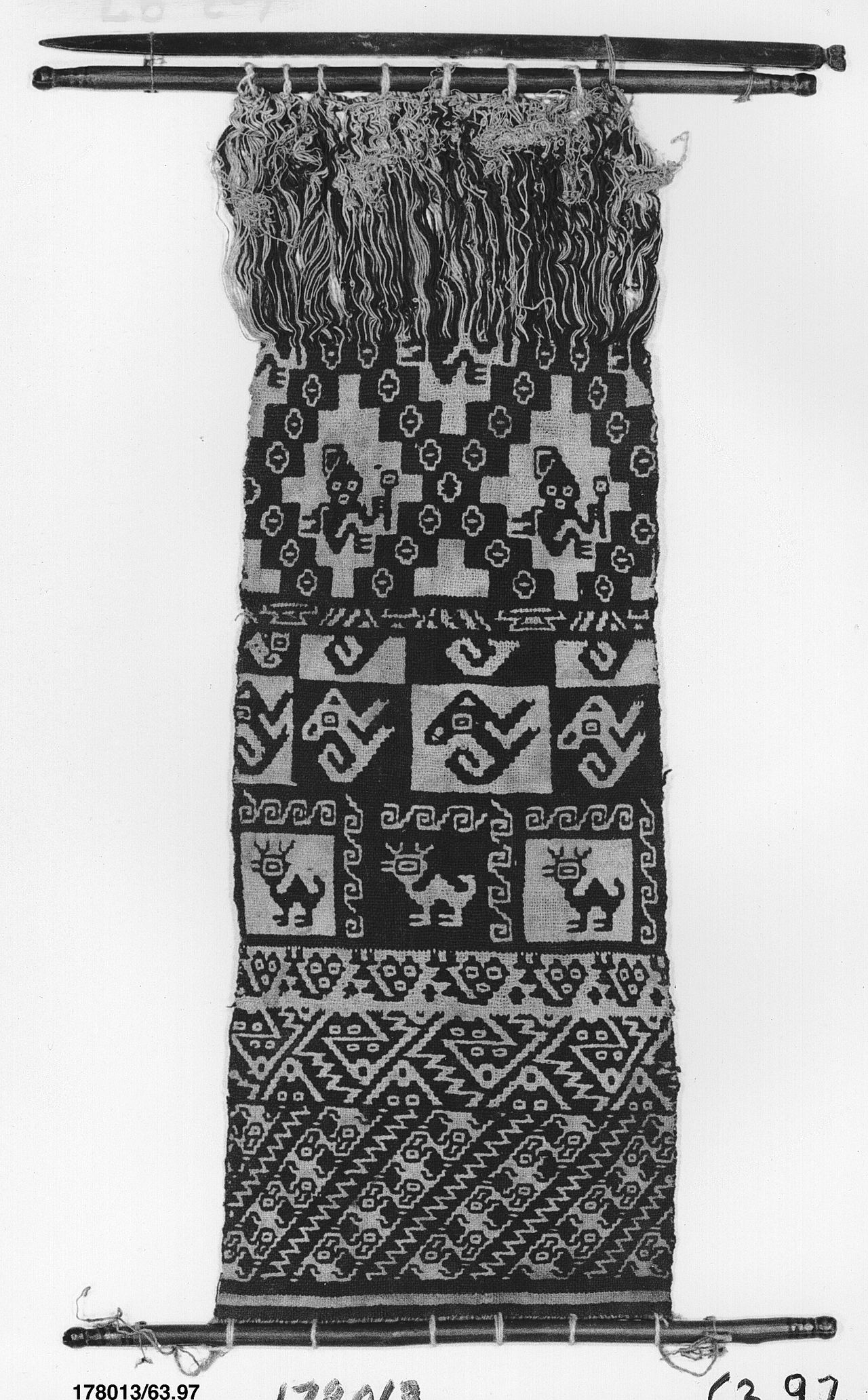
- The Metropolitan Museum of Art, unfinished sampler panel on its loom, Peru, 10th–15th century (63.97), shown above with its unwoven warp still on the loom bars.