The Banyan: Named for India, Cut Like Japan
The loose gown men wore at home in the 1700s took its name from a Gujarati word for merchant and its cut from the Japanese kimono. The story of the word is messier than the garment.
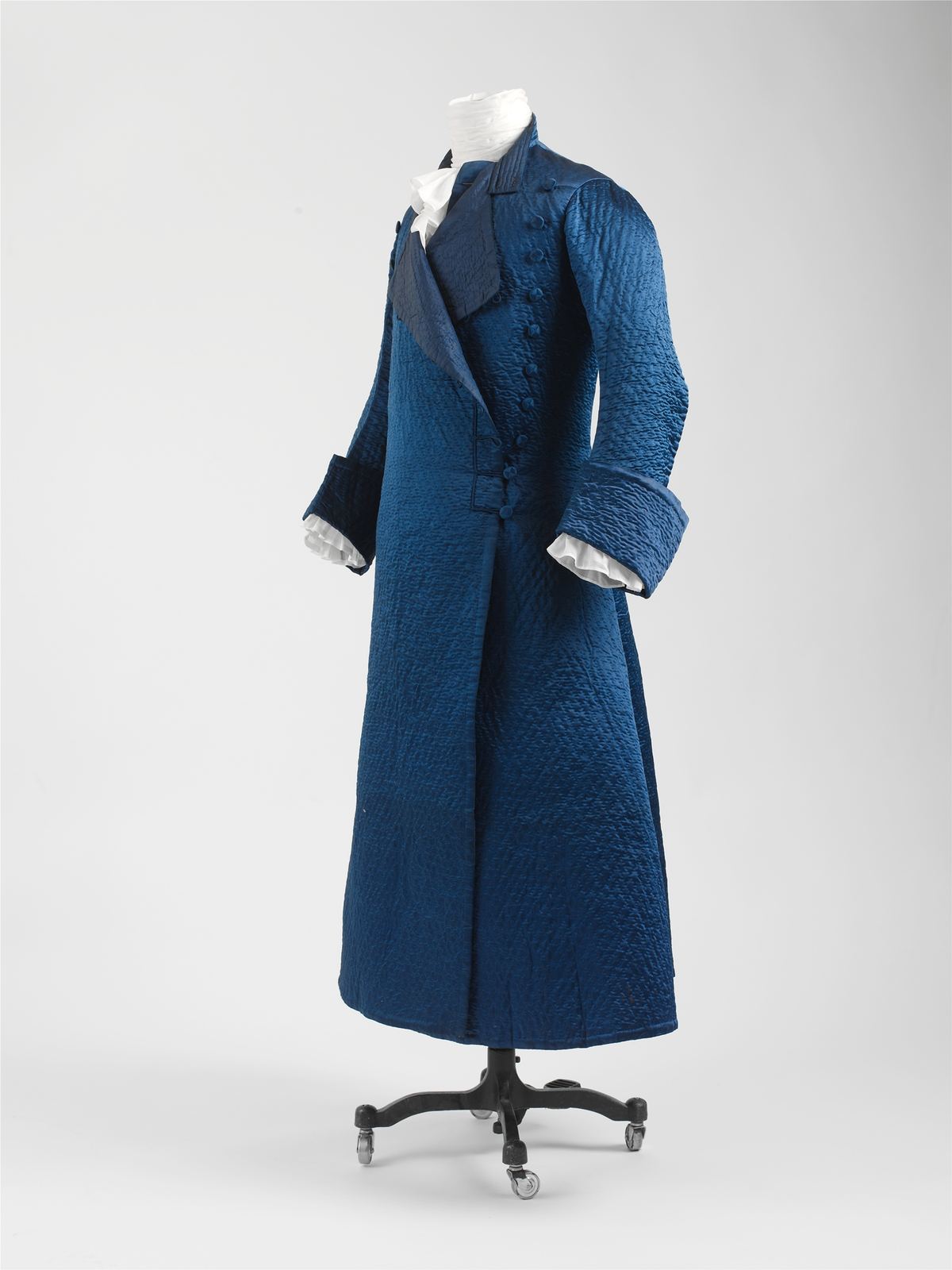
A banyan was a man's loose gown for wearing at home, fashionable from the late 1600s to the early 1800s. Its name comes from a Gujarati word for a merchant, but its cut descends from the Japanese kimono, which the Dutch East India Company carried to Europe.
What is a banyan?
A banyan is an informal gown for men, loose, often richly made and meant for indoors. The Fairchild dictionary of fashion, quoted by the FIT Museum, calls it a "comfortable, loose-fitted dressing gown" cut from cotton calico, elaborate silks or glazed wool. English speakers also called it a nightgown, which Samuel Johnson's 1755 Dictionary defines as "a loose gown used for an undress." Undress meant informal dress.
There were two main cuts. Tortora and Eubank, summarizing Cunningham, describe a full, kimono-style gown that was more common early in the century and a more fitted type, like a man's coat, with set-in sleeves. The Met's blue banyan, Chinese, 1760–70, is the second kind: lapels, fabric-covered buttons and deep turned-back cuffs, a coat in everything but length.
Why is a Japanese-style gown named for Indian merchants?
The word is Indian; the garment's ancestry is murkier. According to Hobson-Jobson (1903), the Anglo-Indian glossary, "banyan" was adopted from vaniya, a man of the trading caste (Gujarati vāṇiyo), which comes from the Sanskrit for a merchant. The same word named the tree: the glossary says the name appears to have been first given to a fig tree near Bandar Abbas, under which Hindu traders had built a small pagoda.
For the gown, Hobson-Jobson quotes a definition of banyan as a loose dressing gown "such as Hindu tradesmen wear" and says this "probably" was the original use. The novelist Amitav Ghosh likewise suspects the word once meant a garment distinctive of India.
Recent research complicates the picture. Angelina Illes, summarizing Susan North's work, reports that 17th-century English speakers called these gowns "Indian gowns," and that until the 1730s "banyan" meant a social class in India. The Dutch called them japonse rok, a Japanese robe. Museums now use "banyan" for the whole family: the V&A catalogues a portrait of about 1685 as showing a banyan. The Met, as quoted by the FIT Museum, says the English called these gowns "banyans" or "Indian nightgown" because of their kimono-like form and Eastern origin. Illes adds that the geographic labels Dutch traders attached to such gowns often meant only "foreign."
| Where | Name used | Source |
|---|---|---|
| Dutch Republic, later 1600s | japonse rok (also nachtrok, japon, cambaay) | Illes 2023 |
| England, 1600s | Indian gown, nightgown | Illes 2023, citing North |
| England, from the 1730s | banyan, as the term appears in published sources | Illes 2023, citing North |
How did the East India companies bring it to Europe?
Through gifts first, then orders. The V&A dates the arrival of the kimono in Western Europe to the 1650s, as annual gifts from the Japanese shoguns to members of the Dutch East India Company (VOC). Demand soon outstripped supply, and both the Dutch and English companies began importing kimono-style gowns from India, made of printed cottons. Illes adds that the VOC ordered chintz robes from India from 1684, and a 2021 study by Ariane Fennetaux examines ready-made chintz nightgowns produced on the Coromandel Coast between about 1680 and 1780.
The supply from Japan was never large. Illes, drawing on earlier scholarship, notes that a ship leaving Japan in 1651 carried 200 silk robes and that the Dutch received 123 gifted robes in 1692. In the Dutch Textile Trade Project's cargo data for 1704–24, six ships brought 176 pieces from Japan to Batavia. Europe filled the gap itself. English tailors, says the V&A, made the gowns up in fashionable silks. One V&A banyan was made in Italy in the 1750s from silk woven in Nanjing for a Chinese imperial dragon robe. The tailor stitched the robe's side opening shut and unpicked its center-front seam. Another, from Flanders, is lined with linen block-printed in a design inspired by Indian chintz.
Why were men painted in them?
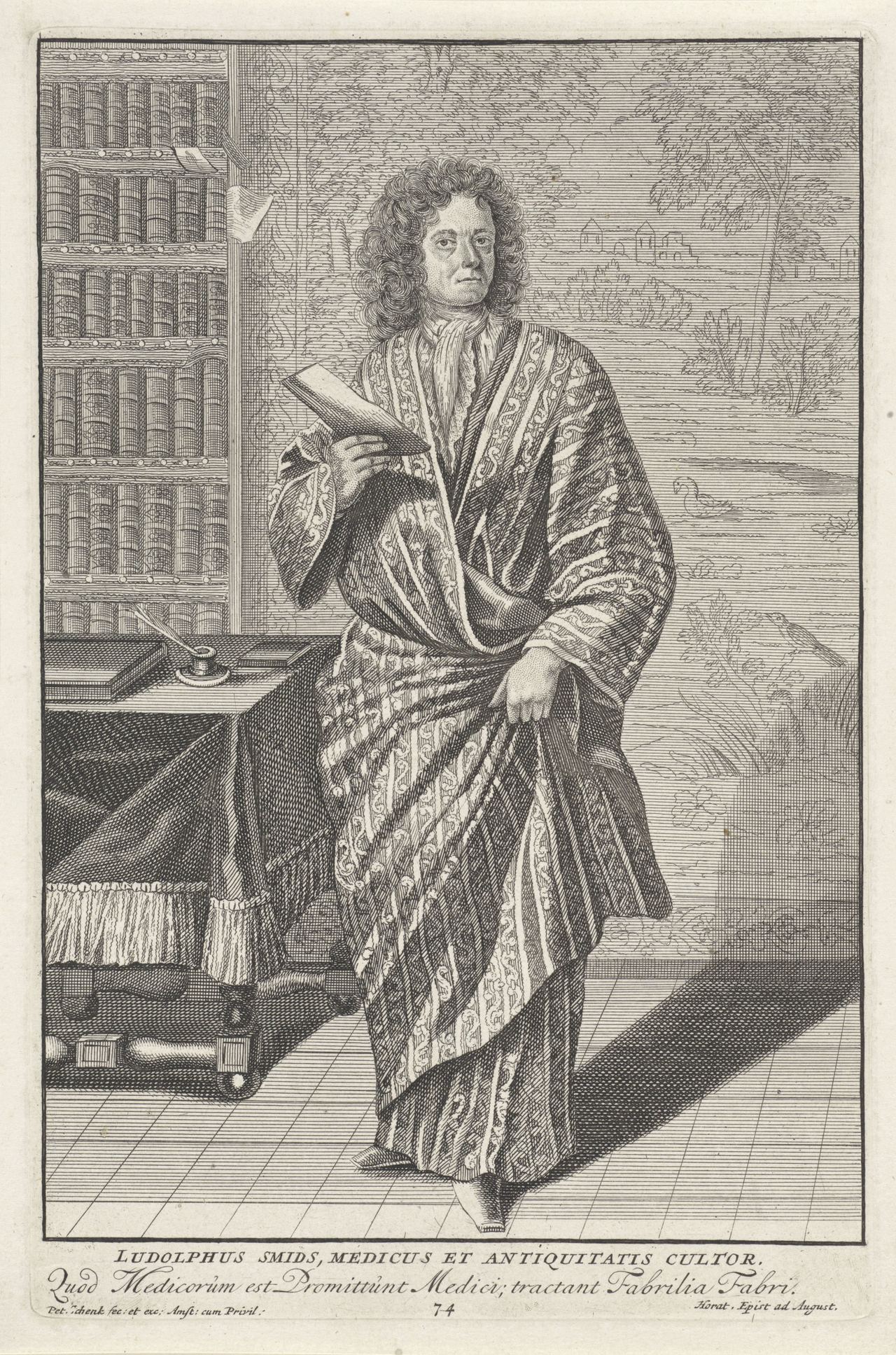
A gown at home suggested leisure and learning. Illes notes that Japanese-style robes appeared in Dutch portraits from the mid-1600s and by the end of the century were both a status symbol and an attribute of scholars, as in Vermeer's The Geographer (1669). This Rijksmuseum print shows the physician Ludolphus Smids in his study in such a robe, with books, letter and quill.
The fashion crossed borders. The V&A holds a portrait attributed to Louis Ferdinand Elle, about 1685, of a young man in a brocaded banyan with a lace cravat, and says such portraits were fashionable at the end of the 17th century. By 1751 an engraving shows the Dutch actor and writer Frederik Duim at his desk, pen in hand, in a loose gown.
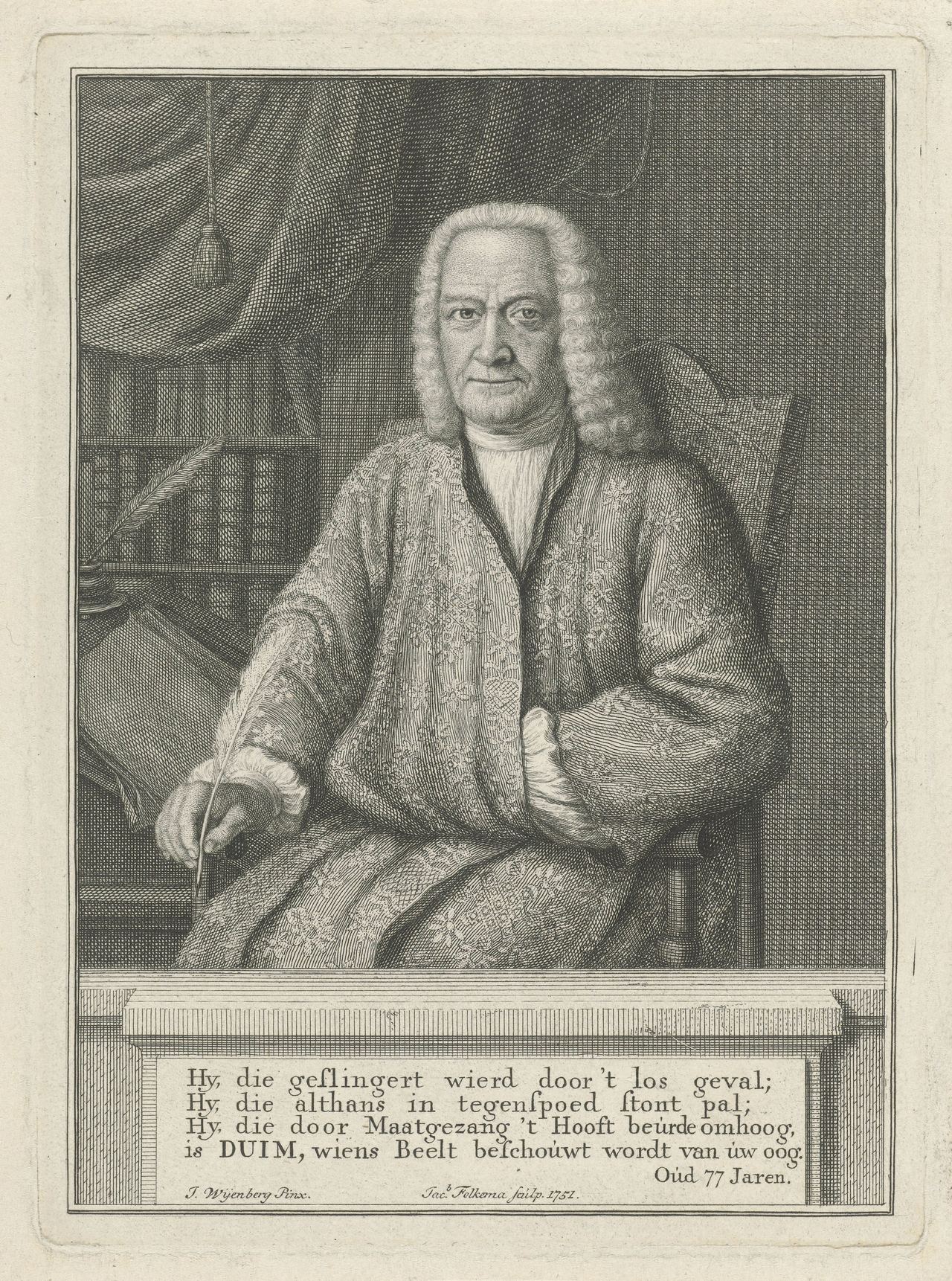
Do not read these portraits as wardrobe records. Martha Hollander, cited by Illes, argues that an artist painted in such a gown was not necessarily wearing it to work. For how to read the rest of a sitter's clothing, see Reading a Portrait: How to Date a Sitter by the Sleeve.
Some were bold. The Met's British banyan of about 1775 is a saturated yellow silk with a woven pattern that appears to be damask; Color as Rank uses it as a test case for what dress colors can safely be said to mean. The London Museum has a hand-painted Indian cotton banyan of 1771–90 that textile expert Natalie Rothstein thought might suit an English official in India, carefully quilted for cool evenings.
Where can you see one?
The Met has public-domain banyans including a French example of about 1760 (1976.149.1), the British yellow one (1978.135.1) and the Chinese blue one (2008.75). The V&A's banyans include T.92-2003, T.77:1, 2-2009 and 1182-1899, and the London Museum holds 58.40. For the scholarship, read North's "Indian Gowns and Banyans: New Evidence and Perspectives" (Costume, 2020), Fennetaux's "'Indian Gowns Small and Great'" (Costume, 2021) and Illes's open-access essay in the Journal of Historians of Netherlandish Art (2023).
Sources
- banyan (fashion history timeline). FIT Museum. Full page read: Tortora/Fairchild definition, Tortora and Eubank on Cunningham's two cuts, and the Met's 'banyans or Indian nightgown' wording as quoted Accessed October 26, 2026.
- Hobson-Jobson (1903 edition), entry BANYAN. Internet Archive (Crooke ed.). Full-text OCR read: etymology (Gujarati vaniyo, Sanskrit), tree named after traders near Gombroon, C. P. Brown's 'loose dressing-gown' definition and 'probably the original use' Accessed October 26, 2026.
- The Fascination with Japanese-Styled Gowns (Angelina Illes). Journal of Historians of Netherlandish Art, 2023. Full open-access text and footnotes read: japonse rok, names, VOC cargo data, 1684 chintz orders, Vermeer's Geographer, Hollander; footnote 18 on North (Indian gown, banyan from the 1730s) Accessed October 26, 2026.
- Banyan, British, 1750s (T.92-2003). Victoria and Albert Museum. Record read via V&A API: kimono introduced by the Dutch East India Company in the 1650s, English tailors, T-shaped cut Accessed October 26, 2026.
- Doll's undress gown, 1690-1700 (T.846Q-1974). Victoria and Albert Museum. Record read via V&A API: kimonos as shogun gifts to VOC members in the 1650s; Dutch and English companies imported printed-cotton kimonos from India Accessed October 26, 2026.
- Banyan and waistcoat, Italian, 1750s (T.77:1, 2-2009). Victoria and Albert Museum. Record read via V&A API: Nanjing dragon-robe silk made up by an Italian tailor Accessed October 26, 2026.
- Banyan, made in Flanders, 1730s (1182-1899). Victoria and Albert Museum. Record read via V&A API: pink silk satin, linen lining block-printed after Indian chintz Accessed October 26, 2026.
- Portrait of a Young Man, attributed to Louis Ferdinand Elle (P.68-1917). Victoria and Albert Museum. Record read via V&A API: banyan in portraits at the end of the 17th century Accessed October 26, 2026.
- Portrait of Ludolphus Smids in a study (RP-P-1905-4490). Rijksmuseum. Linked Art record read (maker, date range, description, Public Domain Mark) and image inspected Accessed October 26, 2026.
- Portrait of Frederik Duim (RP-P-OB-52.010). Rijksmuseum. Linked Art record read (maker, 1751, description, Public Domain Mark) and image inspected Accessed October 26, 2026.
- Banyan, Chinese, 1760-70 (2008.75). The Metropolitan Museum of Art. Met Collection API record read (date, culture, medium, credit, public domain); object page returned 429, so no catalogue text was read Accessed October 26, 2026.
- Banyan, British, ca. 1775 (1978.135.1) and French, ca. 1760 (1976.149.1). The Metropolitan Museum of Art. Met Collection API records read (date, culture, medium, accession, public domain); images inspected Accessed October 26, 2026.
- Dressing gown, banyan, 1771-1790 (58.40). London Museum. Full record read: hand-painted Indian cotton, Rothstein's remark Accessed October 26, 2026.
- A Dictionary of the English Language (1755), vol. 2, entry Nightgown. Internet Archive. Full-text OCR read, entry Nightgown: 'A loose gown used for an undress' Accessed October 26, 2026.
- The Well Traveled Banyan: 1 of 2 (Amitav Ghosh). amitavghosh.com. Page read via WebFetch: word probably once meant a garment distinctive of India Accessed October 26, 2026.
- Indian Gowns and Banyans: New Evidence and Perspectives (Susan North), Costume 51(1), 2020. Edinburgh University Press / Crossref. Abstract only (Crossref); publisher page returned 403. Claims about its content rest on Illes's footnotes Accessed October 26, 2026.
- 'Indian Gowns Small and Great' (Ariane Fennetaux), Costume 55(1), 2021. Edinburgh University Press / Crossref. Abstract only (Crossref); publisher page returned 403 Accessed October 26, 2026.
Glossary
Last updated · Markdown · Report an error