Neckwear
The Falling Band: How the Ruff Lost Its Stiffness
In the early 1600s men's neckwear stopped standing up and began to lie on the shoulders. Here is what a falling band is, why it beat the ruff, and how to date a portrait by it.
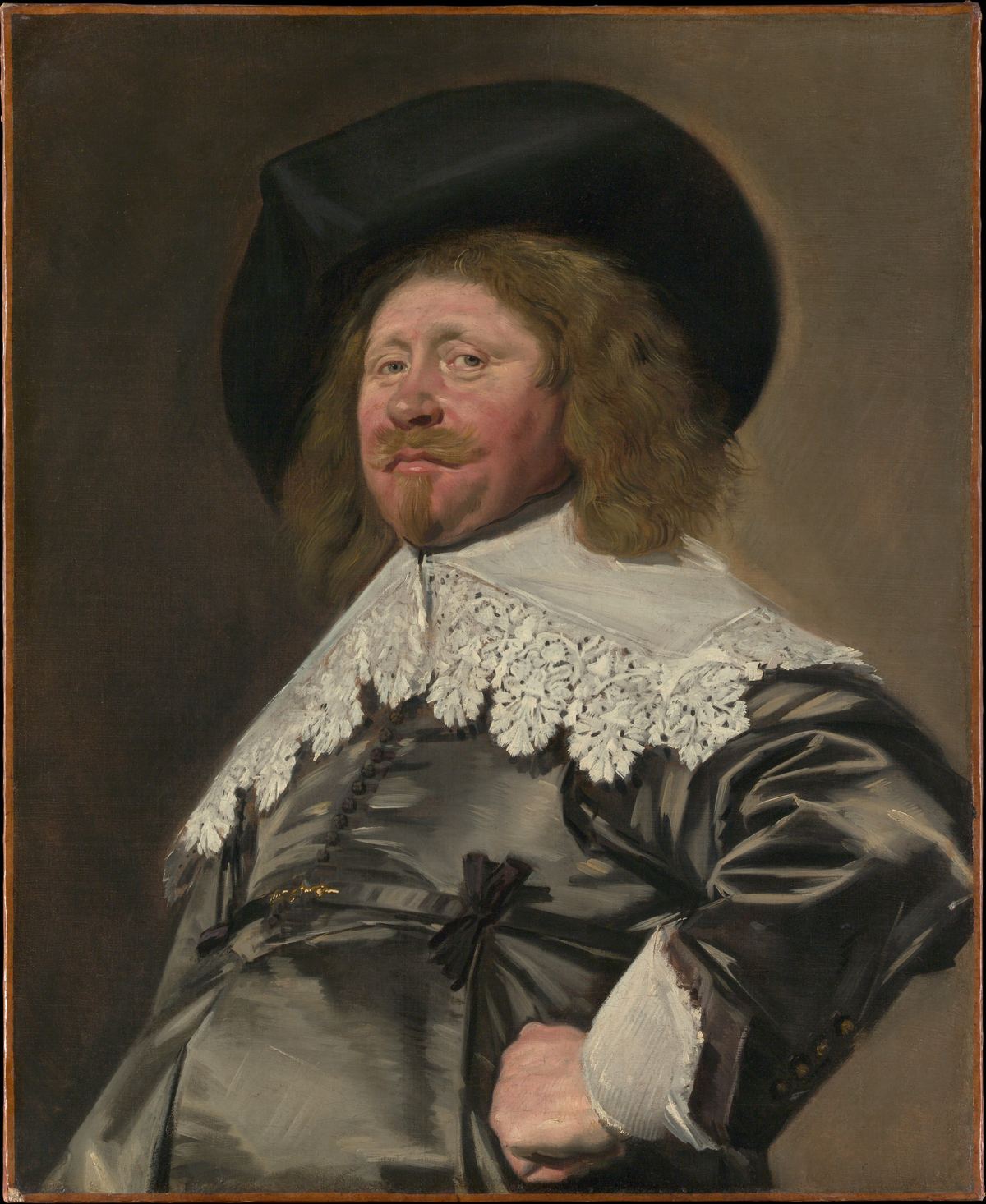
A falling band is a wide, flat linen collar, often edged with lace, that lies across the shoulders instead of standing up around the neck. Men took it up because, unlike the starched, wire-propped ruff, it needed less cloth and less labor. Sources disagree on exactly when the ruff gave way.
If you are planning to see Lace and Legacy at The Bowes Museum (14 November 2026 to 11 April 2027), this is the neckwear to understand first: the show, its organizers say, spans the sixteenth to the twentieth century and includes portraits, and the collar is the first thing to read in a seventeenth-century one.
What is a falling band?
A falling band is a broad, flat white collar worn by men, and occasionally by women, in the seventeenth century. "Band" is the period term; "falling collar" is the modern shorthand. The Victoria and Albert Museum separates a standing band, heavily starched and held flat by a support of wire, bone or card, from a falling band, lightly starched and left to drape over the collar of the garment underneath.
The V&A's own example is plain in construction: a rectangle of linen, darted at the neck edge and sewn to a narrow neckband, fastened by an eyelet at each end. Its outer edge is scalloped and worked in cutwork. Falling bands were often paired with cuffs of the same design, according to the FIT Museum's fashion-history timeline.
How is a band different from a ruff?
A ruff needs scaffolding; a band does not. In 1583 the Puritan writer Philip Stubbes complained that fashionable ruffs stood "a full quarter of a yarde (and more)" from the neck. He blamed two props. One was starch, which made the linen "stand stiffe and inflexible". The other was a wire frame he called a "supportasse, or underpropper", worn under the ruff to hold it up "from falling and hanging down". The V&A holds an English supportasse of 1595 to 1615 made of linen reinforced with whalebone, card and wire.
| Ruff | Falling band | |
|---|---|---|
| Shape | Rounded collar standing out from the neck | Flat collar lying over the shoulders |
| Folds | Set into tubular folds with setting sticks | Cut flat and darted to fit the neck |
| Stiffening | Starch to hold the folds | Lightly starched |
| Support | Wire frame (supportasse) beneath | None needed |
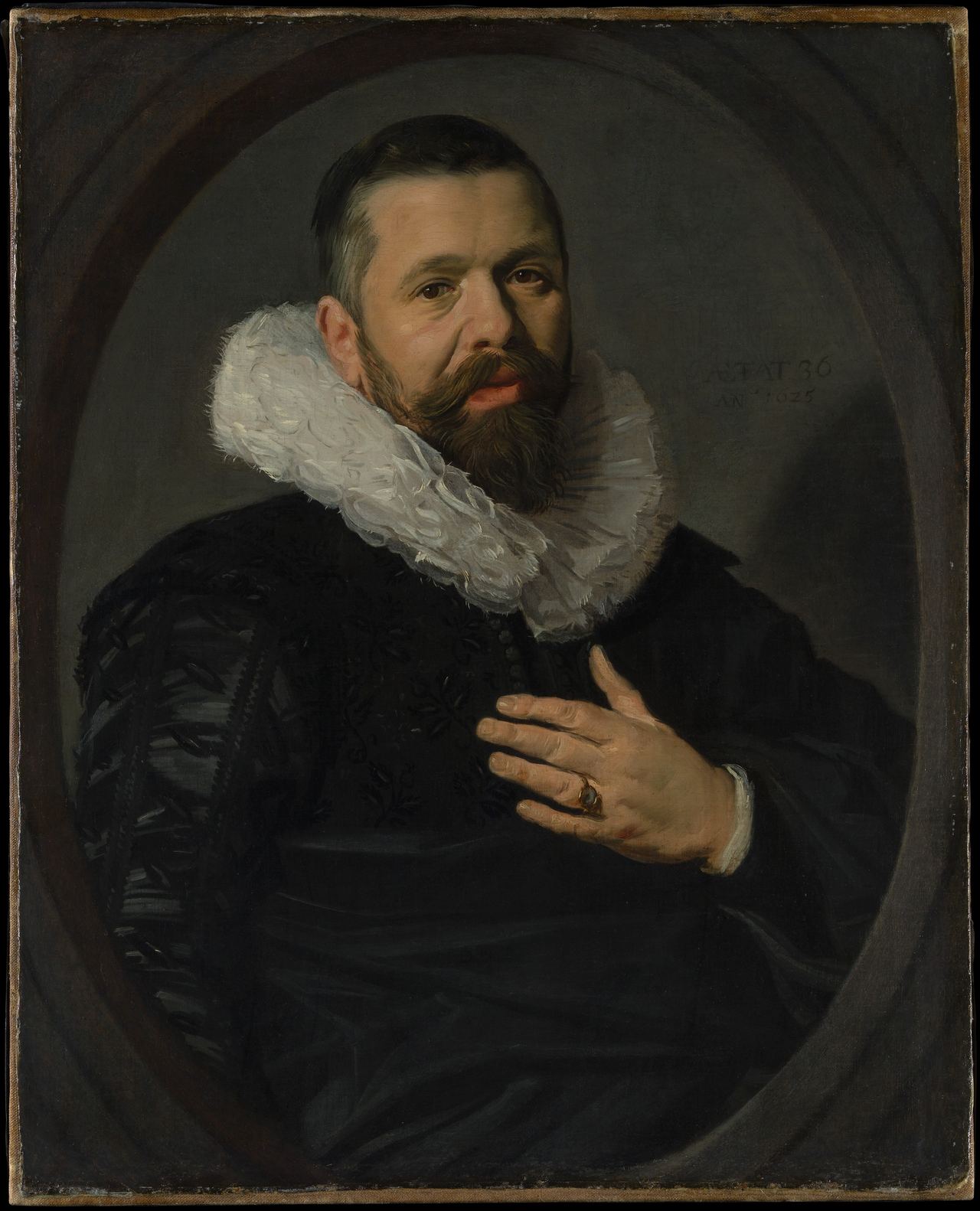
The Hals portrait above, inscribed 1625, shows the older shape at its fullest: a deep ruff pleated all the way round the neck.
Why did men give up the ruff?
Mostly because of cost and care. The V&A says the band used less fabric than the ruff and was therefore less expensive, was much easier to look after, and soon replaced the ruff for all but the most formal occasions. The Shakespeare Birthplace Trust adds the laundry detail: a ruff soiled quickly so close to the face, and cleaning it meant unstitching it, washing it, restarching it and stitching it back. The Dictionary of Costume, quoted by the FIT Museum, puts the linen in a fashionable ruff of the 1580s at eighteen to nineteen yards.
Fashion moved the same way. The Trust notes that in England collars came to fall over the shoulders, on the outside of the clothes, rather than stand up.
One thing the sources do not support is the popular idea that the painter Anthony van Dyck started the fashion. A dictionary quoted by FIT does list "Vandyke" as another name for the collar, but the V&A records the band as a new style in the 1590s, the decade in which Van Dyck (1599 to 1641) was born.
When did the ruff actually end?
Sources give different answers, and that is the honest picture. The V&A dates the first bands to the 1590s. The Dictionary of Fashion History gives about 1615 to 1640 for the "falling ruff", a gathered, unpleated cousin of the band. FIT says falling bands were very large in the 1620s and 1630s and shrank from about 1640. A costume summary quoted on the Diary of Samuel Pepys site says plain falling bands replaced the ruff about 1640 and were universal by 1650. Read together, they describe an overlap lasting into the 1630s, with the ruff surviving longest on formal dress.
It also lasted longer in some places. The Shakespeare Birthplace Trust says Spain and Holland kept the stiff, upright ruff well into the seventeenth century. The Met's oval portrait by Rembrandt, dated 1632, shows a ruff on a man in a Dutch portrait, while Frans Hals painted the band at the top of this page about 1636 to 1638.
How did lace make the band a luxury?
Lace gave the cheaper collar back its price. The V&A calls lace among the most prized and expensive textiles of the seventeenth century, and says Flemish bobbin lace was the major fashion lace from the 1630s to the 1660s. Its pot-of-flowers pattern suited the deep scallops of falling bands. The museum also records that in 1637 the Countess of Leicester, buying English bobbin lace as a present for Anne of Austria, the French queen, complained of the considerable expense.
Not every band carried lace. The V&A's cutwork example, a probably English band of the 1620s or 1630s, relies on whitework and simple bobbin insertions. Others used needle lace, like the Met's band of about 1660 to 1665 below, made of linen and needle lace and finished with cords and tassels.
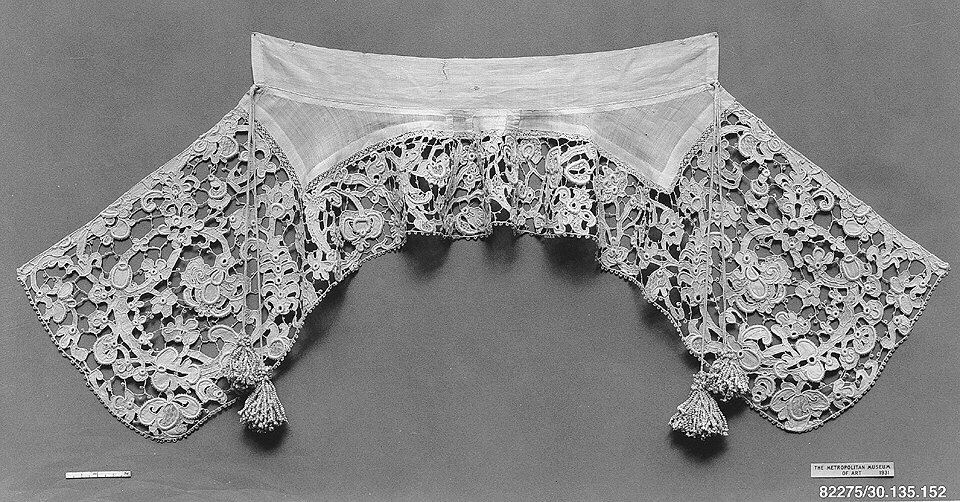
The fashion for width did not last. By the mid-1650s, the V&A says, the scallops on Flemish lace had shrunk to a straight edge, and in menswear wide falling bands were replaced by bib-fronted bands. The next collar was the cravat.
How can you date a portrait by the neckwear?
Use the neckwear as a range, not a date. The rough sequence, from the sources above:
| What you see | Rough date | Source |
|---|---|---|
| Deep ruff standing out from the neck | 1580s onward | Stubbes, 1583 |
| Very large flat band, lace-edged | 1620s to 1630s | FIT Museum |
| Smaller band, still broad over the shoulders | 1640s | FIT Museum |
| Smaller again | 1650s | FIT Museum |
| Scallops reduced to a straight edge; bib-fronted bands | mid-1650s | V&A |
Then check for exceptions: Dutch sitters can wear ruffs later than English ones, and the ruff survived on formal occasions. Our guide to reading a portrait explains how to weigh several clues together, and how to read a piece of lace helps with the edge itself.
Where can you see one?
The Bowes Museum's collection page highlights a "cavalier's collar" of English needle lace from about 1635, "believed to have belonged to King Charles I, but there is no evidence for this". The Textile Research Centre in Leiden records that the collar was lent to the Royal Collection Trust in 2013 and shown beside Van Dyck's triple portrait of Charles I, in which, it says, the king wears a comparable needle-lace collar in each of the three views. The exhibition page names no individual objects, so treat the collar as the collection's headline lace, not a confirmed part of the new show.
The Blackborne collection builds on lace acquired by Joséphine Bowes, and the family were London lace dealers, whose trade we describe in Mended, Made Up, Made Over. Elsewhere, the Met's collar and portraits above are online with open-access images, and the V&A's bands can be searched in its collection database.
Sources
- Band (O130591). Victoria and Albert Museum. Full record via the V&A API: construction, cutwork edge, standing vs falling band, cost and care, 1590s appearance. The record's own dating varies (1620-30 field, 1630s text, 1625-50 summary), so we say 1620s or 1630s Accessed October 24, 2026.
- Band (O77374). Victoria and Albert Museum. Full record via the V&A API: bobbin-lace band 1630-40, portraits of the 1630s and early 1640s, Countess of Leicester 1637 Accessed October 24, 2026.
- Collar (O90043). Victoria and Albert Museum. Full record via the V&A API: lace as luxury, Flemish bobbin lace 1630s-1660s, scallops, straight edge by mid-1650s, bib-fronted bands Accessed October 24, 2026.
- Supportasse (T.62-1910). Victoria and Albert Museum. Full record via the V&A API: materials of an English supportasse, 1595-1615 Accessed October 24, 2026.
- Falling band. FIT Fashion History Timeline. Full page read: definition, sizes by decade, cuffs, alternative names (quotes reference books) Accessed October 24, 2026.
- Ruff. FIT Fashion History Timeline. Full page read: Dictionary of Fashion History (falling ruff c.1615-1640), Dictionary of Costume (18-19 yards of linen) Accessed October 24, 2026.
- Shakespeare in 100 Objects: Ruff. Shakespeare Birthplace Trust. Full page read: supportasse, laundering cost, Spain and Holland kept the ruff, collars falling over the shoulders in England Accessed October 24, 2026.
- The anatomie of abuses (1583 first edition, reproduced by J. P. Collier, 1870). Internet Archive. Full text read: Stubbes on ruffs, starch and the supportasse Accessed October 24, 2026.
- Bands (The Diary of Samuel Pepys encyclopedia). The Diary of Samuel Pepys. Full page read: reader-contributed costume summary (quoting reference works) putting plain falling bands replacing the ruff about 1640; used only as a differing date Accessed October 24, 2026.
- Lace & Legacy: Fashion Treasures from The Blackborne Collection. The Bowes Museum. Full page read: dates 14 Nov 2026 - 11 Apr 2027, portraits and garments, Joséphine Bowes. No individual objects named Accessed October 24, 2026.
- Lace and Legacy: Fashion Treasures from The Blackborne Collection. Art Fund. Full page read: museum-supplied listing, 16th to 20th century, portraits, garments Accessed October 24, 2026.
- The Blackborne Lace Collection. The Bowes Museum. Full page read: cavalier's collar of English needle lace c.1635, 'believed to have belonged to King Charles I, but there is no evidence for this' Accessed October 24, 2026.
- Seventeenth Century Needle Lace Collar. Textile Research Centre, Leiden. Full page read: Blackborne & Co, 2006 gift, 2013 loan shown beside Van Dyck's triple portrait (page last modified 2016). The Royal Collection page itself blocked automated access Accessed October 24, 2026.
- Portrait of a Man, Possibly Nicolaes Pietersz Duyst van Voorhout, ca. 1636-38 (49.7.33). The Metropolitan Museum of Art. Record via Met Open Access API (public domain flag true); image inspected at full size Accessed October 24, 2026.
- Portrait of a Bearded Man with a Ruff, 1625 (49.7.34). The Metropolitan Museum of Art. Record via Met Open Access API; inscription AETAT 36 AN 1625 read on a full-size crop Accessed October 24, 2026.
- Falling band (collar) with tassels, ca. 1660-65 (30.135.152). The Metropolitan Museum of Art. Record via Met Open Access API: linen, needle lace; image inspected Accessed October 24, 2026.
- Portrait of a Man, 1632 (64.126). The Metropolitan Museum of Art. Record via Met Open Access API; image inspected (ruff visible) Accessed October 24, 2026.
Glossary
Last updated · Markdown · Report an error