Crochet
The Granny Square Is Older Than the Granny
Crochet's most familiar motif first appears in print in April 1885, in a Chicago farm weekly, as a wool "Crazy Afghan" with a black edge. The word "granny" arrives decades later.
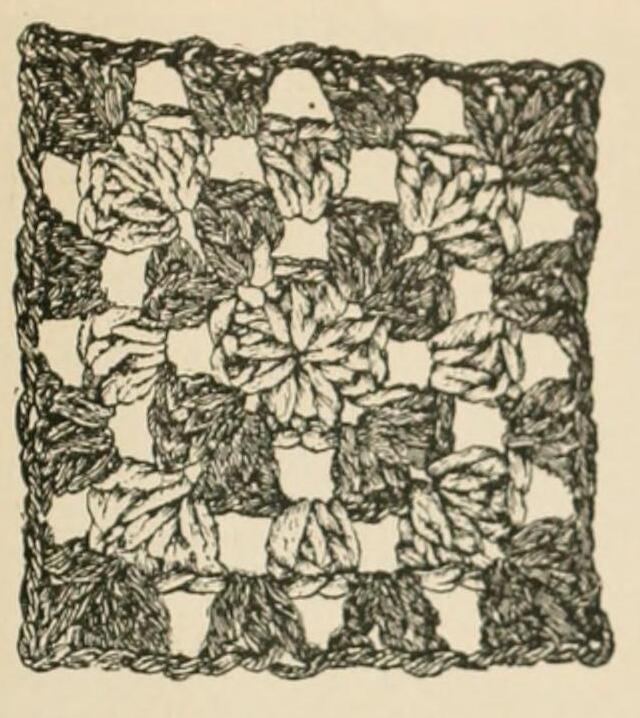
The earliest granny square anyone has found is a "Crazy Afghan" pattern printed in the Chicago weekly Prairie Farmer on April 4, 1885, credited to a Mrs. Phelps. It was worked in wool with a black edge, in imitation of a crazy quilt block. The word "granny" came decades later.
Who invented the granny square?
Nobody can prove a first, but the earliest dated pattern found so far is Mrs. Phelps's. Prairie Farmer reported it on April 4, 1885, in its Housekeeper's Improvement Club column, after a club meeting on March 14. Her first name was not printed. Both PieceWork magazine and the crochet site The Yarn Queen trace the square to that page; I could not open the Illinois newspaper scan itself, which refuses automated access, so the wording below is as they transcribe it.
Phelps called it a "Crazy Afghan" and described it as "on the principle of the crazy work so popular now." The blocks were worked in bright, varied Germantown wool, a worsted-weight yarn, with a black outer edge, and joined into strips. That detail matters: most crochet patterns of the time called for fine thread and made lace, and yarn blankets were only becoming popular. PieceWork calls hers "probably the first granny square ever," and the hedge is fair. The Yarn Queen's author searched earlier Prairie Farmer issues and found no precursor, but a pattern that never reached print could still be older.
What was "crazy work," and why does it matter?
Crazy work was the 1880s fashion for patchwork of irregular, brightly colored scraps, often bordered in black. The Kent State University Museum notes that directions for crazy quilts first appeared in ladies' magazines in 1882, and that the fad was already waning by the December 1887 Godey's Lady's Book, which called crazy patchwork "the most childish, and unsatisfactory of all work done with the needle."
Phelps turned the idea into crochet. Each block imitates a crazy-quilt square: bright sections, black border. So the square is a quilting fashion translated into crochet, not an heirloom invented at a grandmother's hearth.
Is the 1891 engraving the same square?
Close to it. The Art of Crocheting, published by the Butterick Publishing Company in London and New York in 1891, prints a "Block for a Slumber Robe" on page 95. I read the page on the Internet Archive. The engraving shows a square worked outward from a small center in rings of clustered stitches with open corners, and the text says that in large robes "the outside row of every block is made with black wool," with the blocks crocheted together in a bright color, "usually yellow." It suggests colors for each ring: lilac, pale green, pink, then black. It gives no stitch-by-stitch pattern, only the remark that "the engraving clearly explains the method of making."
Two more printings sit between Phelps and the book, both reported by PieceWork and The Yarn Queen. On March 4, 1888, the Boston Globe ran Eva Marie Niles's "Afghan Crocheted in Blocks," which ends each block with a black round, the border we recognize today. The Yarn Queen also reports that Prairie Farmer ran the same picture again in July 1890, as a "slumber robe" credited to a Mrs. Clay. PieceWork's 1886 reprint date I could not confirm, so I leave it out.
Round-worked crochet squares were not new. Thérèse de Dillmont's Encyclopedia of Needlework describes a crochet square built round by round from a ring of four chain stitches, with three stitches at each corner. But hers uses plain stitches only, with none of the clustered stitches and open gaps of a granny square. What the 1885 pattern added was thick wool, a new color for each ring and a black frame.
Did settlers, grandmothers or "afghans" start it?
The popular stories do not survive the dates.
- Colonial thrift. Martha Stewart Magazine, according to The Yarn Queen, dated the square to thrifty settlers in the early 1700s. The Yarn Queen put that to colonial-era interpreters at Jamestown-Yorktown, one of whom said he knew of no verified European or American crochet from the 17th or 18th century. Wikipedia, which I used to locate references, likewise says the first substantive evidence of crocheted fabric in Europe is from the 19th century. The earliest published instructions it cites are in the Dutch magazine Penélopé in the 1820s.
- Afghan squares. In The Art of Crocheting, "afghan stitch" is another name for tricot, a different technique, and an afghan is a rug or throw. I found no pattern for a square like Phelps's from before 1885, so claims about mid-19th-century British "afghan squares" come without an example.
- The granny. PieceWork found no definitive origin for the name. The earliest I could read myself is the December 1933 issue of The New Movie Magazine, which tells readers they can make Jean Parker's "Granny afghan crocheted from yarns of all shades and colors, joined together with black." PieceWork reports the first use of "granny square" it found in a 1953 classified advertisement in North Carolina.
That leaves a sequence of 1885, 1888, 1891, 1933 and 1953, in which the grandmother is the last to arrive.
Why is the granny square back?
Because craft is selling again. Michaels' 2026 Creativity Trend Report, released March 10, 2026, says searches for analog hobbies such as knitting, crocheting, embroidery, journaling and painting had surged 136% over the previous six months. The Stylist, reporting Etsy's spring/summer 2026 trends in March, described a "soft stitch era" with crochet and embroidery in the spotlight. Neither figure says anything about squares in particular.
The motif suits the moment for the same reasons Phelps liked it: it is small, portable and scrap-friendly. Reading her era's instructions needs care, though, because yarn weight labels and crochet terms have changed since 1885. Our guides to reading a yarn label and to US and UK crochet terms help with both.
Where can you see early crochet?
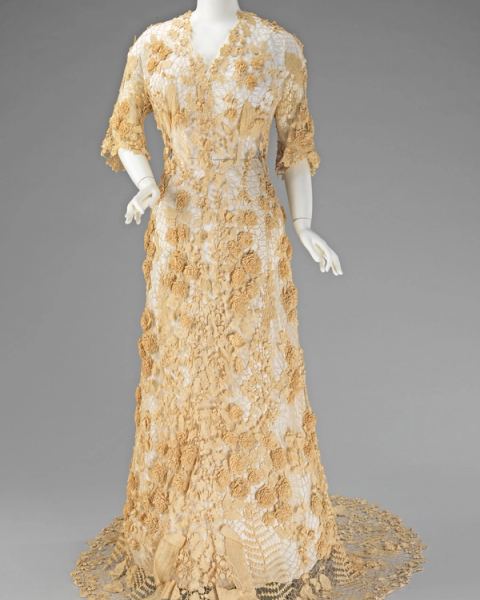
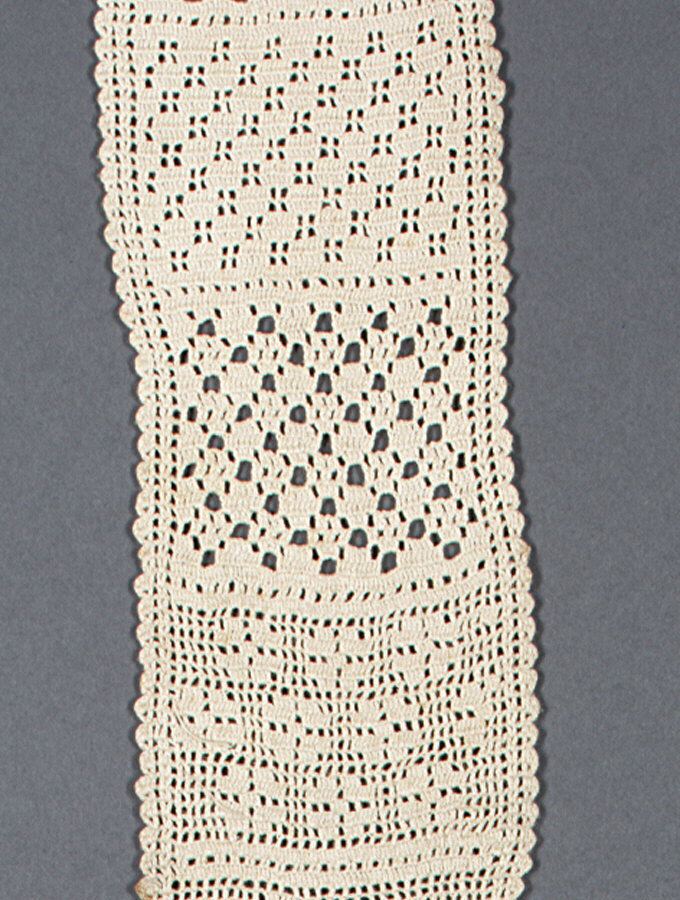
The Internet Archive holds the full 1891 Art of Crocheting (archive.org), and the Met's open-access record includes a 19th-century crochet sampler (accession 57.122.709) with the lace-like openwork patterns that were typical of crochet before Phelps's wool.
Sources
- The Art of Crocheting (1891). Internet Archive (Butterick Publishing Co.). Full OCR text and page images read. Block for a Slumber Robe, p. 95 (page image viewed); tricot/afghan stitch; imprint 1891. The engraving shows a granny-type block; no stitch pattern is given. Accessed October 21, 2026.
- The First Granny Square: Translating the 1880s' Crazy-Quilt Trend to Crochet (Nicole Gustas, Oct 2, 2023). PieceWork. Read in full: Prairie Farmer April 4, 1885, Mrs. Phelps, Niles 1888, 'granny afghan' 1933, 1953 classified. Its 1886 reprint date could not be confirmed and is not used. Accessed October 21, 2026.
- The World's First Granny Square Pattern (Plus 7 More to Make). The Yarn Queen. Read in full: transcription of the Phelps text, Housekeeper's Improvement Club, March 14 meeting, Niles 1888, July 1890 Mrs. Clay reprint, Dillmont comparison, interview with colonial interpreters. Secondary; used with the primary scans below. Accessed October 21, 2026.
- The New Movie Magazine, December 1933, p. 63 ('Presents from Hollywood') via Internet Archive. The New Movie Magazine. Full OCR text read: Jean Parker's 'Granny afghan crocheted from yarns of all shades and colors, joined together with black'. Accessed October 21, 2026.
- Encyclopedia of Needlework, Therese de Dillmont (English edition). Project Gutenberg. Full text read: 'Crochet square' (fig. 441), worked in rounds from 4 chain, plain stitches, 3 plain at each corner. Accessed October 21, 2026.
- Crazy Quilts in the Kent State University Museum Collection. Kent State University Museum. Page read: directions first in ladies' magazines in 1882; fad waning by Godey's December 1887, quoted 'the most childish, and unsatisfactory of all work done with the needle'. Accessed October 21, 2026.
- Michaels Unveils 2026 Creativity Trend Report (press release, March 10, 2026). Michaels Companies. Page read: searches for analog hobbies such as knitting, crocheting, embroidery, journaling and painting up 136% over the past six months. Accessed October 21, 2026.
- Etsy Spring/Summer 2026 trends (Amy Beecham, March 2026). Stylist. Page read: 'Soft stitch era' section, crochet and embroidery 'stepping into the spotlight' according to Etsy. Etsy's own page refuses automated access. Accessed October 21, 2026.
- Sampler, 19th century (57.122.709), open-access record. The Metropolitan Museum of Art. Object record read via the Met API (CC0; medium listed as wool, crochet); full-size image inspected and cropped. Accessed October 21, 2026.
- Crochet; Granny square. Wikipedia. Used to locate references. Read: first substantive evidence of crocheted fabric in Europe is 19th century; Penelope magazine 1820s (1823 or 1824 given). The Granny square page gives both April 4 and April 5, 1885 and cites the Illinois Digital Newspaper Collections item PFR18850404.2.45 (the 4th is correct: a Saturday). Accessed October 21, 2026.
Glossary
Last updated · Markdown · Report an error