Quilting
Wearing a Quilt: How Quilting Became Clothing
Quilting is stitching padding between layers of cloth, and tailors and needleworkers have used it for armor, petticoats, gowns and firefighters' coats as well as beds. How garment quilting is made, how it differs from a quilt, and where to see it.
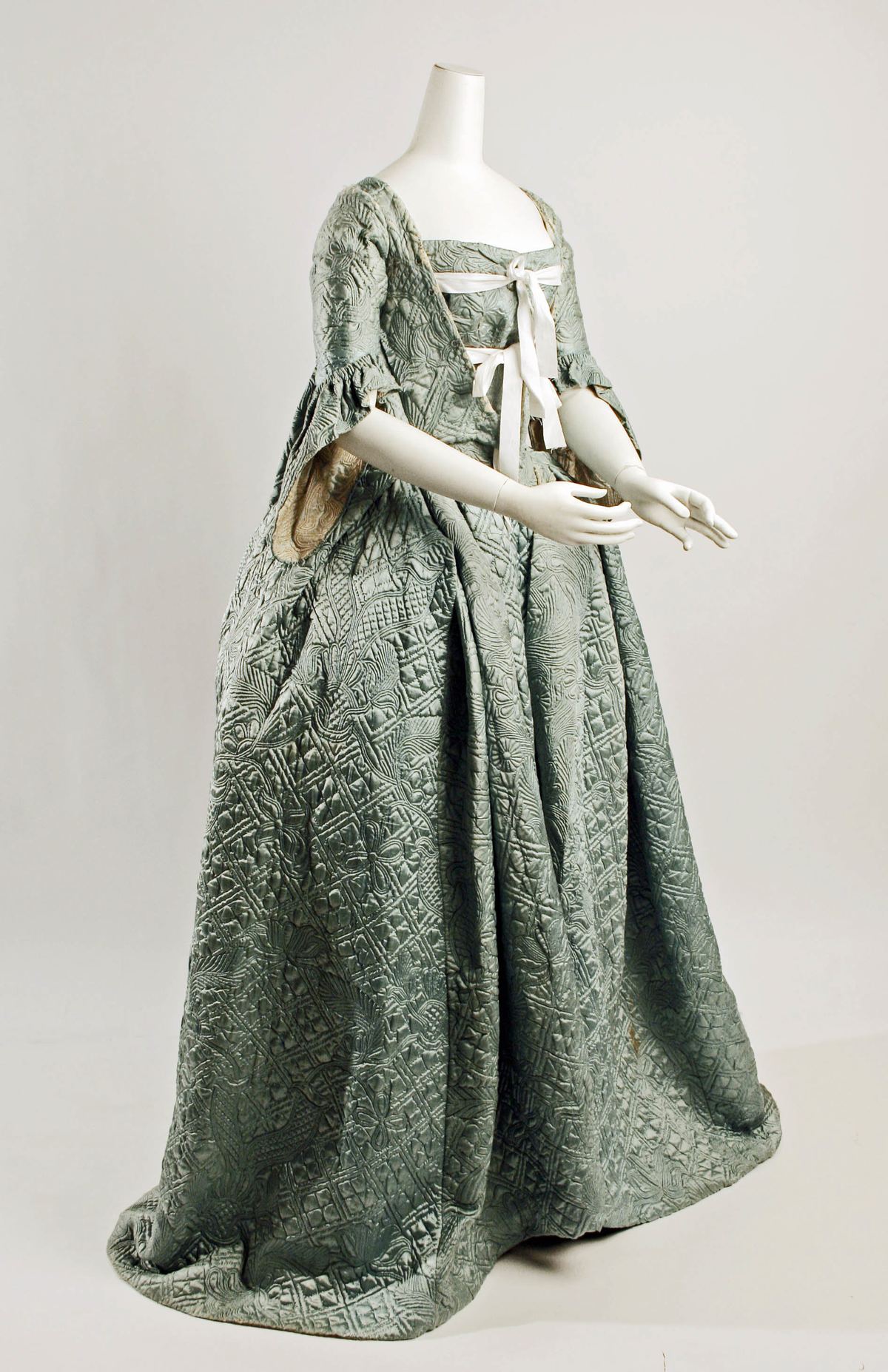
Quilted clothing is clothing made from two layers of cloth with padding between them, held in place by lines of stitching. The padding adds warmth, shape or protection, and the stitching often makes the pattern too. The same method lined medieval armor, filled eighteenth-century petticoats and gowns, and padded the coats of Japanese firefighters.
What is quilted clothing?
Quilted clothing is any garment made by stitching layers of cloth together with padding, called wadding, between them. The stitches hold the padding in place and usually form the pattern. The V&A defines quilting as a method of stitching layers of material together, with each stitch catching all the layers.
The method is old and it is not tied to beds. The V&A says quilting dates back at least to medieval times, and that the English word quilt may come from the Latin culcita, a bolster or cushion, and seems to appear first in the thirteenth century. One current exhibition puts bedcovers and garments side by side: "Stitches in Time: Quilts & Fashion" at the LSU Textile & Costume Museum in Baton Rouge, curated by Michael E. Mamp, runs from 3 May 2026 to 15 January 2027. It pairs nineteenth- and twentieth-century quilts with quilted fashions, and its centerpiece is a gift of garments by the designer Geoffrey Beene.
Why would anyone quilt a garment?
Three reasons recur in the museum records we read: warmth, shape and protection. The stitch pattern can also be decoration.
Warmth. The V&A says quilted petticoats were worn by women in the eighteenth century until about 1790, for their practicality (warmth) and because the open style of eighteenth-century gowns let the decorative stitching show. The Hopkins Costume Trust says such petticoats were worn by all levels of society.
Shape. Padding changes a silhouette. ASU's FIDM Museum says petticoats with elaborate quilting were fashionable between about 1825 and 1850, and that women wore several at once, sometimes six, before the cage crinoline of 1856. A British petticoat of 1865 to 1870 in the Metropolitan Museum, recorded as cotton, linen and down, is stitched in horizontal channels that give the skirt a stepped outline in the museum's photograph. The V&A's quilted yellow silk waistcoat or "jumps" of the 1740s has canvas panels stiffened with strips of baleen inside, so there the quilting is part of the structure of a bodice.
Protection. A gambeson is a padded, quilted defensive garment of the Middle Ages. Merriam-Webster describes it as made of quilted cloth or leather, worn first under a mail coat and later also on its own as armor. The V&A adds that padded clothing was worn under armor, or alone by people who could not afford metal armor. The word came through French from a Germanic root related to Old High German wamba, "belly."
Modern writers use several names for these garments and do not always agree. The enthusiast reference MyArmoury, summarizing the historians Claude Blair and David Edge, separates the aketon, worn under mail or plate, from the thicker gambeson, worn over armor, while noting that period texts often used the words interchangeably. It describes the usual construction as two or more linen layers quilted vertically into tube-like pockets stuffed with wool, tow or similar filling. Treat the names as loose labels. The 1882 Dictionary of Needlework ties the two worlds together: the diamond-shaped checkers produced in quilting, it says, "were anciently called 'Gamboised.'" In seventeenth-century Britain, the V&A notes, the wealthy wore quilted silk doublets and breeches.
How did quilting become fashion in the 1700s?
In the eighteenth century quilting moved from lining to display. Women wore quilted petticoats under open-fronted gowns so the stitching showed, men wore quilted waistcoats and dressing gowns, and a few gowns were quilted whole. The V&A, the Met and other museums hold many examples from Britain, France and Sweden.
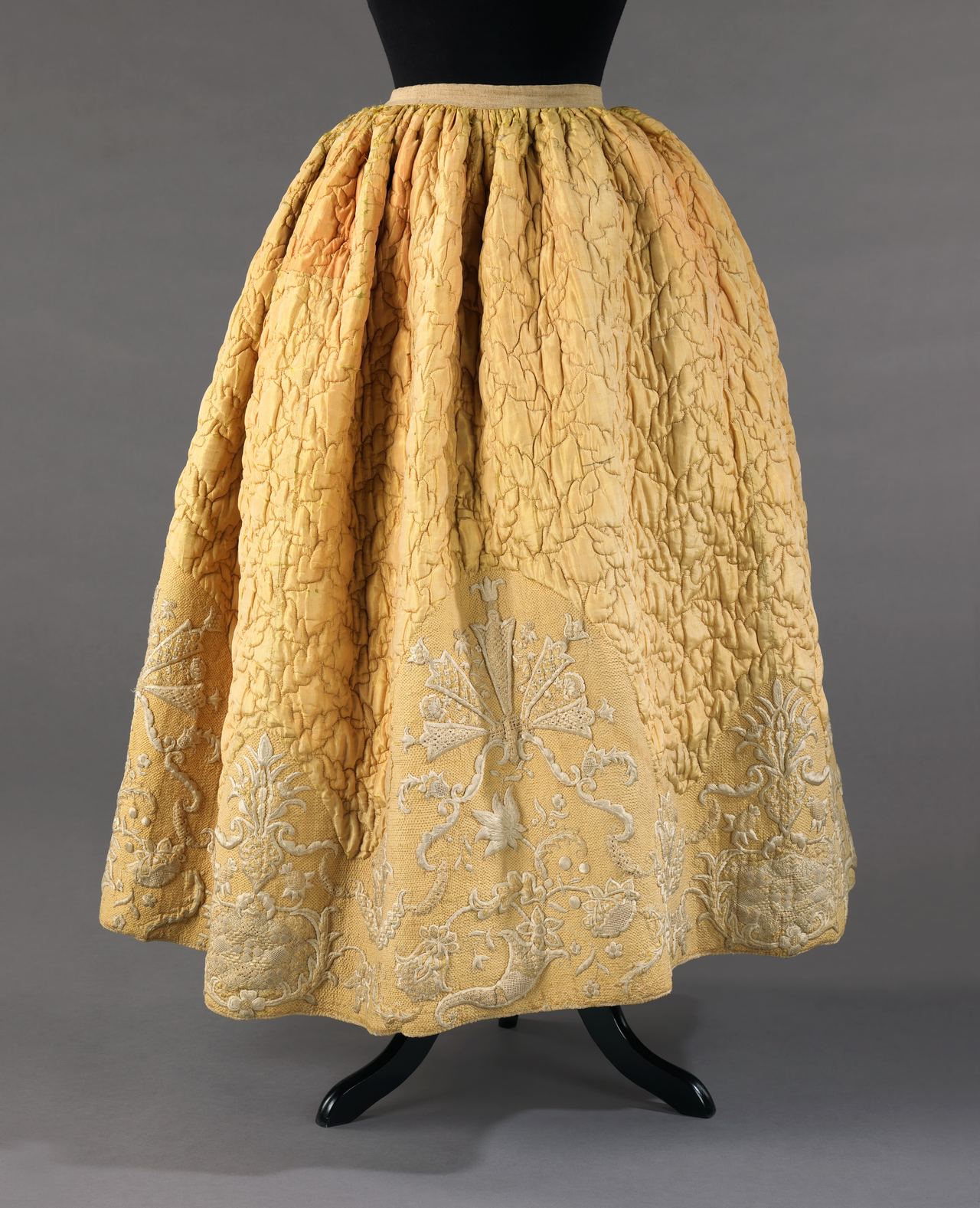
The petticoat is the best documented case. V&A records describe silk petticoats made of six to eight panels sewn together before quilting, with thin wool wadding and a wool or silk lining, quilted in running stitch with silk thread in diamond grids or in leaf and sunflower borders at the hem. One ivory example has quilting that stops 15 cm below the waist, presumably to keep the pleated waist from bulking, and it has pocket openings in the seams. The V&A says quilted petticoats may well have been one of the few items of eighteenth-century fashion to be ready-made, a suggestion rather than a proven fact. A bill of 1738 in the C. Hoare & Co. archive charges "for quilting a coat," according to the Hopkins Costume Trust, which suggests quilting could be paid for as a service.
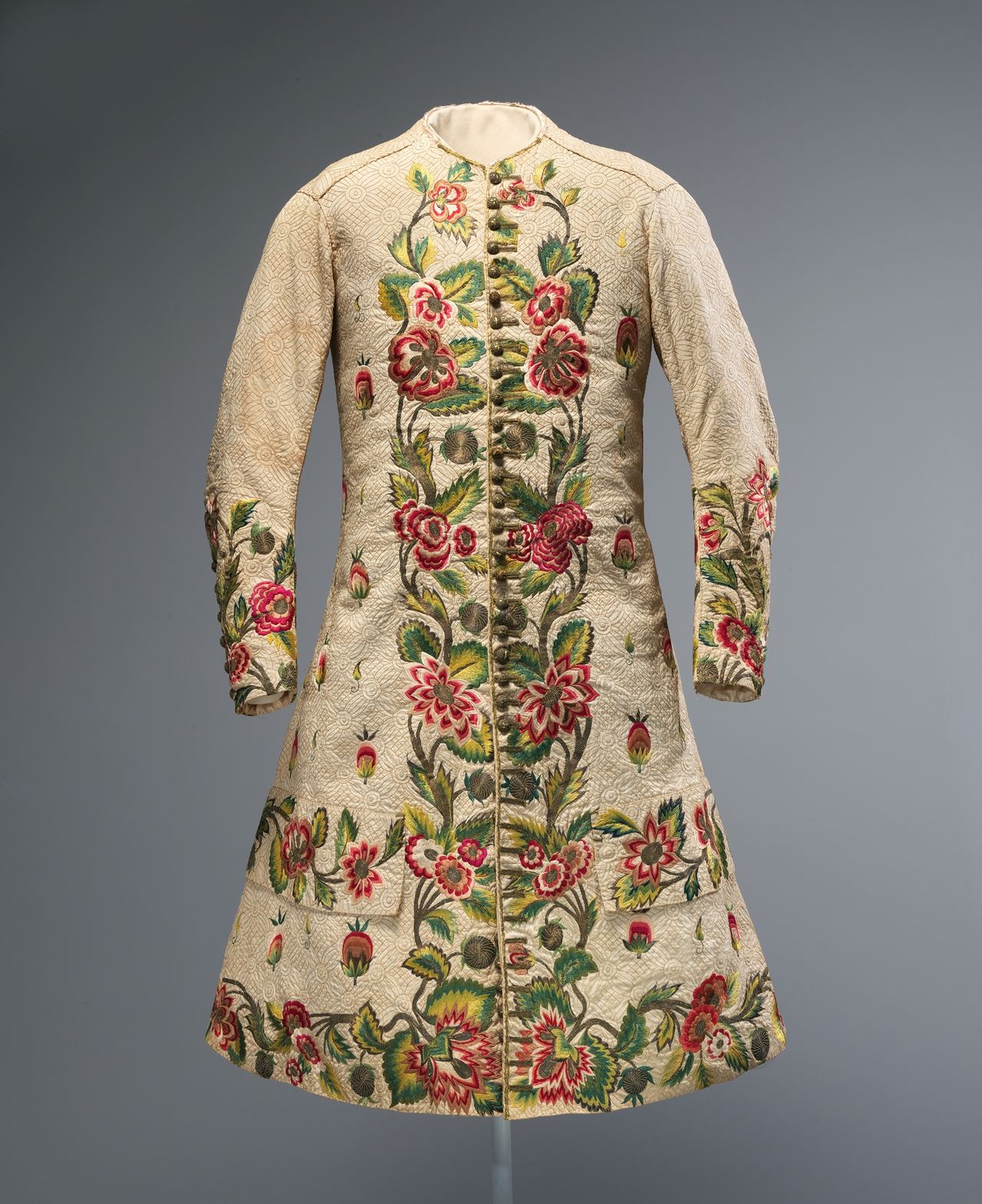
Men's clothes took the same stitching. A French man's waistcoat of 1710 to 1720 in the V&A is "quilted-to-shape" over wool wadding, with large flowers on the fronts and a repeating geometric (diaper) pattern elsewhere. That phrase matters: the pattern was worked on pieces already cut to the garment's outline. A British linen waistcoat of 1755 to 1760 combines embroidery, cording, quilting and drawn-thread work, and a man's quilted silk satin nightgown of 1780 to 1820 has pocket holes let into the side seams. The Met's early eighteenth-century British waistcoat, shown above, has embroidered flowers over a ground that appears to be quilted in a lattice with circular medallions.
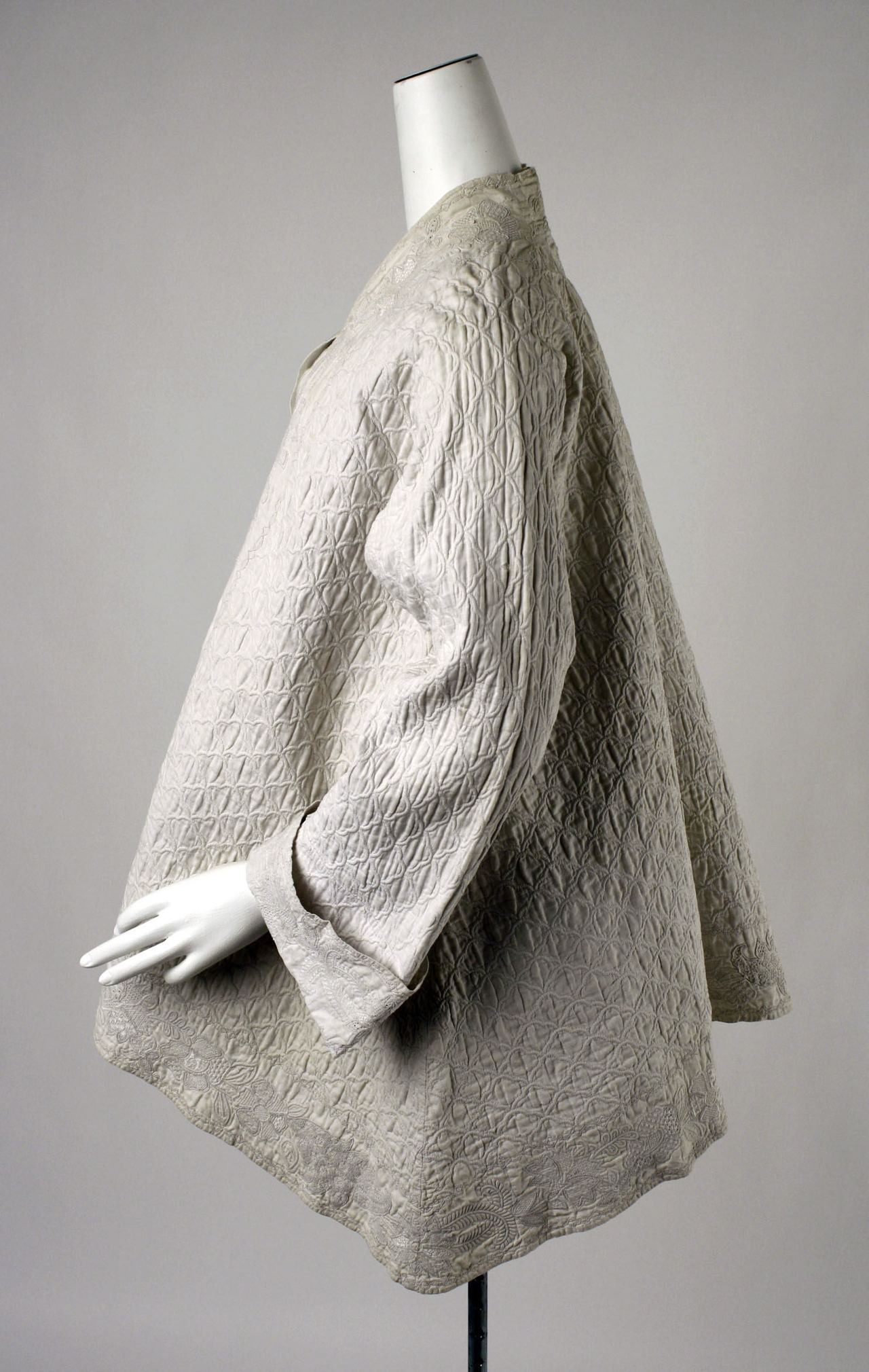
The most dramatic object may be a gown. The Met's robe à la française of about 1750, the hero image of this article, appears to be quilted over its whole surface, bodice and skirt, in grids of diamonds, flowers and feathery sprays. The Met catalogues it as a robe à la française, a style usually worn open over a visible petticoat. A loose linen dressing jacket of 1725 to 1750 at the same museum, covered in overlapping curved stitch lines, shows the same stitching in plain cloth.
In the nineteenth century the work moved down-market. ASU's FIDM Museum describes a quilted petticoat of the 1840s as "simply large quilts meant to be worn on the body," often made like bed quilts, with women working together on the stitching. A cotton petticoat of 1865 to 1880 by Booth and Fox at The Quilt Museum in York has wavy quilted channels filled with down.
How did Japanese firefighters use quilting?
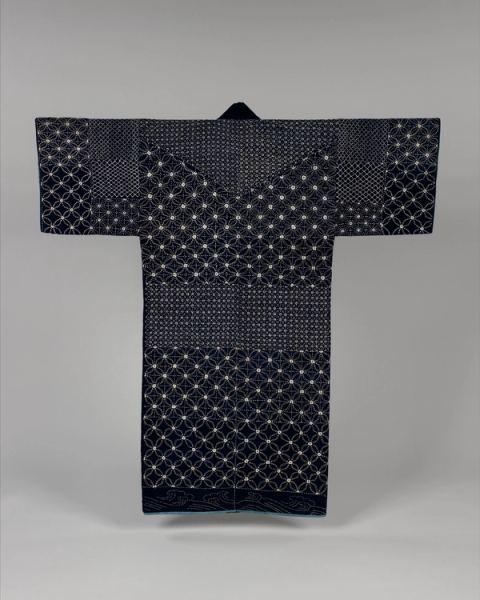
Japanese firefighters of the nineteenth century wore reversible padded coats called hikeshi-banten. The V&A and the Musée Guimet both describe them as thick cotton quilted with sashiko stitching and meant to be soaked with water, so the cloth could shield the wearer from flames.
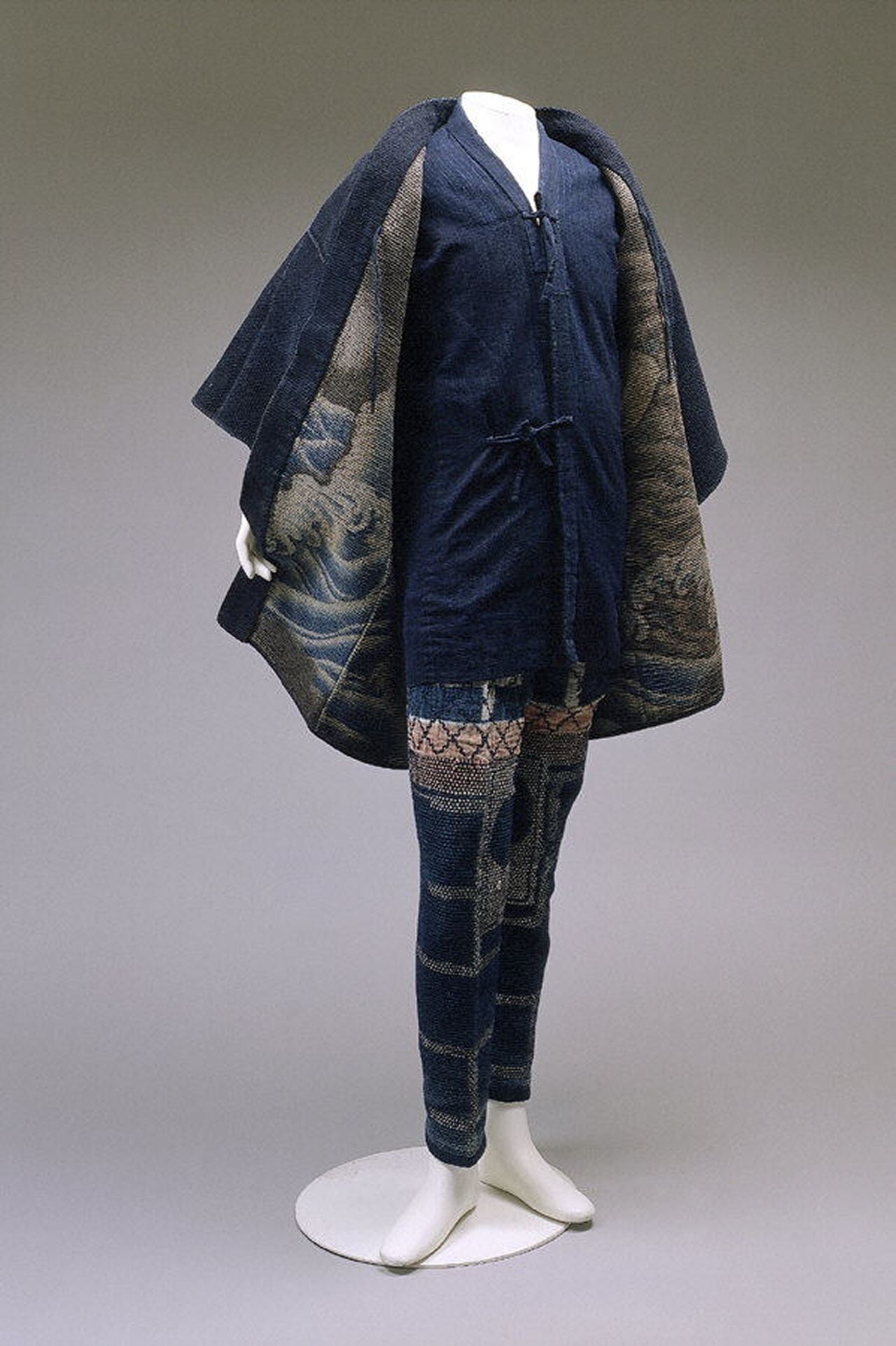
The V&A's example, dated 1850 to 1900, is made of several layers of indigo cotton quilted together with vertical stitching in double blue cotton thread, with a dragon among clouds in freehand paste-resist dyeing on the upper half. The fireman wore the plain side out during a fire; the painted side was shown afterward and on festival days. The Guimet, which dates its example to the nineteenth century, describes a lining dyed with the hero Tawara Toda fighting a centipede demon. The Met's mid-nineteenth-century ensemble, shown above, is recorded as quilted cotton with tube-drawn paste-resist dyeing; its trousers carry white bands of stitching and its cape-like hood is lined with a painted scene.
For the stitch itself, see sashiko versus boro. Bengal's quilted cloths are covered in nakshi kantha.
How is quilted clothing made?
Hand quilting is a few simple steps repeated across a large surface. The sequence below draws on the V&A's cataloguing and an 1882 needlework manual, the Dictionary of Needlework.
- Build the sandwich. Quilting is done through three layers: a fashion fabric on the right side, a soft layer in the middle, and a lining. The manual recommends flannel as the middle layer between a satin or silk face and the lining; the V&A petticoats use thin wool wadding.
- Mark the pattern. The manual gives two ways: tack a tissue-paper design temporarily to the right side, or fold and press the cloth on the diagonal and follow the creases to get an even diamond grid.
- Stitch. Use running stitch or backstitch, and take each stitch individually so that it catches all the layers, as the V&A puts it. The Textile Research Centre in Leiden, summarizing Mary Thomas's Embroidery Book, says each stitch is made in two movements, down and then up.
- Shape it. A petticoat could be quilted as panels joined first, and a waistcoat could be quilted-to-shape on pieces cut in advance. For a puffy skirt, the manual says to use the thickest wadding, split it open, lay the satin over the unglazed side and stitch through the two with no lining behind.
- Finish the edges. The V&A's petticoats have hems bound with silk ribbon, and its firefighter's jacket has cuffs and hem bound with cotton. A modern maker can cut bias binding for the same job.
How do the main quilting methods differ?
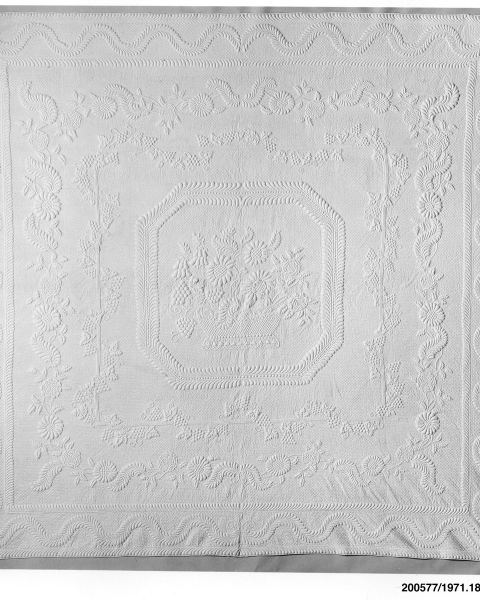
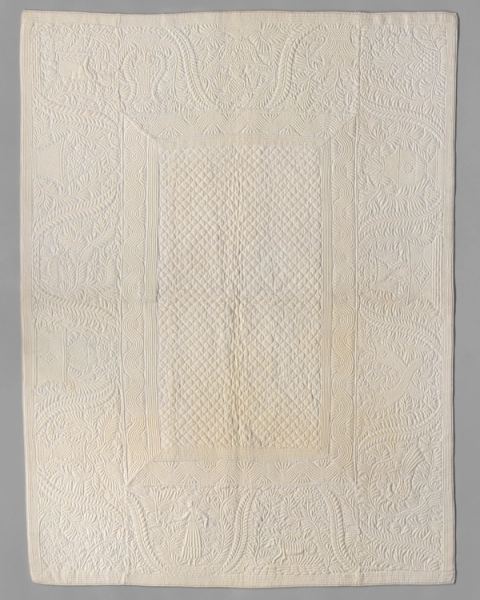
The padding method decides the look. In wadded quilting the padding is a sheet laid between the layers. In corded quilting cord is drawn through narrow stitched channels, and in trapunto filling is pushed into chosen shapes through the back.
| Method | Layers | What makes the relief | Where our sources show it |
|---|---|---|---|
| Wadded (running-stitch) quilting | Face cloth, wadding, lining | Padding held between lines of stitching | V&A petticoats, waistcoats and jumps; Met gown and dressing jacket |
| Wholecloth | Same, with a plain top | Stitching alone carries the design, with no patchwork or appliqué ([wholecloth quilt](glossary:glossary-wholecloth-quilt)) | A term used mainly for bed quilts in our sources; plain-silk petticoats follow the same logic |
| Corded | Two layers | Cord threaded from the back through parallel stitched channels | V&A waistcoat of 1755–60 (cording with quilting); caps, a corset and a coat in the International Quilt Museum's Marseille show |
| Trapunto (stuffed) | Two layers | Extra filling pushed in through small gaps in the back | Mainly bed covers, such as the Tristan Quilt (Sicily, about 1360–1400, the V&A's caption date) |
| Marseilles type (woven) | One woven cloth | A double weave raises the pattern on a loom | Bed covers, such as the Met's ca. 1800–20 piece; not stitched ([marcella](glossary:glossary-marcella)) |
Corded work took its commercial name from a city. The International Quilt Museum reports that quilted and corded furnishings and garments were shipped from Marseille from the late 1600s, that the name broderie de Marseille was not in common use until about 1770, and that the trade stopped in the plague of 1720 and restarted in a simpler form around 1730. French heritage records describe boutis, the stuffed work of southern France, as emerging in Marseille after a royal edict of 1686 that banned Indian printed cottons but allowed plain white cotton to be imported if quilted locally. We have only that one source for the edict, so treat it as the ministry's account. Looms later imitated the effect: the Minneapolis Institute of Art says the British weaver Robert Elsden developed woven marcella in 1763.
For the whitework side, see white-on-white American quilts and quilt, coverlet, counterpane.
How can you tell garment quilting from bed quilting?
Look for shaping and for places where a body has been. A quilted garment has a waist treatment, openings, ties or buttons, and wear and repairs where a person moved; a bed quilt is a flat rectangle planned for the surface of a bed.
| Clue | Garment | Bed quilt |
|---|---|---|
| Outline | Cut to a pattern, or made of panels joined to fit a body | A rectangle sized to a bed (the 1882 manual gives lengths up to 3 yards) |
| Waist and openings | Pleats or gathers at a waistband, ties, pocket slits in the seams, buttonholes or lacing holes | None of these |
| Pattern placement | Stitching placed where it shows, or only below the waist | A field planned as a whole, often a central design with a border, as on the Met's Marseilles-type bed cover |
| Wear and repair | Alterations for another wearer, replaced waist bindings | Wear that follows the bed and its folds, not a body |
Treat these as clues, not proofs. The International Quilt Museum notes that, once laying a white cover on the wedding bed became a custom in the early nineteenth century, many Provençal petticoats were recycled into bedcovers. A piece that looks like a bedcover may have begun as a skirt.
How do you care for quilted clothing, and where can you see it?
Quilted garments combine heavy padding with delicate face cloths, so they need support. The International Quilt Museum says washing a quilt has too many risks to recommend and advises consulting a textile conservator first. The Canadian Conservation Institute advises storing fragile or heavily decorated costumes, or those with weak shoulder seams, flat rather than hanging; a sound heavy piece can be hung on a padded hanger if it also has support from the waist. The International Quilt Museum names clothes moths and carpet beetles as the main threats and says they are especially attracted to wool, silk, hair and feathers; since a petticoat like the V&A's combines silk with wool filling, our reading is that it needs regular inspection. See how to store a vintage quilt or dress.
Where to see examples:
- V&A, London. Many quilted petticoats, waistcoats and jackets are in the online catalogue. The record for the ivory petticoat T.264A-1966 says it is held at the V&A East Storehouse and can be ordered to view.
- The Metropolitan Museum of Art, New York. The pieces shown here are in its online collection; check each record for display status.
- The Quilt Museum, York. Its online costume collection includes quilted petticoats and a quilted dressing gown; the museum is at St Anthony's Hall, Peasholme Green.
- La Maison du Boutis, Calvisson, France. A museum-workshop for boutis; the regional tourism listing gives 2026 opening as Thursday to Saturday afternoons and adult admission of 4 euros, so confirm before you travel.
- LSU Textile & Costume Museum, Baton Rouge. "Stitches in Time" runs until 15 January 2027 at 330 Tower Drive.
Our sources document quilted clothing mostly in Britain, France, Sweden and Japan, with single examples from India and the Ottoman world. They say little about quilted garments elsewhere, and we have not tried to write that history here.
Sources
- An introduction to quilting and patchwork. Victoria and Albert Museum. Full page read. Definition of quilting and wadding, "each stitch must catch all the layers", medieval padded clothing under armor, quilt etymology, 17th-century doublets and Mughal hunting coat, Tristan Quilt (text and caption dates differ). Accessed November 1, 2026.
- Woman's petticoats T.264A-1966, T.427-1966, T.719-1913 (records O25539, O74090, O1139912). Victoria and Albert Museum. Records read through the V&A API: panels sewn before quilting, running stitch, wool wadding, quilting stopping 15 cm below the waist, pocket openings, historical note on warmth and display, "ready made" suggestion, alterations. Accessed November 1, 2026.
- Man's waistcoats 659-1898 and T.158-1975; woman's waistcoat or jumps T.87-1978; man's nightgown T.113-1939 (records O357033, O360068, O13542, O13947). Victoria and Albert Museum. Records read through the V&A API: "quilted-to-shape" over wool wadding, embroidered/corded/quilted linen waistcoat, boned quilted jumps with baleen, quilted silk satin nightgown with pocket holes. Accessed November 1, 2026.
- Firefighter's jacket (hikeshi-banten), FE.107-1982 (record O12783). Victoria and Albert Museum. Record read through the V&A API: several layers of indigo cotton quilted with sashiko, tsutsugaki dragon, reversible, soaked in water, plain side out in a fire. Accessed November 1, 2026.
- Fireman's jacket (hikeshi-banten), MA 12981. Musée Guimet. Page read: 19th-century quilted and sashiko-stitched cotton, tsutsugaki lining, designed to be soaked to shield firefighters. Accessed November 1, 2026.
- Robe à la française 1981.152a–e; Waistcoat 45.49; Dressing jacket 1988.197; Petticoats 2009.300.2974 and 1986.106.8; Fireman's jacket 1983.158a–c; Quilt, Marseilles type 11.60.329. The Metropolitan Museum of Art (Collection API). Open Access API records read for titles, dates, media, credit lines and isPublicDomain true. The Met web pages return 429 to bots, so catalogue essays were not read; quilted construction in captions is taken from the photographs, enlarged and inspected. Accessed November 1, 2026.
- 1750 Quilted petticoat. Hopkins Costume Trust. Page read: construction (silk satin, calimanco, wool wadding, running stitch), worn by all levels of society for warmth and display, 1737 and 1738 bills in the C. Hoare & Co. archive. Accessed November 1, 2026.
- Quilted petticoat. ASU FIDM Museum. Page read: elaborate quilted petticoats fashionable c. 1825-1850, several worn before the 1856 cage crinoline, "simply large quilts meant to be worn on the body", cites Baumgarten 2002. Accessed November 1, 2026.
- Booth and Fox quilted petticoat. The Quilt Museum (York). Page read: 1865-1880 Turkey red cotton petticoat, wavy quilted channels filled with down; museum address and contact. Accessed November 1, 2026.
- Gambeson. Merriam-Webster. Page read: definition and etymology (Middle French, Old French, Old High German wamba). No first-use date given on the page. Accessed November 1, 2026.
- Spotlight: Quilted Armour Defenses of the High Middle Ages. MyArmoury. Page read (enthusiast reference, used with attribution): summary of Blair and Edge on aketon, gambeson, pourpoint and jack; construction of quilted linen and wool-stuffed defenses. Its earliest-date claims are not used. Accessed November 1, 2026.
- The Dictionary of Needlework (1882), entry Quilting. S. F. A. Caulfeild and B. C. Saward, via Internet Archive. Full text (djvu) downloaded and the Quilting entry read: three layers, diagonal runnings, flannel middle layer, tacked tissue-paper designs, pressed-line grid, puffy petticoats, "Gamboised" checkers, quilts sized to the bed. Accessed November 1, 2026.
- English quilting. Textile Research Centre Leiden. Page read: definition, stitches through three layers, each stitch in two movements, garments listed; cites Mary Thomas (1936) and a V&A waistcoat. Accessed November 1, 2026.
- Marseille: White Corded Quilting (exhibition page). International Quilt Museum. Page read in full: Saint-Aubin 1770, piques de Marseille chronology (late 1600s shipping, 1720 plague, c. 1730 revival), garments (petticoats, caps, corset, coat), wedding-bed custom recycling petticoats. Accessed November 1, 2026.
- Taie et courtepointe en boutis (PM30002635). Ministère de la Culture, base Palissy. Notice read (French): definition of boutis and the account of the 1686 edict. Single source for the edict; attributed in the text. Accessed November 1, 2026.
- La Maison du Boutis, Calvisson. Gard Tourisme. Page read (French): museum-workshop description, 2026 opening days, admission, address. Accessed November 1, 2026.
- Marcella Counterpane (90.136), catalog text. Minneapolis Institute of Art. Catalog text as read for the Teazle glossary entry on marcella (woven quilting, Robert Elsden 1763); attributed to the museum. Accessed November 1, 2026.
- Hanging Storage for Costumes (CCI Notes 13/5). Canadian Conservation Institute. Page read: store fragile or heavily decorated costumes and those with weak shoulder seams flat; support heavy garments from the waist; padded hangers. Accessed November 1, 2026.
- Care and Conservation. International Quilt Museum. Page read: washing not recommended, consult a conservator, moths and carpet beetles attracted to wool and silk, cedar and mothball cautions. Accessed November 1, 2026.
- Stitches in Time: Quilts & Fashion. LSU Textile & Costume Museum. Page read: 3 May 2026 - 15 January 2027, quilts and quilted fashions, Geoffrey Beene gift, address 330 Tower Drive. Curator not named on this page; see the next two sources. Accessed November 1, 2026.
- Stitches in Time: Quilts and Fashion (event listing). LSU Calendar. Page read: curator named as Dr. Michael Mamp. The listing's own dates are inconsistent, so dates are taken from the museum page. Accessed November 1, 2026.
- Stitches in Time: Quilts & Fashion. University of the Arts London, Fashion Exhibition Making. Page read: curator Michael E. Mamp, dates 3 May 2026 to 15 January 2027, content summary. Accessed November 1, 2026.
Glossary
- Quilting
- Wadding
- Gambeson
- Hikeshi-banten
- Sashiko
- Corded quilting
- Trapunto
- Wholecloth quilt
- Marcella
- Robe à la française
- Petticoat
- Waistcoat
On the Workbench
Last updated · Markdown · Report an error